Nemeno Judee Grace E, Lee Soojung, Yang Wojong, Lee Kyung Mi, Lee Jeong Ik
Regenerative Medicine Laboratory, Center for Stem Cell Research, Department of Biomedical Science and Technology, Institute of Biomedical Science & Technology (IBST), Konkuk University, Seoul 143-701, Republic of Korea.
Biomed Res Int. 2014;2014:936196. doi: 10.1155/2014/936196. Epub 2014 Jun 3.
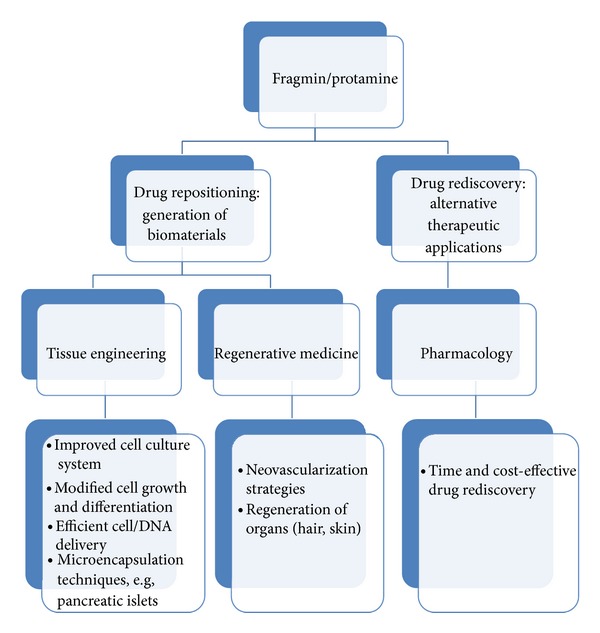
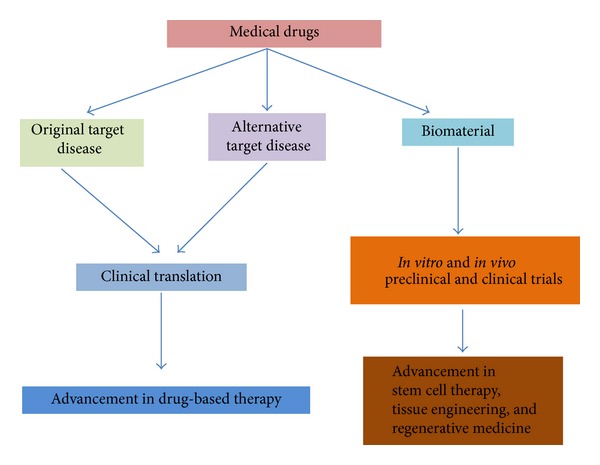
Drug repositioning is one of the most rapidly emerging fields of study. This concept is anchored on the principle that diseases have similar damaged or affected signaling pathways. Recently, drugs have been repositioned not only for their alternative therapeutic uses but also for their applications as biomaterials in various fields. However, medical drugs as biomaterials are rarely focused on in reviews. Fragmin and protamine have been recently the sources of increasing attention in the field of tissue engineering and regenerative medicine. Fragmin and protamine have been manufactured primarily as a safe antidote for the circulating heparin. Lately, these drugs have been utilized as either micro- or nanoparticle biomaterials. In this paper, we will briefly describe the concept of drug repositioning and some of the medical drugs that have been repurposed for their alternative therapeutic uses. Also, this will feature the historical background of the studies focused on fragmin/protamine micro/nanoparticles (F/P M/NPs) and their applications as biomaterials in tissue engineering, stem cell therapy, and regenerative medicine.
药物重新定位是发展最为迅速的研究领域之一。这一概念基于疾病具有相似的受损或受影响信号通路这一原理。近来,药物不仅因其替代治疗用途而被重新定位,还因其在各个领域作为生物材料的应用而被重新定位。然而,作为生物材料的医用药物在综述中很少受到关注。最近,法安明和鱼精蛋白在组织工程和再生医学领域越来越受到关注。法安明和鱼精蛋白主要作为循环肝素的安全解毒剂生产。最近,这些药物已被用作微米或纳米颗粒生物材料。在本文中,我们将简要描述药物重新定位的概念以及一些因其替代治疗用途而被重新利用的医用药物。此外,本文还将介绍聚焦于法安明/鱼精蛋白微/纳米颗粒(F/P M/NPs)的研究的历史背景及其作为生物材料在组织工程、干细胞治疗和再生医学中的应用。