Parvez Kashif, Parvez Aatif, Zadeh Gelareh
Division of Neurosurgery, University Health Network, Toronto Western Hospital, University of Toronto, Toronto, ON M5T 2S8, Canada.
Department of Medical Imaging, Royal University Hospital, University of Saskatchewan, Saskatoon, SK S7N 0W8, Canada.
Int J Mol Sci. 2014 Jul 3;15(7):11832-46. doi: 10.3390/ijms150711832.
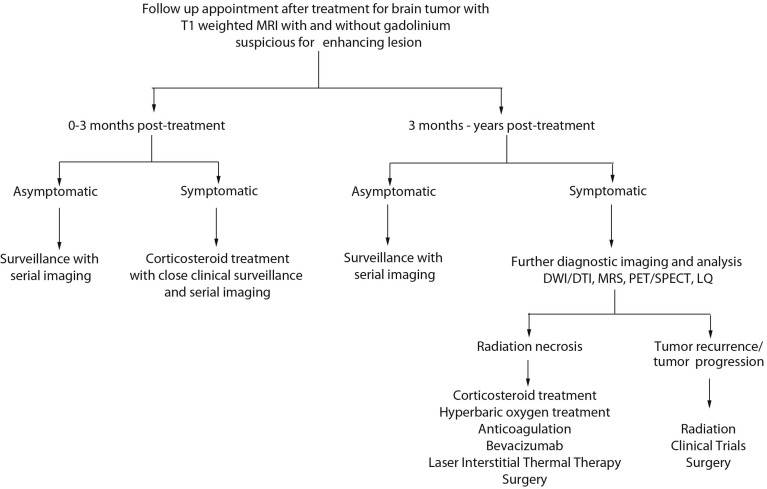
Radiation therapy is an important modality used in the treatment of patients with brain metastatic disease and malignant gliomas. Post-treatment surveillance often involves serial magnetic resonance imaging. A challenge faced by clinicians is in the diagnosis and management of a suspicious gadolinium-enhancing lesion found on imaging. The suspicious lesion may represent post-treatment radiation effects (PTRE) such as pseudoprogression, radiation necrosis or tumor recurrence. Significant progress has been made in diagnostic imaging modalities to assist in differentiating these entities. Surgical and medical interventions have also been developed to treat PTRE. In this review, we discuss the pathophysiology, clinical presentation, diagnostic imaging modalities and provide an algorithm for the management of pseudoprogression, radiation necrosis and tumor recurrence.
放射治疗是用于治疗脑转移瘤和恶性胶质瘤患者的一种重要治疗方式。治疗后的监测通常包括系列磁共振成像检查。临床医生面临的一个挑战是对影像学检查中发现的可疑钆增强病变进行诊断和管理。该可疑病变可能代表治疗后放射效应(PTRE),如假性进展、放射性坏死或肿瘤复发。在辅助鉴别这些病变的诊断成像方式方面已取得显著进展。也已开发出手术和药物干预措施来治疗PTRE。在本综述中,我们讨论其病理生理学、临床表现、诊断成像方式,并提供一个用于管理假性进展、放射性坏死和肿瘤复发的算法。