Ganann Rebecca, Fitzpatrick-Lewis Donna, Ciliska Donna, Peirson Leslea J, Warren Rachel L, Fieldhouse Paul, Delgado-Noguera Mario F, Tort Sera, Hams Steven P, Martinez-Zapata Maria José, Wolfenden Luke
Effective Public Health Practice Project, McMaster University, Room HSC 3 N25, 1280 Main Street West, Hamilton, Ontario L8S 4 K1, Canada.
BMC Res Notes. 2014 Jul 4;7:422. doi: 10.1186/1756-0500-7-422.
Low fruit and vegetable (FV) consumption is one of the top 10 global risk factors for mortality, and is related to increased risk for cancer, cardiovascular disease and diabetes. Many environmental, sociodemographic and personal factors affect FV consumption. The purpose of this review is to examine the effects of interventions delivered in the home, school and other nutritional environments designed to increase FV availability for five to 18-year olds.
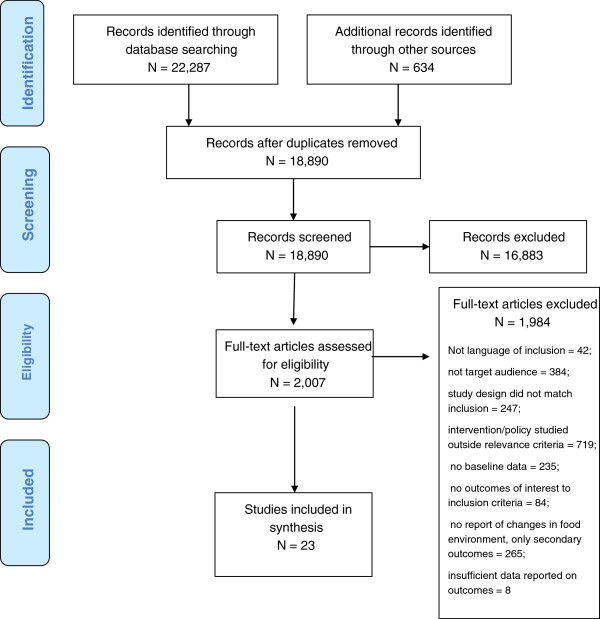
The search included: 19 electronic bibliographic databases; grey literature databases; reference lists of key articles; targeted Internet searching of key organization websites; hand searching of key journals and conference proceedings; and consultation with experts for additional references. Articles were included if: in English, French and Spanish; from high-, middle-, and low-income countries; delivered to anyone who could bring about change in FV environment for 5 to 18 year olds; with randomized and non-randomized study designs that provided before-after comparisons, with or without a control group. Primary outcomes of interest were measures of FV availability.
The search strategy retrieved nearly 23,000 citations and resulted in 23 unique studies. Interventions were primarily policy interventions at the regional or state level, a number of curriculum type interventions in schools and community groups and a garden intervention. The majority of studies were done in high-income countries.The diversity of interventions, populations, outcomes and outcome measurements precluded meta-analysis. The most promising strategies for improving the FV environment for children are through local school food service policies. Access to FV was successfully improved in four of the six studies that evaluated school-based policies, with the other two studies finding no effect. Broader state or federally mandated policies or educational programs for food service providers and decision makers had mixed or small impact. Similarly family interventions had no or small impact on home accessibility, with smaller impact on consumption.
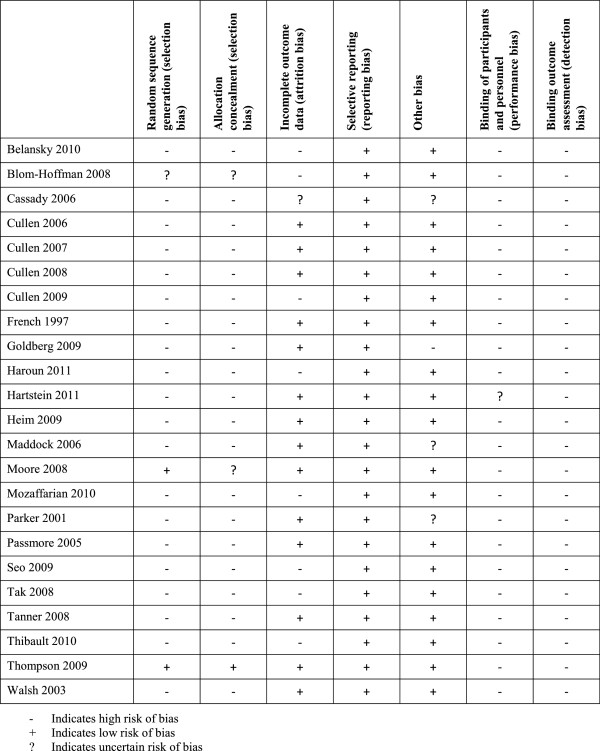
The studies have high risk of bias but more rigorous studies are difficult to impossible to conduct in naturalistic settings and in policy implementation and evaluation. However, there are promising strategies to improve the FV environment, particularly through school food service policies.
水果和蔬菜(FV)摄入量低是全球十大死亡风险因素之一,且与癌症、心血管疾病和糖尿病风险增加有关。许多环境、社会人口学和个人因素会影响FV的摄入量。本综述的目的是研究在家庭、学校和其他营养环境中实施的干预措施对增加5至18岁儿童FV供应量的影响。
检索范围包括:19个电子文献数据库;灰色文献数据库;关键文章的参考文献列表;对关键组织网站进行有针对性的互联网搜索;手工检索关键期刊和会议论文集;并向专家咨询以获取更多参考文献。纳入标准为:英文、法文和西班牙文;来自高收入、中等收入和低收入国家;针对任何能够改变5至18岁儿童FV环境的人群;采用随机和非随机研究设计,提供干预前后的比较,有或无对照组。主要关注的结果是FV供应量的测量指标。
检索策略共检索到近23000条引文,最终纳入23项独立研究。干预措施主要包括区域或州层面的政策干预、学校和社区团体的一些课程类干预以及一项园艺干预。大多数研究在高收入国家进行。干预措施、人群、结果和结果测量方法的多样性使得无法进行荟萃分析。改善儿童FV环境最有前景的策略是通过地方学校食品服务政策。在评估学校政策的六项研究中,有四项成功改善了FV的可及性,另外两项研究未发现效果。更广泛的州或联邦强制要求食品服务提供商和决策者实施的政策或教育项目效果不一或影响较小。同样,家庭干预对家庭中FV的可及性没有影响或影响较小,对消费量的影响更小。
这些研究存在较高的偏倚风险,但在自然环境以及政策实施和评估中,更严格的研究很难甚至无法开展。然而,有一些有前景的策略可以改善FV环境,特别是通过学校食品服务政策。