Fendyur Anna, Varma Sarvesh, Lo Catherine T, Voldman Joel
Department of Electrical Engineering and Computer Science, Massachusetts Institute of Technology , 77 Massachusetts Avenue, Room 36-824, Cambridge, Massachusetts 02139, United States.
Anal Chem. 2014 Aug 5;86(15):7598-605. doi: 10.1021/ac501412c. Epub 2014 Jul 7.
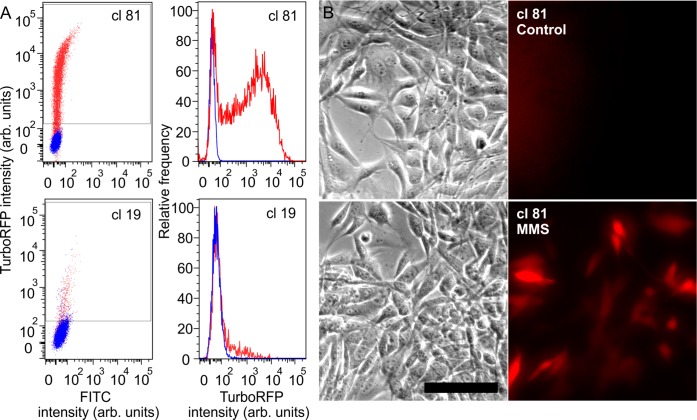
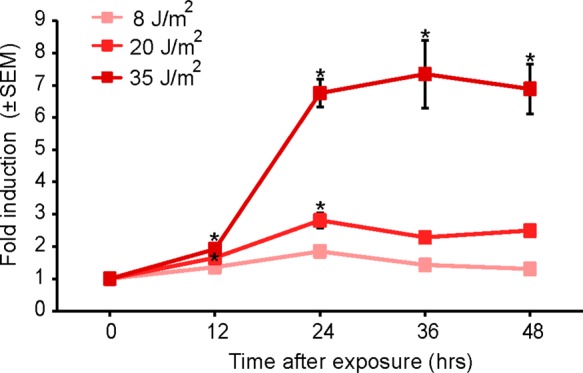
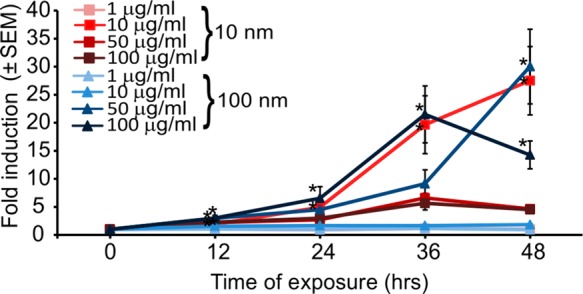
Understanding how newly engineered micro- and nanoscale materials and systems that interact with cells impact cell physiology is crucial for the development and ultimate adoption of such technologies. Reports regarding the genotoxic impact of forces applied to cells in such systems that can both directly or indirectly damage DNA emphasize the need for developing facile methods to assess how materials and technologies affect cell physiology. To address this need we have developed a TurboRFP-based DNA damage reporter cell line in NIH-3T3 cells that fluoresce to report genotoxic stress caused by a wide variety of agents, from chemical genotoxic agents to UV-C radiation. Our biosensor was successfully implemented in reporting the genotoxic impact of nanomaterials, demonstrating the ability to assess size dependent geno- and cyto-toxicity. The biosensor cells can be assayed in a high throughput, noninvasive manner, with no need for overly sophisticated equipment or additional reagents. We believe that this open-source biosensor is an important resource for the community of micro- and nanomaterials and systems designers and users who wish to evaluate the impact of systems and materials on cell physiology.
了解新设计的与细胞相互作用的微米和纳米级材料及系统如何影响细胞生理学,对于此类技术的开发和最终应用至关重要。关于在此类系统中施加于细胞的力可能直接或间接损伤DNA的遗传毒性影响的报告强调,需要开发简便的方法来评估材料和技术如何影响细胞生理学。为满足这一需求,我们在NIH-3T3细胞中开发了一种基于TurboRFP的DNA损伤报告细胞系,该细胞系通过荧光报告由多种试剂(从化学遗传毒性试剂到UV-C辐射)引起的遗传毒性应激。我们的生物传感器成功用于报告纳米材料的遗传毒性影响,证明了评估尺寸依赖性基因毒性和细胞毒性的能力。生物传感器细胞可以高通量、非侵入性方式进行检测,无需过于复杂的设备或额外的试剂。我们相信,这种开源生物传感器对于希望评估系统和材料对细胞生理学影响的微米和纳米材料及系统设计人员和用户群体而言是一项重要资源。