Metabolism Unit, National Institute on Aging, National Institutes of Health Baltimore, MD, USA.
Division of Neurobiology, Department of Psychiatry and Behavioral Sciences, Johns Hopkins University School of Medicine Baltimore, MD, USA ; Departments of Neuroscience and Pharmacology and Molecular Sciences, Johns Hopkins University School of Medicine Baltimore, MD, USA.
Front Physiol. 2014 Jun 23;5:231. doi: 10.3389/fphys.2014.00231. eCollection 2014.
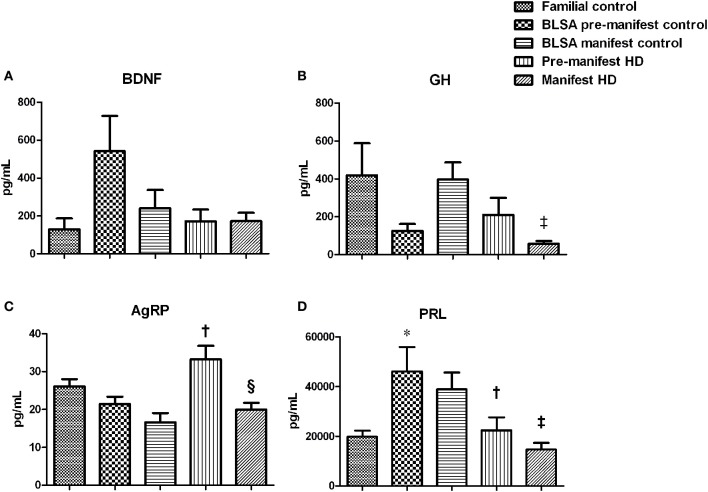
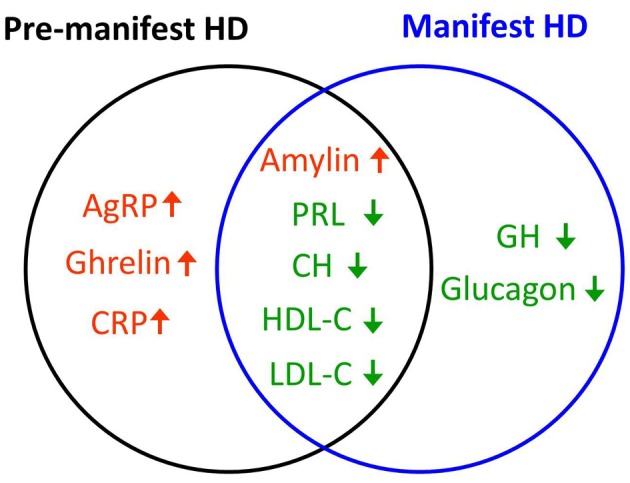
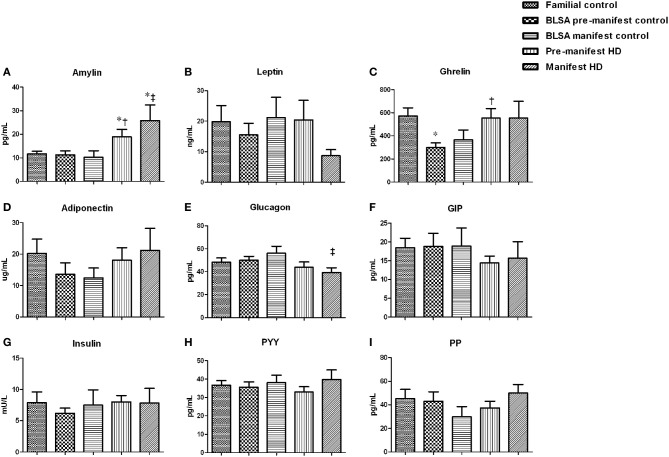
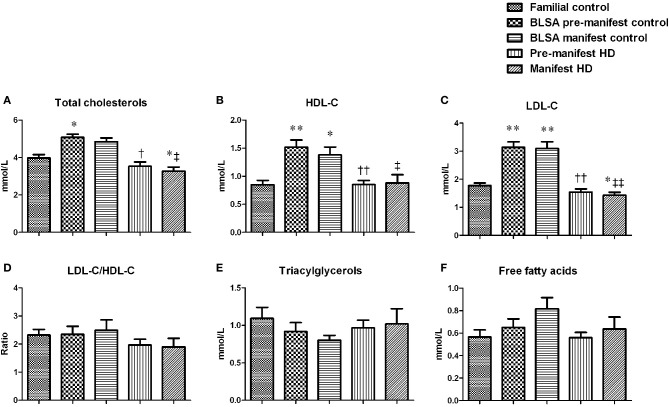
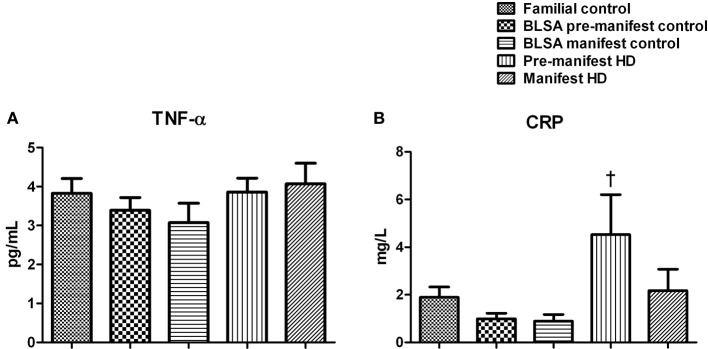
Huntington's disease (HD) is an inherited neurodegenerative disorder typified by involuntary body movements, and psychiatric and cognitive abnormalities. Many HD patients also exhibit metabolic changes including progressive weight loss and appetite dysfunction. Here we have investigated metabolic function in pre-manifest and manifest HD subjects to establish an HD subject metabolic hormonal plasma signature. Individuals at risk for HD who have had predictive genetic testing showing the cytosine-adenine-guanine (CAG) expansion causative of HD, but who do not yet present signs and symptoms sufficient for the diagnosis of manifest HD are said to be "pre-manifest." Pre-manifest and manifest HD patients, as well as both familial and non-familial controls, were evaluated for multiple peripheral metabolism signals including circulating levels of hormones, growth factors, lipids, and cytokines. Both pre-manifest and manifest HD subjects exhibited significantly reduced levels of circulating growth factors, including growth hormone and prolactin. HD-related changes in the levels of metabolic hormones such as ghrelin, glucagon, and amylin were also observed. Total cholesterol, HDL-C, and LDL-C were significantly decreased in HD subjects. C-reactive protein was significantly elevated in pre-manifest HD subjects. The observation of metabolic alterations, even in subjects considered to be in the pre-manifest stage of HD, suggests that in addition, and prior, to overt neuronal damage, HD affects metabolic hormone secretion and energy regulation, which may shed light on pathogenesis, and provide opportunities for biomarker development.
亨廷顿病(HD)是一种遗传性神经退行性疾病,其特征为不自主的身体运动、精神和认知异常。许多 HD 患者还表现出代谢变化,包括进行性体重减轻和食欲功能障碍。在这里,我们研究了前显型和显型 HD 患者的代谢功能,以建立 HD 患者代谢激素血浆特征。已经进行了预测性基因检测的 HD 高危个体,显示出导致 HD 的胞嘧啶-腺嘌呤-鸟嘌呤(CAG)扩展,但尚未出现足以诊断为显型 HD 的体征和症状,被称为“前显型”。对前显型和显型 HD 患者以及家族性和非家族性对照者进行了多种外周代谢信号的评估,包括循环激素、生长因子、脂质和细胞因子的水平。前显型和显型 HD 患者的循环生长因子水平显著降低,包括生长激素和催乳素。还观察到与 HD 相关的代谢激素如 ghrelin、胰高血糖素和胰淀素水平的变化。HD 患者的总胆固醇、HDL-C 和 LDL-C 显著降低。C 反应蛋白在前显型 HD 患者中显著升高。即使在被认为处于 HD 前显型阶段的患者中也观察到代谢改变,这表明除了明显的神经元损伤之外,HD 还影响代谢激素的分泌和能量调节,这可能有助于阐明发病机制,并为生物标志物的开发提供机会。