Mirrakhimov Aibek E, Ali Alaa M, Khan Maliha, Barbaryan Aram
Department of Internal Medicine, Saint Joseph Hospital , Chicago, IL, USA.
Rare Tumors. 2014 Jun 13;6(2):5389. doi: 10.4081/rt.2014.5389. eCollection 2014 May 13.
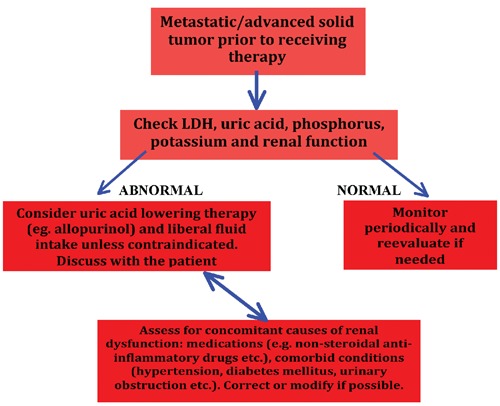
Tumor lysis syndrome (TLS) is a potentially deadly complication of tumors or their treatment. This syndrome consists of a constellation of laboratory findings such as hyperuricemia, hyperkalemia, hyperphosphatemia, and hypocalcemia, known as laboratory TLS. When clinical complications such as seizures, acute renal failure, and cardiac dysrhythmias occur in patients with laboratory TLS, the syndrome is called clinical TLS. TLS is especially common in patients with hematological malignancies with rapid cellular turnover rates such as acute lymphocytic leukemia and Burkitt lymphoma, but is very rare in patients with solid tumors. Nevertheless, there are multiple reports in the literature on the occurrence of TLS in patients with solid tumors. In this review article, we summarize the current data on the occurrence of TLS in patients with solid tumors. We propose an algorithm of risk stratification and prevention of TLS in patients with solid cancers.
肿瘤溶解综合征(TLS)是肿瘤或其治疗的一种潜在致命并发症。该综合征由一系列实验室检查结果组成,如高尿酸血症、高钾血症、高磷血症和低钙血症,称为实验室肿瘤溶解综合征。当实验室肿瘤溶解综合征患者出现癫痫发作、急性肾衰竭和心律失常等临床并发症时,该综合征称为临床肿瘤溶解综合征。肿瘤溶解综合征在细胞更新率快的血液系统恶性肿瘤患者中尤为常见,如急性淋巴细胞白血病和伯基特淋巴瘤,但在实体瘤患者中非常罕见。然而,文献中有多篇关于实体瘤患者发生肿瘤溶解综合征的报道。在这篇综述文章中,我们总结了实体瘤患者发生肿瘤溶解综合征的现有数据。我们提出了一种实体癌患者肿瘤溶解综合征的风险分层和预防算法。