Pineda-Peña Andrea-Clemencia, Schrooten Yoeri, Vinken Lore, Ferreira Fossie, Li Guangdi, Trovão Nídia Sequeira, Khouri Ricardo, Derdelinckx Inge, De Munter Paul, Kücherer Claudia, Kostrikis Leondios G, Nielsen Claus, Littsola Kirsi, Wensing Annemarie, Stanojevic Maja, Paredes Roger, Balotta Claudia, Albert Jan, Boucher Charles, Gomez-Lopez Arley, Van Wijngaerden Eric, Van Ranst Marc, Vercauteren Jurgen, Vandamme Anne-Mieke, Van Laethem Kristel
Clinical and Epidemiological Virology, Rega Institute for Medical Research, Department of Microbiology and Immunology, KU Leuven, Leuven, Belgium; Clinical and Molecular Infectious Diseases Group, Faculty of Sciences and Mathematics, Universidad del Rosario, Bogotá, Colombia.
Clinical and Epidemiological Virology, Rega Institute for Medical Research, Department of Microbiology and Immunology, KU Leuven, Leuven, Belgium; AIDS Reference Laboratory, University Hospitals Leuven, Leuven, Belgium.
PLoS One. 2014 Jul 8;9(7):e101738. doi: 10.1371/journal.pone.0101738. eCollection 2014.
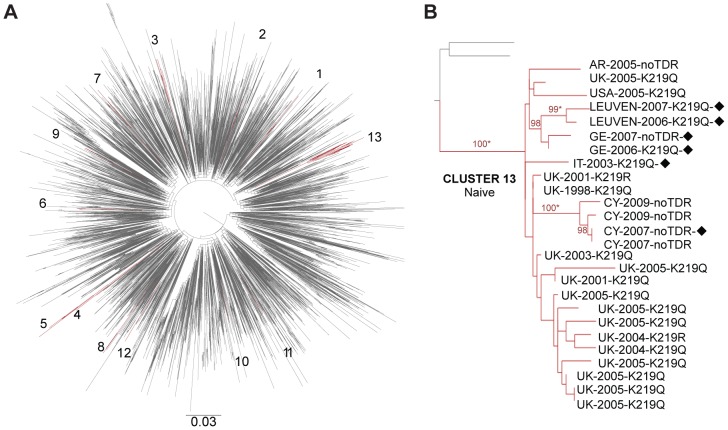
We aimed to study epidemic trends and predictors for transmitted drug resistance (TDR) in our region, its clinical impact and its association with transmission clusters. We included 778 patients from the AIDS Reference Center in Leuven (Belgium) diagnosed from 1998 to 2012. Resistance testing was performed using population-based sequencing and TDR was estimated using the WHO-2009 surveillance list. Phylogenetic analysis was performed using maximum likelihood and Bayesian techniques. The cohort was predominantly Belgian (58.4%), men who have sex with men (MSM) (42.8%), and chronically infected (86.5%). The overall TDR prevalence was 9.6% (95% confidence interval (CI): 7.7-11.9), 6.5% (CI: 5.0-8.5) for nucleoside reverse transcriptase inhibitors (NRTI), 2.2% (CI: 1.4-3.5) for non-NRTI (NNRTI), and 2.2% (CI: 1.4-3.5) for protease inhibitors. A significant parabolic trend of NNRTI-TDR was found (p = 0.019). Factors significantly associated with TDR in univariate analysis were male gender, Belgian origin, MSM, recent infection, transmission clusters and subtype B, while multivariate and Bayesian network analysis singled out subtype B as the most predictive factor of TDR. Subtype B was related with transmission clusters with TDR that included 42.6% of the TDR patients. Thanks to resistance testing, 83% of the patients with TDR who started therapy had undetectable viral load whereas half of the patients would likely have received a suboptimal therapy without this test. In conclusion, TDR remained stable and a NNRTI up-and-down trend was observed. While the presence of clusters with TDR is worrying, we could not identify an independent, non-sequence based predictor for TDR or transmission clusters with TDR that could help with guidelines or public health measures.
我们旨在研究本地区传播性耐药(TDR)的流行趋势和预测因素、其临床影响以及与传播集群的关联。我们纳入了1998年至2012年期间在比利时鲁汶艾滋病参考中心确诊的778例患者。使用基于人群的测序进行耐药性检测,并使用世界卫生组织2009年监测清单估算TDR。采用最大似然法和贝叶斯技术进行系统发育分析。该队列主要为比利时人(58.4%)、男男性行为者(MSM)(42.8%)且为慢性感染(86.5%)。总体TDR患病率为9.6%(95%置信区间(CI):7.7 - 11.9),核苷类逆转录酶抑制剂(NRTI)为6.5%(CI:5.0 - 8.5),非核苷类逆转录酶抑制剂(NNRTI)为2.2%(CI:1.4 - 3.5),蛋白酶抑制剂为2.2%(CI:1.4 - 3.5)。发现NNRTI - TDR呈显著的抛物线趋势(p = 0.019)。单因素分析中与TDR显著相关的因素包括男性、比利时血统、MSM、近期感染、传播集群和B亚型,而多因素和贝叶斯网络分析指出B亚型是TDR最具预测性的因素。B亚型与含TDR的传播集群相关,这些集群中的TDR患者占TDR患者总数的42.6%。由于耐药性检测,开始治疗的TDR患者中有83%的病毒载量检测不到,而如果没有这项检测,一半的患者可能会接受次优治疗。总之,TDR保持稳定,且观察到NNRTI呈上升和下降趋势。虽然存在含TDR的集群令人担忧,但我们无法识别出一个独立的、非基于序列的TDR预测因素或含TDR的传播集群预测因素,以帮助制定指南或公共卫生措施。