Santiago-Rodríguez Eduardo J, Mayor Angel M, Fernández-Santos Diana M, Ruiz-Candelaria Yelitza, Hunter-Mellado Robert F
Retrovirus Research Center, Universidad Central del Caribe School of Medicine, 00960-6032 Bayamón, Puerto Rico.
BMC Res Notes. 2014 Jul 8;7:439. doi: 10.1186/1756-0500-7-439.
Anemia occurs frequently in HIV-infected patients and has been associated with an increased risk of death in this population. For Hispanic subjects, information describing this blood disorder during HIV is scarce. Therefore, the present study examined data from a cohort of HIV-positive Hispanics to determine the prevalence of anemia, identify its associated factors, and evaluate its relationship with one-year mortality.
This study included 1,486 patients who enrolled between January, 2000 and December, 2010 in an HIV-cohort in Bayamón, Puerto Rico. Data were collected through personal interviews and medical record abstractions. To determine the factors independently associated with anemia, a multivariable logistic regression model was used. Kaplan-Meier and Cox proportional hazards models were also performed to estimate survival time and to predict death risk.
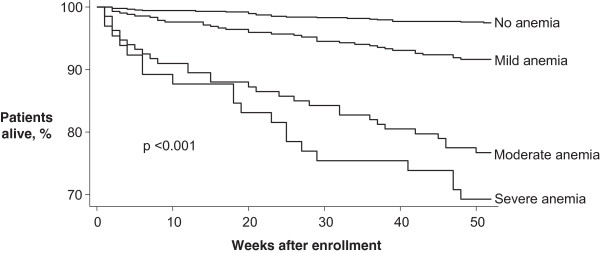
The prevalence of anemia at enrollment was 41.5%. Factors independently associated with increased odds of anemia were: unemployment (OR = 2.02; 95% CI 1.45-2.79), CD4 count <200 cells/μL (OR = 2.66; 95% CI 1.94-3.66), HIV viral load ≥100,000 copies/mL (OR = 1.94; 95% CI 1.36-2.78), white blood cell count <4,000 cells/μL (OR = 2.42; 95% CI 1.78-3.28) and having clinical AIDS (OR = 2.39; 95% CI 1.39-4.09). Overweight (OR = 0.43; 95% CI 0.32-0.59) and obese (OR = 0.44; 95% CI 0.29-0.67) BMI's were independently associated with reduced odds of anemia. Survival differed significantly by anemia status (log-rank test: p < 0.001). One-year mortality estimates were: 30.8%, 23.3%, 8.4% and 2.5%, for patients with severe, moderate, mild and no anemia, respectively. Having anemia at baseline was independently associated with an increased one-year mortality risk (severe anemia: HR = 9.06; 95% CI: 4.16-19.72; moderate anemia: HR = 6.51; 95% CI: 3.25-13.06; mild anemia: HR = 2.53; 95% CI: 1.35-4.74).
A high prevalence of anemia at enrollment was observed in this cohort of HIV-infected Hispanics. Unemployment and several adverse prognostic features of HIV infection were independently associated with this blood disorder. Anemia resulted to be the strongest predictor of one-year mortality, evidencing a dose-response effect. Further investigations are needed to evaluate whether recovering from anemia is associated with longer survival, and to identify the types of anemia affecting this particular group of HIV patients.
贫血在HIV感染患者中频繁发生,并且与该人群死亡风险增加相关。对于西班牙裔受试者,关于HIV感染期间这种血液疾病的信息很少。因此,本研究检查了一组HIV阳性西班牙裔人群的数据,以确定贫血的患病率,识别其相关因素,并评估其与一年死亡率的关系。
本研究纳入了2000年1月至2010年12月在波多黎各巴亚蒙的一个HIV队列中登记的1486名患者。数据通过个人访谈和病历摘要收集。为了确定与贫血独立相关的因素,使用了多变量逻辑回归模型。还进行了Kaplan-Meier和Cox比例风险模型来估计生存时间并预测死亡风险。
入组时贫血的患病率为41.5%。与贫血几率增加独立相关的因素有:失业(比值比[OR]=2.02;95%置信区间[CI]1.45-2.79)、CD4细胞计数<200个/μL(OR=2.66;95%CI 1.94-3.66)、HIV病毒载量≥100,000拷贝/mL(OR=1.94;95%CI 1.36-2.78)、白细胞计数<4,000个/μL(OR=2.42;95%CI 1.78-3.28)以及患有临床艾滋病(OR=2.39;95%CI 1.39-4.09)。超重(OR=0.43;95%CI 0.32-0.59)和肥胖(OR=0.44;95%CI 0.29-0.67)的体重指数(BMI)与贫血几率降低独立相关。生存情况因贫血状态而有显著差异(对数秩检验:p<0.001)。一年死亡率估计分别为:重度贫血患者30.8%、中度贫血患者23.3%、轻度贫血患者8.4%和无贫血患者2.5%。基线时患有贫血与一年死亡风险增加独立相关(重度贫血:风险比[HR]=9.06;95%CI:4.16-19.72;中度贫血:HR=6.51;95%CI:3.25-13.06;轻度贫血:HR=2.53;95%CI:1.35-4.74)。
在这组HIV感染的西班牙裔人群中观察到入组时贫血的高患病率。失业和HIV感染的几个不良预后特征与这种血液疾病独立相关。贫血是一年死亡率的最强预测因素,显示出剂量反应效应。需要进一步研究来评估贫血恢复是否与更长生存期相关,以及确定影响这一特定HIV患者群体的贫血类型。