Mata-Marín José A, Gaytán-Martínez Jesús E, Martínez-Martínez Rosa E, Arroyo-Anduiza Carla I, Fuentes-Allen José L, Casarrubias-Ramirez Moisés
Infectious Diseases Department, Hospital de Infectología, "La Raza" National Medical Center, IMSS, Mexico City, México.
BMC Res Notes. 2010 Aug 20;3:230. doi: 10.1186/1756-0500-3-230.
Hematologic manifestations of the human immunodeficiency virus (HIV) infection are a well-recognized complication of the disease and may be clinically important. Our objective was to determine the risk factors for anemia and its correlation with HIV treatment-naïve infected patients without co-infection or opportunistic diseases.
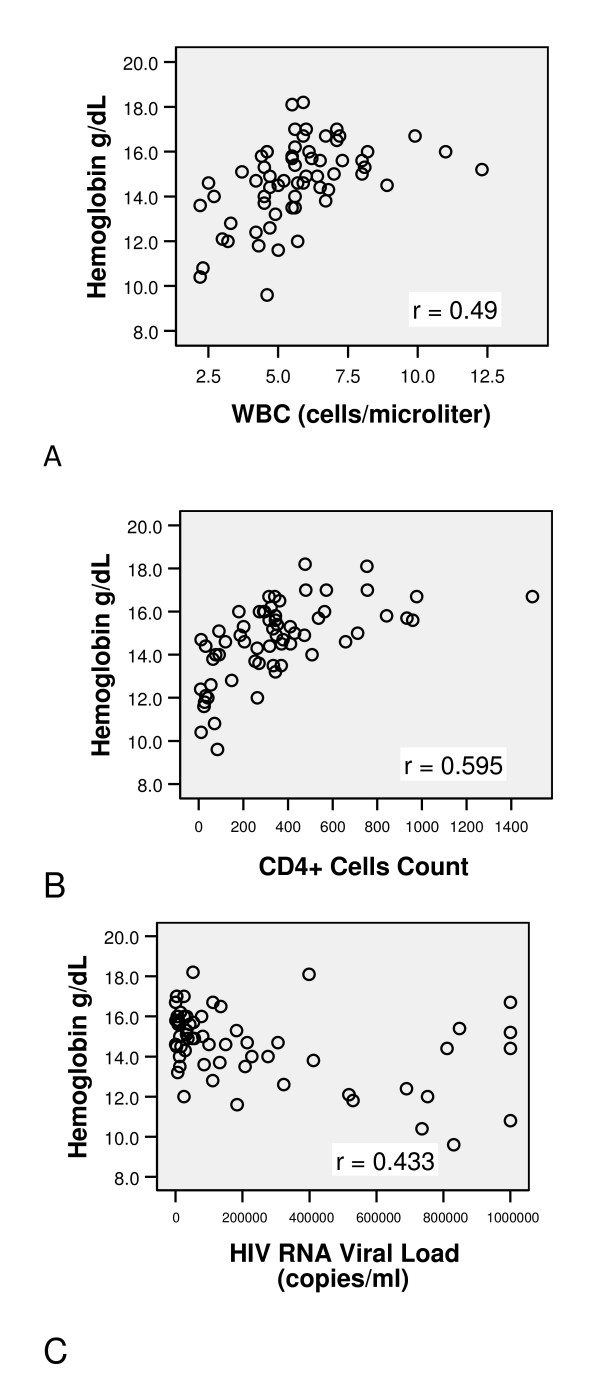
We performed a cross-sectional comparative study in which HIV treatment-naïve infected patients with anemia were compared with a control group of HIV patients without anemia. The interrelationship between risk factors and anemia was determined. Odds ratio and 95% confidence intervals were calculated, to adjust for the effects of potential confounders and we used a logistic regression model. Pearson's correlation coefficient was obtained to calculate the correlation between risk factors and hemoglobin.We enrolled 54 men and 9 women. Anemia was found in 13 patients; prevalence .20 (CI 95% 0.12-0.32). Severe anemia was found in only one patient (1.5%). Only CD4+ Cells Count <200 cells/mm3 was associated with increased risk of anemia in the multivariate analysis. There was a moderately strong, positive correlation between WBC and hemoglobin (r = 0.49, P < 0.001) and between CD4+ cell count and hemoglobin (r = 0.595, P < 0.001) and a moderately strong, negative correlation between HIV RNA viral load and hemoglobin (r = - 0.433, P < 0.001).
Anemia is a common manifestation in the Mexican population without antiretroviral therapy. In HIV naïve patients a CD4+ Cell Count < 200 cells/mm3 was associated with an increased risk of anemia. There is a positive correlation between hemoglobin and CD4+ cell count.
人类免疫缺陷病毒(HIV)感染的血液学表现是该疾病公认的并发症,且可能具有临床重要性。我们的目标是确定贫血的危险因素及其与未接受过HIV治疗、无合并感染或机会性疾病的感染患者之间的相关性。
我们进行了一项横断面比较研究,将未接受过HIV治疗且患有贫血的感染患者与未患贫血的HIV患者对照组进行比较。确定了危险因素与贫血之间的相互关系。计算了比值比和95%置信区间,以调整潜在混杂因素的影响,并使用了逻辑回归模型。获得了皮尔逊相关系数以计算危险因素与血红蛋白之间的相关性。我们纳入了54名男性和9名女性。13名患者被发现患有贫血;患病率为0.20(95%CI 0.12 - 0.32)。仅1名患者(1.5%)被发现患有严重贫血。在多变量分析中,只有CD4 +细胞计数<200个细胞/mm³与贫血风险增加相关。白细胞与血红蛋白之间存在中度强正相关(r = 0.49,P < 0.001),CD4 +细胞计数与血红蛋白之间存在中度强正相关(r = 0.595,P < 0.001),HIV RNA病毒载量与血红蛋白之间存在中度强负相关(r = - 0.433,P < 0.001)。
在未接受抗逆转录病毒治疗的墨西哥人群中,贫血是一种常见表现。在未接受过HIV治疗的患者中,CD4 +细胞计数<200个细胞/mm³与贫血风险增加相关。血红蛋白与CD4 +细胞计数之间存在正相关。