Arthritis & Clinical Immunology Research Program, Oklahoma Medical Research Foundation, Oklahoma City, OK 73104, USA.
Department of Urology, University of Oklahoma Health Sciences Center, Oklahoma City, OK 73104, USA.
Chin Med. 2014 Jul 2;9:18. doi: 10.1186/1749-8546-9-18. eCollection 2014.
Frankincense (Boswellia carterii, known as Ru Xiang in Chinese) and sandalwood (Santalum album, known as Tan Xiang in Chinese) are cancer preventive and therapeutic agents in Chinese medicine. Their biologically active ingredients are usually extracted from frankincense by hydrodistillation and sandalwood by distillation. This study aims to investigate the anti-proliferative and pro-apoptotic activities of frankincense and sandalwood essential oils in cultured human bladder cancer cells.
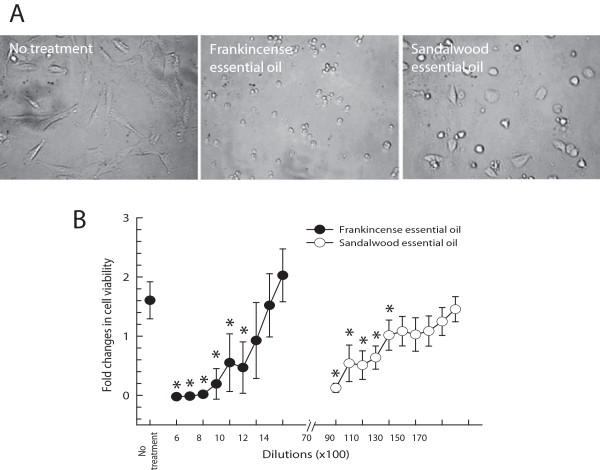
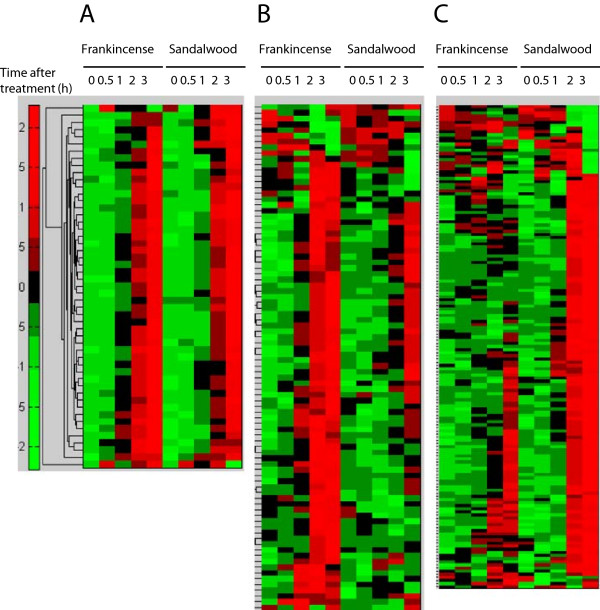
The effects of frankincense (1,400-600 dilutions) (v/v) and sandalwood (16,000-7,000 dilutions) (v/v) essential oils on cell viability were studied in established human bladder cancer J82 cells and immortalized normal human bladder urothelial UROtsa cells using a colorimetric XTT cell viability assay. Genes that responded to essential oil treatments in human bladder cancer J82 cells were identified using the Illumina Expression BeadChip platform and analyzed for enriched functions and pathways. The chemical compositions of the essential oils were determined by gas chromatography-mass spectrometry.
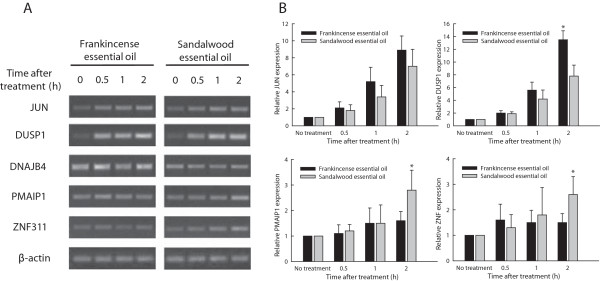
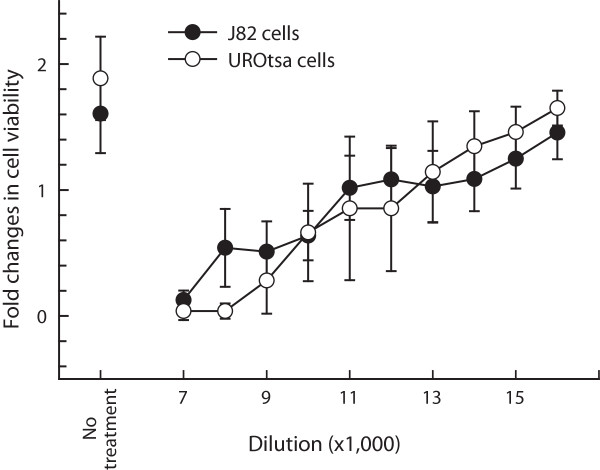
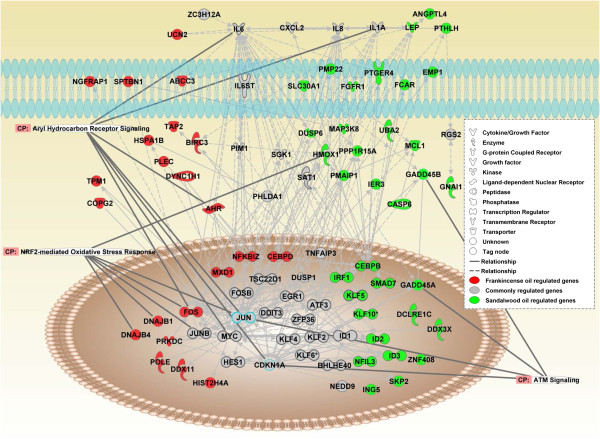
Human bladder cancer J82 cells were more sensitive to the pro-apoptotic effects of frankincense essential oil than the immortalized normal bladder UROtsa cells. In contrast, sandalwood essential oil exhibited a similar potency in suppressing the viability of both J82 and UROtsa cells. Although frankincense and sandalwood essential oils activated common pathways such as inflammatory interleukins (IL-6 signaling), each essential oil had a unique molecular action on the bladder cancer cells. Heat shock proteins and histone core proteins were activated by frankincense essential oil, whereas negative regulation of protein kinase activity and G protein-coupled receptors were activated by sandalwood essential oil treatment.
The effects of frankincense and sandalwood essential oils on J82 cells and UROtsa cells involved different mechanisms leading to cancer cell death. While frankincense essential oil elicited selective cancer cell death via NRF-2-mediated oxidative stress, sandalwood essential oil induced non-selective cell death via DNA damage and cell cycle arrest.
乳香(Boswellia carterii,中文称为乳香)和檀香(Santalum album,中文称为檀香)是中药中预防和治疗癌症的药物。它们的生物活性成分通常通过水蒸气蒸馏从乳香中提取,通过蒸馏从檀香中提取。本研究旨在探讨乳香和檀香精油在培养的人膀胱癌细胞中的抗增殖和促凋亡活性。
采用比色 XTT 细胞活力测定法,研究乳香(1400-600 稀释度)(v/v)和檀香(16000-7000 稀释度)(v/v)精油对已建立的人膀胱癌 J82 细胞和永生化正常人类膀胱尿路上皮 UROtsa 细胞活力的影响。使用 Illumina Expression BeadChip 平台鉴定对人膀胱癌 J82 细胞精油处理有反应的基因,并对富集功能和途径进行分析。通过气相色谱-质谱法确定精油的化学成分。
人膀胱癌 J82 细胞对乳香精油的促凋亡作用比永生化正常膀胱 UROtsa 细胞更为敏感。相比之下,檀香精油对 J82 和 UROtsa 细胞的活力均具有相似的抑制作用。虽然乳香和檀香精油激活了共同的途径,如炎性白细胞介素(IL-6 信号),但每种精油对膀胱癌细胞都有独特的分子作用。乳香精油激活热休克蛋白和组蛋白核心蛋白,而檀香精油处理则激活蛋白激酶活性和 G 蛋白偶联受体的负调控。
乳香和檀香精油对 J82 细胞和 UROtsa 细胞的作用涉及导致癌细胞死亡的不同机制。虽然乳香精油通过 NRF-2 介导的氧化应激引起选择性癌细胞死亡,但檀香精油通过 DNA 损伤和细胞周期阻滞引起非选择性细胞死亡。