Hellstrand Sophie, Ericson Ulrika, Gullberg Bo, Hedblad Bo, Orho-Melander Marju, Sonestedt Emily
Diabetes and Cardiovascular Disease-Genetic Epidemiology
Diabetes and Cardiovascular Disease-Genetic Epidemiology.
J Nutr. 2014 Sep;144(9):1356-63. doi: 10.3945/jn.114.192708. Epub 2014 Jul 9.
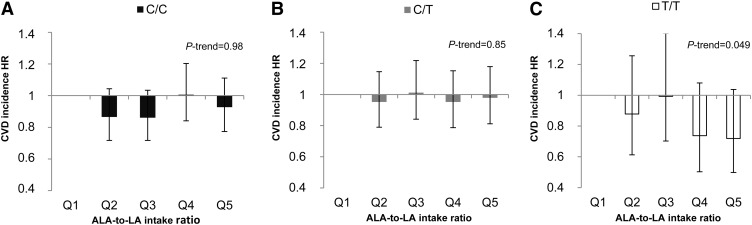
The unclear link between intake of polyunsaturated fatty acids (PUFAs) and risk of cardiovascular disease (CVD) could depend on genetic differences between individuals. Minor alleles of single-nucleotide polymorphisms (SNPs) in the ∆5 fatty acid desaturase (FADS) 1 gene were associated with lower blood concentrations of long-chain ω-3 (n-3) and ω-6 (n-6) PUFAs, indicating an associated loss of function effect. We examined whether the SNP rs174546 in FADS1 modifies the association between PUFA intakes and CVD risk. We included 24,032 participants (62% women, aged 44-74 y) from the Malmö Diet and Cancer cohort without prevalent CVD and diabetes. During a mean follow-up of 14 y, 2648 CVD cases were identified. Diet was assessed by a modified diet history method. A borderline interaction was observed between the α-linolenic acid (ALA) (18:3n-3)-to-linoleic acid (LA) (18:2n-6) intake ratio and FADS1 genotype on CVD incidence (P = 0.06). The ALA-to-LA intake ratio was inversely associated with CVD risk only among participants homozygous for the minor T-allele (HR for quintile 5 vs. quintile 1 = 0.72; 95% CI: 0.50, 1.04; P-trend = 0.049). When excluding participants reporting unstable food habits in the past (35%), the interaction between the ALA-to-LA intake ratio and FADS1 genotype on CVD incidence was strengthened and statistically significant (P = 0.04). Additionally, we observed a significant interaction between ALA and FADS1 genotype on ischemic stroke incidence (P = 0.03). ALA was inversely associated with ischemic stroke only among TT genotype carriers (HR for quintile 5 vs. quintile 1 = 0.50; 95% CI: 0.27, 0.94; P-trend = 0.02). In this large cohort, we found some weak, but not convincing, evidence of effect modification by genetic variation in FADS1 on the associations between PUFA intakes and CVD risk. For the 11% of the population homozygous for the minor T-allele of rs174546 that associates with lower ∆5 FADS activity, high ALA intake and ALA-to-LA intake ratio may be preferable in the prevention of CVD and ischemic stroke.
多不饱和脂肪酸(PUFAs)摄入量与心血管疾病(CVD)风险之间的关联尚不明确,这可能取决于个体之间的基因差异。∆5脂肪酸去饱和酶(FADS)1基因单核苷酸多态性(SNPs)的次要等位基因与长链ω-3(n-3)和ω-6(n-6)PUFAs的较低血液浓度相关,表明存在相关的功能丧失效应。我们研究了FADS1基因中的SNP rs174546是否会改变PUFAs摄入量与CVD风险之间的关联。我们纳入了来自马尔默饮食与癌症队列的24,032名参与者(62%为女性,年龄44 - 74岁),这些参与者无CVD和糖尿病病史。在平均14年的随访期间,共确定了2648例CVD病例。饮食通过改良的饮食史方法进行评估。在α-亚麻酸(ALA)(18:3n-3)与亚油酸(LA)(18:2n-6)的摄入量比值和FADS1基因分型之间,观察到了关于CVD发病率的临界相互作用(P = 0.06)。仅在次要T等位基因纯合的参与者中,ALA与LA的摄入量比值与CVD风险呈负相关(第5五分位数与第1五分位数相比的风险比= 0.72;95%置信区间:0.50, 1.04;P趋势= 0.049)。当排除过去报告有不稳定饮食习惯的参与者(35%)后,ALA与LA的摄入量比值和FADS1基因分型之间关于CVD发病率的相互作用得到加强且具有统计学意义(P = 0.04)。此外,我们观察到ALA与FADS1基因分型之间在缺血性中风发病率方面存在显著相互作用(P = 0.03)。仅在TT基因型携带者中,ALA与缺血性中风呈负相关(第5五分位数与第1五分位数相比的风险比= 0.50;95%置信区间:0.27, 0.94;P趋势= 0.02)。在这个大型队列中,我们发现了一些微弱但不具说服力的证据,表明FADS1基因变异对PUFAs摄入量与CVD风险之间的关联存在效应修饰作用。对于rs174546次要T等位基因纯合的11%人群,其与较低的∆5 FADS活性相关,高ALA摄入量和ALA与LA的摄入量比值在预防CVD和缺血性中风方面可能更为可取。