National Center for Rehabilitative Auditory Research, Department of Veterans Affairs, Portland VA Medical Center Portland, OR, USA ; Otolaryngology/Head and Neck Surgery, Oregon Health and Science University Portland, OR, USA.
National Center for Rehabilitative Auditory Research, Department of Veterans Affairs, Portland VA Medical Center Portland, OR, USA ; Department of Public Health and Preventive Medicine, Oregon Health and Science University Portland, OR, USA.
Front Neurosci. 2014 Jun 25;8:172. doi: 10.3389/fnins.2014.00172. eCollection 2014.
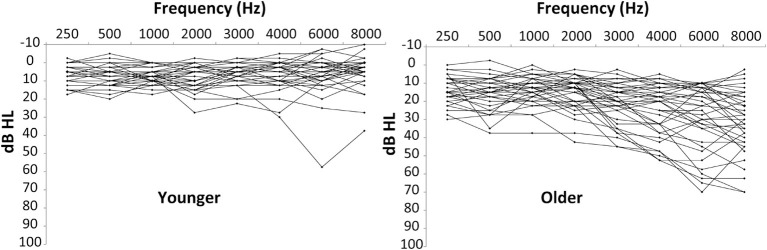
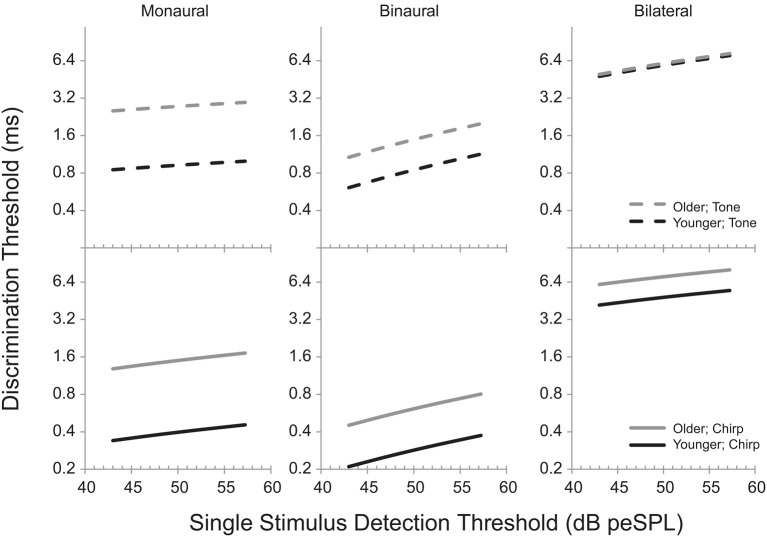
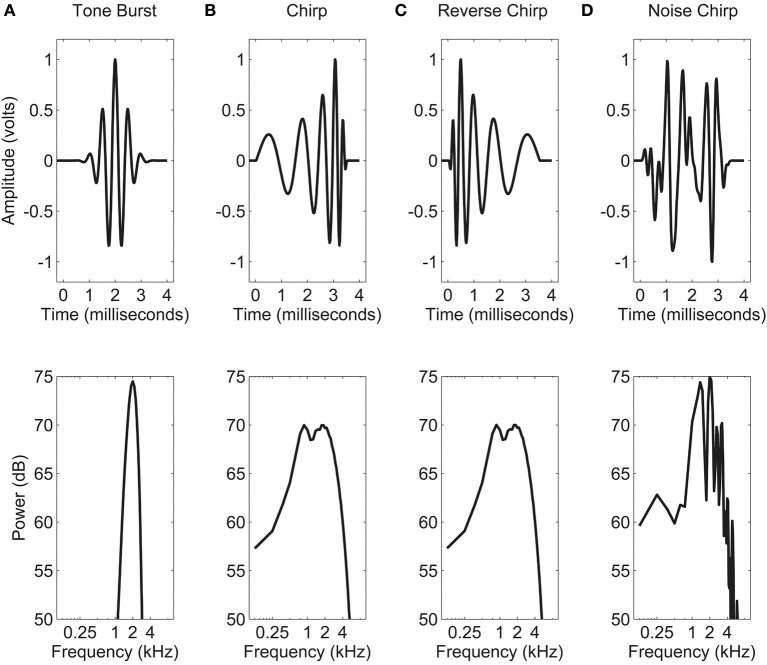
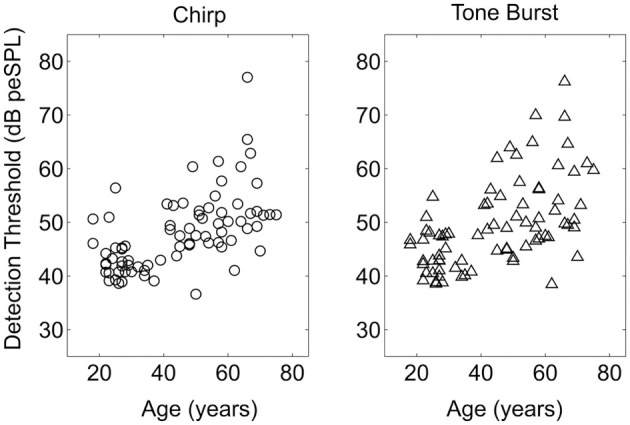
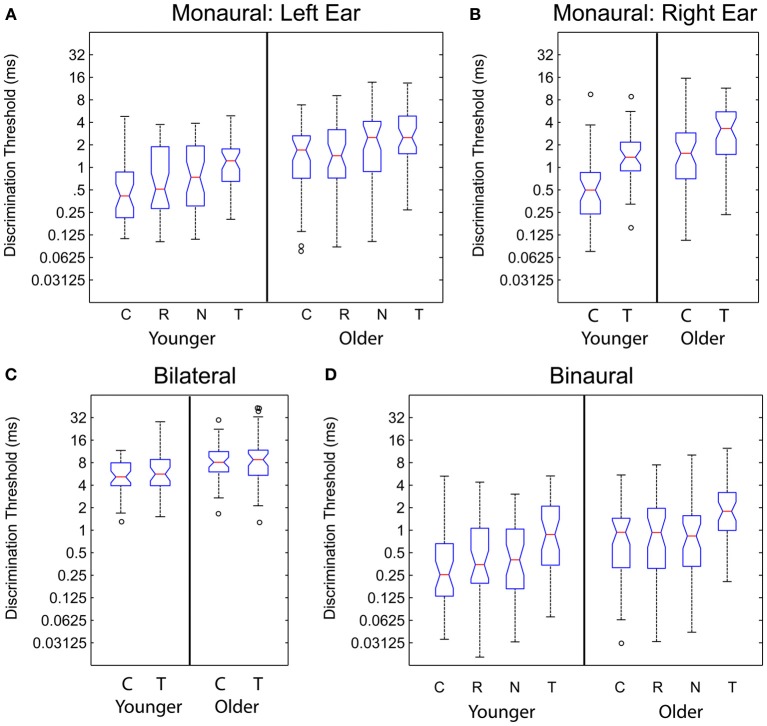
Older listeners are more likely than younger listeners to have difficulties in making temporal discriminations among auditory stimuli presented to one or both ears. In addition, the performance of older listeners is often observed to be more variable than that of younger listeners. The aim of this work was to relate age and hearing loss to temporal processing ability in a group of younger and older listeners with a range of hearing thresholds. Seventy-eight listeners were tested on a set of three temporal discrimination tasks (monaural gap discrimination, bilateral gap discrimination, and binaural discrimination of interaural differences in time). To examine the role of temporal fine structure in these tasks, four types of brief stimuli were used: tone bursts, broad-frequency chirps with rising or falling frequency contours, and random-phase noise bursts. Between-subject group analyses conducted separately for each task revealed substantial increases in temporal thresholds for the older listeners across all three tasks, regardless of stimulus type, as well as significant correlations among the performance of individual listeners across most combinations of tasks and stimuli. Differences in performance were associated with the stimuli in the monaural and binaural tasks, but not the bilateral task. Temporal fine structure differences among the stimuli had the greatest impact on monaural thresholds. Threshold estimate values across all tasks and stimuli did not show any greater variability for the older listeners as compared to the younger listeners. A linear mixed model applied to the data suggested that age and hearing loss are independent factors responsible for temporal processing ability, thus supporting the increasingly accepted hypothesis that temporal processing can be impaired for older compared to younger listeners with similar hearing and/or amounts of hearing loss.
年长的听众比年轻的听众更有可能在辨别一只或两只耳朵接收到的听觉刺激的时间上存在困难。此外,年长听众的表现往往比年轻听众更不稳定。本工作的目的是将年龄和听力损失与一组具有不同听力阈值的年轻和年长听众的时间处理能力联系起来。78 名听众在三套时间辨别任务(单耳间隙辨别、双耳间隙辨别和双耳时间差的辨别)上进行了测试。为了研究时间精细结构在这些任务中的作用,使用了四种类型的简短刺激:音脉冲、具有上升或下降频率轮廓的宽频啁啾声、随机相位噪声脉冲。分别对每个任务进行的组间分析显示,所有三个任务的年长听众的时间阈值都有显著增加,而与刺激类型无关,而且大多数任务和刺激组合中,个别听众的表现都存在显著相关性。性能差异与单耳和双耳任务中的刺激有关,但与双耳任务无关。刺激之间的时间精细结构差异对单耳阈值的影响最大。与年轻听众相比,所有任务和刺激的阈值估计值在年长听众中并没有显示出更大的变异性。应用于数据的线性混合模型表明,年龄和听力损失是时间处理能力的独立因素,因此支持了越来越被接受的假设,即与具有相似听力和/或听力损失程度的年轻听众相比,时间处理能力可能会受到年长听众的损害。