Membrane Domains and Viral Assembly, CNRS UMR-5236, Centre d'étude d'agents Pathogènes et Biotechnologies pour la Santé Montpellier, Cedex, France.
Intracellular Transport and Immunity, Immunité et Cancer, Institut Curie - Inserm U932 Paris, France.
Front Microbiol. 2014 Jun 25;5:312. doi: 10.3389/fmicb.2014.00312. eCollection 2014.
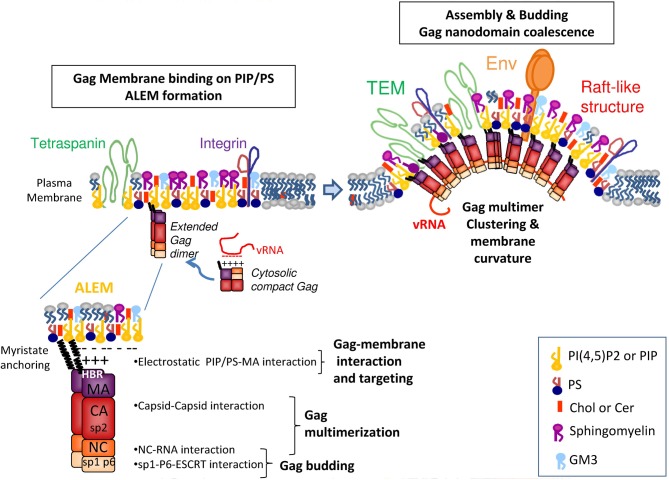
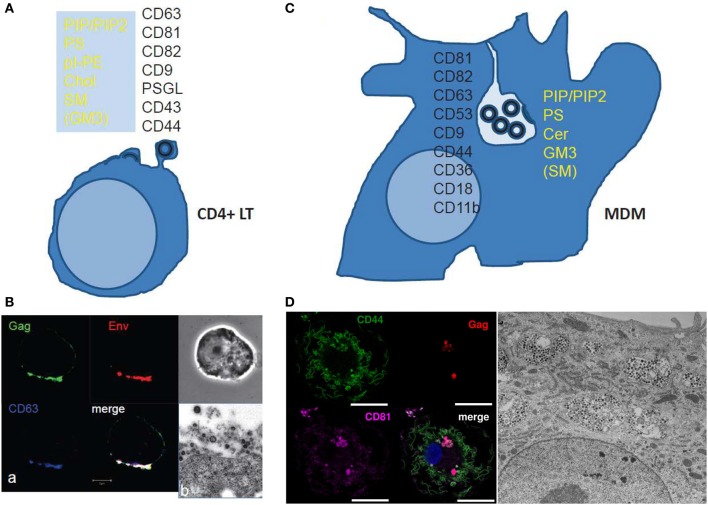
HIV-1 is an RNA enveloped virus that preferentially infects CD4(+) T lymphocytes and also macrophages. In CD4(+) T cells, HIV-1 mainly buds from the host cell plasma membrane. The viral Gag polyprotein targets the plasma membrane and is the orchestrator of the HIV assembly as its expression is sufficient to promote the formation of virus-like particles carrying a lipidic envelope derived from the host cell membrane. Certain lipids are enriched in the viral membrane and are thought to play a key role in the assembly process and the envelop composition. A large body of work performed on infected CD4(+) T cells has provided important knowledge about the assembly process and the membrane virus lipid composition. While HIV assembly and budding in macrophages is thought to follow the same general Gag-driven mechanism as in T-lymphocytes, the HIV cycle in macrophage exhibits specific features. In these cells, new virions bud from the limiting membrane of seemingly intracellular compartments, where they accumulate while remaining infectious. These structures are now often referred to as Virus Containing Compartments (VCCs). Recent studies suggest that VCCs represent intracellularly sequestered regions of the plasma membrane, but their precise nature remains elusive. The proteomic and lipidomic characterization of virions produced by T cells or macrophages has highlighted the similarity between their composition and that of the plasma membrane of producer cells, as well as their enrichment in acidic lipids, some components of raft lipids and in tetraspanin-enriched microdomains. It is likely that Gag promotes the coalescence of these components into an assembly platform from which viral budding takes place. How Gag exactly interacts with membrane lipids and what are the mechanisms involved in the interaction between the different membrane nanodomains within the assembly platform remains unclear. Here we review recent literature regarding the role of Gag and lipids on HIV-1 assembly in CD4(+) T cells and macrophages.
HIV-1 是一种 RNA 包膜病毒,它优先感染 CD4(+)T 淋巴细胞,也感染巨噬细胞。在 CD4(+)T 细胞中,HIV-1 主要从宿主细胞膜芽生。病毒 Gag 多聚蛋白靶向质膜,是 HIV 组装的协调者,因为其表达足以促进携带源自宿主细胞膜的脂性包膜的病毒样颗粒的形成。某些脂质在病毒膜中富集,被认为在组装过程和包膜组成中发挥关键作用。大量在感染的 CD4(+)T 细胞上进行的工作为组装过程和膜病毒脂质组成提供了重要的知识。虽然人们认为 HIV 在巨噬细胞中的组装和出芽遵循与 T 淋巴细胞相同的一般 Gag 驱动机制,但巨噬细胞中的 HIV 周期具有特定的特征。在这些细胞中,新的病毒从似乎是细胞内隔室的限制膜出芽,在那里它们积累而保持感染性。这些结构现在通常被称为含有病毒的隔室(VCC)。最近的研究表明,VCC 代表细胞内隔离的质膜区域,但它们的确切性质仍不清楚。用 T 细胞或巨噬细胞产生的病毒进行的蛋白质组学和脂质组学分析突出了它们的组成与产生细胞的质膜之间的相似性,以及它们在酸性脂质、一些筏脂质成分和富含四跨膜蛋白的微区的富集。很可能 Gag 促进了这些成分凝聚成一个组装平台,病毒从该平台出芽。Gag 如何确切地与膜脂质相互作用以及不同膜纳米域之间的相互作用机制仍不清楚。本文综述了关于 Gag 和脂质在 CD4(+)T 细胞和巨噬细胞中 HIV-1 组装中的作用的最新文献。