Xiong Ri-Bo, Li Qing, Wan Wei-Ren, Guo Jin-Qiang, Luo Bing-DE, Gan Lu
Department of Child and Adolescent Health, School of Public Health and Tropical Medicine, Southern Medical University, Guangzhou, Guangdong 510515, P.R. China.
Department of Child and Adolescent Health, School of Public Health and Tropical Medicine, Southern Medical University, Guangzhou, Guangdong 510515, P.R. China ; Department of Nutrition of Nanfang Hospital, Southern Medical University, Guangzhou, Guangdong 510515, P.R. China.
Exp Ther Med. 2014 Aug;8(2):499-504. doi: 10.3892/etm.2014.1777. Epub 2014 Jun 11.
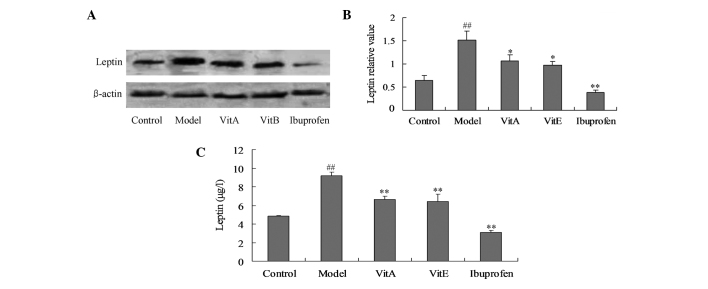
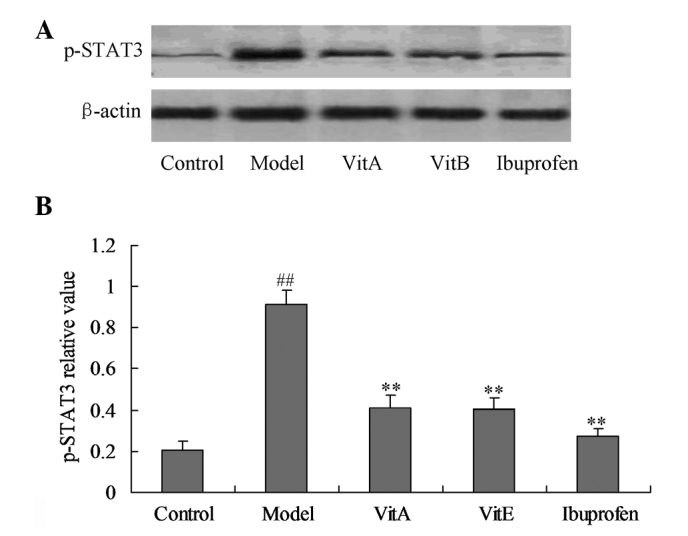
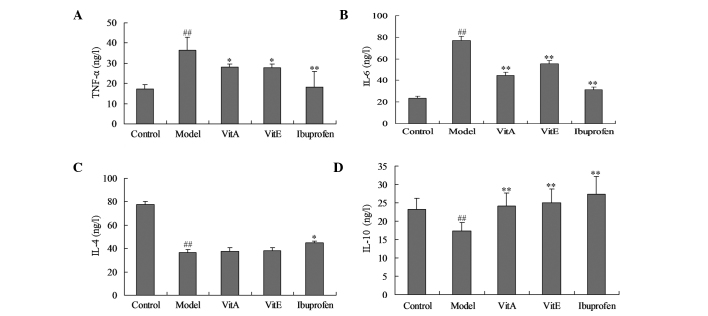
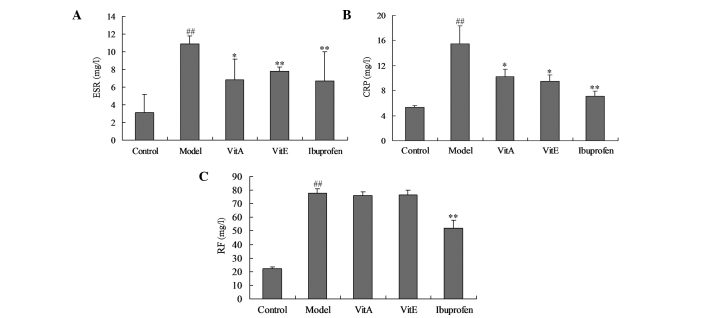
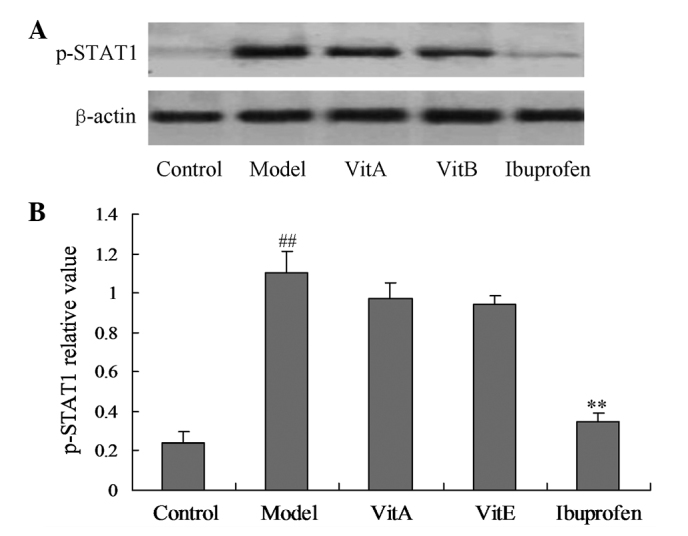
Leptin has been identified as an important cytokine in the inflammatory networks of rheumatoid arthritis (RA). Higher serum leptin levels may accelerate the development of RA. This study aimed to examine the effects of vitamin A (VitA) and vitamin E (VitE) on the levels of leptin and other related experimental and clinical indices, and to explore the mechanisms of these effects through the Janus kinase/signal transducer and activator of transcription (STAT) signal transduction pathway in rats with collagen-induced arthritis (CIA). CIA model rats were established by the intradermal injection of bovine type II collagen emulsified in incomplete Freund's adjuvant, followed by a booster intradermal injection. Four weeks later, the CIA model rats were treated with 42.86 μg retinol equivalents/kg body weight (b.w.) VitA or 200 mg/kg b.w. VitE for four weeks. The levels of leptin, tumor necrosis factor-α (TNF-α), interleukin (IL)-6, IL-10, IL-4, C-reactive protein (CRP) and rheumatic factor were measured by ELISA using commercial kits, and the erythrocyte sedimentation rate (ESR) was determined. In addition, the expression levels of phosphorylated (p)-STAT1, p-STAT3 and leptin in the synovium were evaluated by western blot analysis. The results indicated that VitA and VitE significantly reduced the levels of leptin, TNF-α, IL-6 and CRP and the ESR and significantly increased the levels of IL-10 compared with those of the model group. Furthermore, significantly reduced p-STAT3 protein expression levels were observed in the VitA and VitE groups. In conclusion, VitA and VitE reduced the levels of serum leptin protein and other cytokines. Furthermore, VitA and VitE also reduced the p-STAT3 protein levels. The present study may provide a novel approach for the treatment of RA.
瘦素已被确认为类风湿关节炎(RA)炎症网络中的一种重要细胞因子。较高的血清瘦素水平可能会加速RA的发展。本研究旨在探讨维生素A(VitA)和维生素E(VitE)对瘦素水平及其他相关实验和临床指标的影响,并通过Janus激酶/信号转导子和转录激活子(STAT)信号转导通路,在胶原诱导性关节炎(CIA)大鼠中探究这些作用的机制。通过皮内注射不完全弗氏佐剂乳化的牛II型胶原建立CIA模型大鼠,随后进行皮内加强注射。四周后,对CIA模型大鼠分别给予42.86μg视黄醇当量/千克体重(b.w.)的VitA或200mg/kg b.w.的VitE,持续四周。使用商用试剂盒通过酶联免疫吸附测定法(ELISA)检测瘦素、肿瘤坏死因子-α(TNF-α)、白细胞介素(IL)-6、IL-10、IL-4、C反应蛋白(CRP)和类风湿因子的水平,并测定红细胞沉降率(ESR)。此外,通过蛋白质免疫印迹分析评估滑膜中磷酸化(p)-STAT1、p-STAT3和瘦素的表达水平。结果表明,与模型组相比,VitA和VitE显著降低了瘦素、TNF-α、IL-6和CRP的水平以及ESR,并显著提高了IL-10的水平。此外,在VitA和VitE组中观察到p-STAT3蛋白表达水平显著降低。总之,VitA和VitE降低了血清瘦素蛋白和其他细胞因子的水平。此外,VitA和VitE还降低了p-STAT3蛋白水平。本研究可能为RA的治疗提供一种新方法。