Ray Joel G, Redelmeier Donald A, Urquia Marcelo L, Guttmann Astrid, McDonald Sarah D, Vermeulen Marian J
Departments of Medicine and Obstetrics and Gynecology, St. Michael's Hospital and the Institute for Clinical Evaluative Sciences, University of Toronto, Toronto, Ontario, Canada.
Department of Medicine and Health Policy Management and Evaluation, Institute for Clinical Evaluative Sciences, University of Toronto, Toronto, Ontario, Canada.
PLoS One. 2014 Jul 14;9(7):e102275. doi: 10.1371/journal.pone.0102275. eCollection 2014.
Cerebral palsy (CP) has a multifactorial etiology, and placental vascular disease may be one major risk factor. The risk of placental vascular disease may be lower among some immigrant groups. We studied the association between immigrant status and the risk of CP.
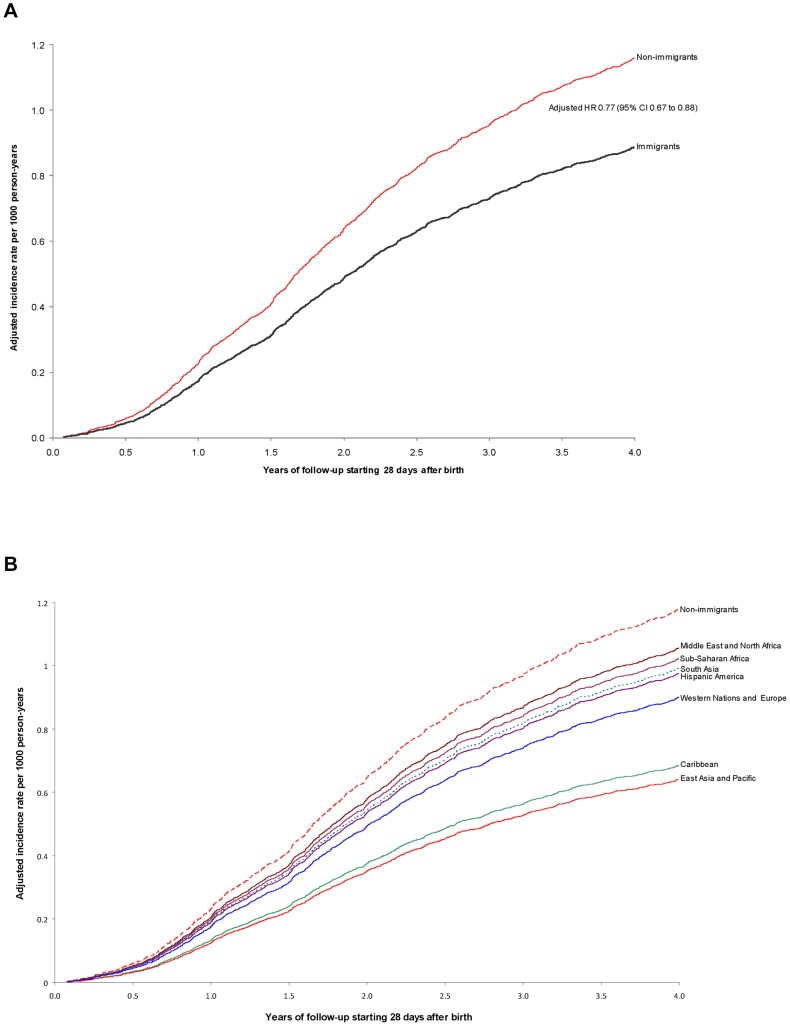
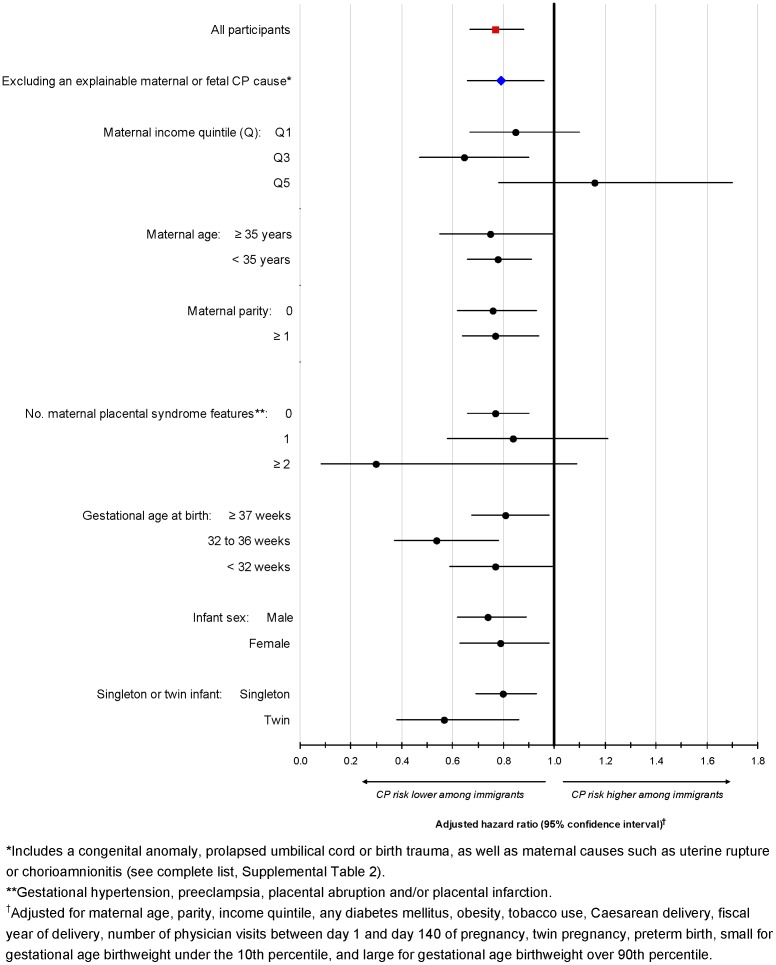
We conducted a population-based retrospective cohort study of all singleton and twin livebirths in Ontario between 2002-2008, and who survived ≥28 days after birth. Each child was assessed for CP up to age 4 years, based on either a single inpatient or ≥2 outpatient pediatric diagnoses of CP. Relative to non-immigrants (n = 566,668), the risk of CP was assessed for all immigrants (n = 177,390), and further evaluated by World region of origin. Cox proportional hazard ratios (aHR) were adjusted for maternal age, income, diabetes mellitus, obesity, tobacco use, Caesarean delivery, year of delivery, physician visits, twin pregnancy, preterm delivery, as well as small- and large-for-gestational age birthweight.
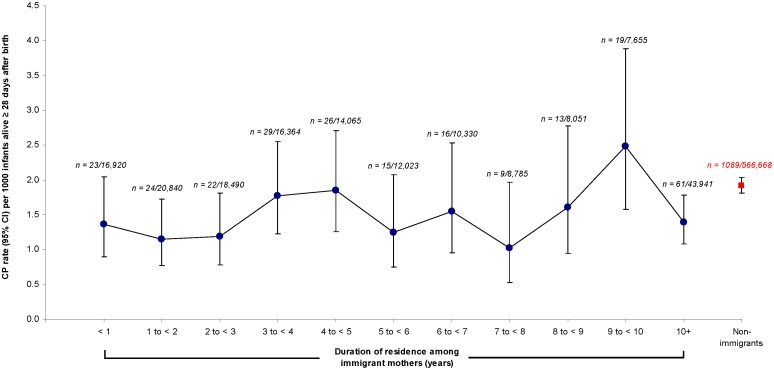
There were 1346 cases of CP, with a lower rate among immigrants (1.45 per 1000) than non-immigrants (1.92 per 1000) (aHR 0.77, 95% confidence interval [CI] 0.67 to 0.88). Mothers from East Asia and the Pacific (aHR 0.54, 95% CI 0.39 to 0.77) and the Caribbean (aHR 0.58, 95% CI 0.37 to 0.93) were at a significantly lower risk of having a child with CP. Whether further adjusting for preeclampsia, gestational hypertension, placental abruption or placental infraction, or upon using a competing risk analysis that further accounted for stillbirth and neonatal death, these results did not change.
Immigration and ethnicity appear to attenuate the risk of CP, and this effect is not fully explained by known risk factors.
脑瘫(CP)病因多因素,胎盘血管疾病可能是主要危险因素之一。某些移民群体中胎盘血管疾病风险可能较低。我们研究了移民身份与脑瘫风险之间的关联。
我们对2002年至2008年安大略省所有单胎和双胎活产且出生后存活≥28天的人群进行了基于人群的回顾性队列研究。根据单次住院或≥2次门诊儿科脑瘫诊断,对每个孩子进行4岁前的脑瘫评估。相对于非移民(n = 566,668),评估所有移民(n = 177,390)的脑瘫风险,并按原籍世界地区进一步评估。Cox比例风险比(aHR)针对母亲年龄、收入、糖尿病、肥胖、吸烟、剖宫产、分娩年份、医生就诊次数、双胎妊娠、早产以及小于胎龄和大于胎龄出生体重进行了调整。
共有1346例脑瘫病例,移民中的发病率(每1000例中有1.45例)低于非移民(每1000例中有1.92例)(aHR 0.77,95%置信区间[CI] 0.67至0.88)。来自东亚和太平洋地区(aHR 0.54,95% CI 0.39至0.77)以及加勒比地区(aHR 0.58,95% CI 0.37至0.93)的母亲生育脑瘫患儿的风险显著较低。无论是进一步调整子痫前期、妊娠期高血压、胎盘早剥或胎盘梗死,还是使用进一步考虑死产和新生儿死亡的竞争风险分析,这些结果均未改变。
移民和种族似乎会降低脑瘫风险,且已知风险因素不能完全解释这种影响。