Prockop Darwin J, Prockop Susan E, Bertoncello Ivan
Institute for Regenerative Medicine, Texas A&M Health Science Center College of Medicine at Scott and White, Temple, Texas, USA.
Stem Cells. 2014 Dec;32(12):3055-61. doi: 10.1002/stem.1806.
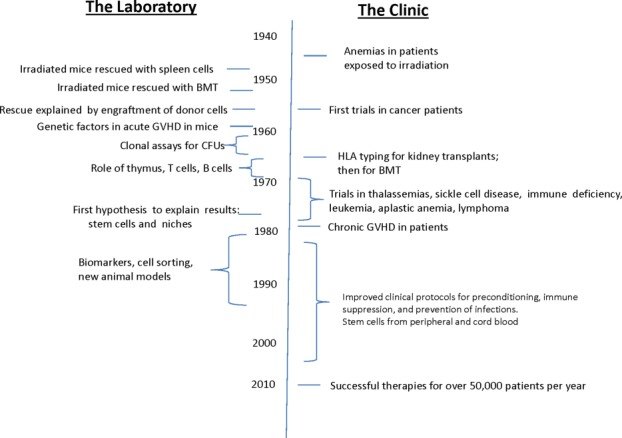
The cells referred to as mesenchymal stem/progenitor cells (MSCs) are currently being used to treat thousands of patients with diseases of essentially all the organs and tissues of the body. Strikingly positive results have been reported in some patients, but there have been few prospective controlled studies. Also, the reasons for the beneficial effects are frequently unclear. As a result there has been a heated debate as to whether the clinical trials with these new cell therapies are too far ahead of the science. The debate is not easily resolved, but important insights are provided by the 60-year history that was required to develop the first successful stem cell therapy, the transplantation of hematopoietic stem cells. The history indicates that development of a dramatically new therapy usually requires patience and a constant dialogue between basic scientists and physicians carrying out carefully designed clinical trials. It also suggests that the field can be moved forward by establishing better records of how MSCs are prepared, by establishing a large supply of reference MSCs that can be used to validate assays and compare MSCs prepared in different laboratories, and by continuing efforts to establish in vivo assays for the efficacy of MSCs.
被称为间充质干/祖细胞(MSCs)的细胞目前正被用于治疗数千名患有身体几乎所有器官和组织疾病的患者。一些患者报告了显著的积极结果,但前瞻性对照研究却很少。此外,有益效果的原因常常不明。因此,关于这些新细胞疗法的临床试验是否在科学上走得太远,引发了激烈的争论。这场争论不易解决,但造血干细胞移植这一首个成功的干细胞疗法历经60年的发展历程提供了重要的见解。这段历史表明,一种全新疗法的开发通常需要耐心,以及基础科学家与开展精心设计临床试验的医生之间持续的对话。它还表明,通过更好地记录MSCs的制备方式、建立大量可用于验证检测方法和比较不同实验室制备的MSCs的参考MSCs供应,以及持续努力建立MSCs体内疗效检测方法,可以推动该领域向前发展。