Guo Na, Zhu Meixuan, Han Xuejiao, Sui Dan, Wang Yang, Yang Qian
School of Municipal and Environmental Engineering, Harbin Institute of Technology, Harbin, China; Alkali Soil Natural Environmental Science Center, Northeast Forestry University; Key Laboratory of Saline-alkali Vegetation Ecology Restoration in Oil Field, Ministry of Education, Harbin, China.
Alkali Soil Natural Environmental Science Center, Northeast Forestry University; Key Laboratory of Saline-alkali Vegetation Ecology Restoration in Oil Field, Ministry of Education, Harbin, China.
PLoS One. 2014 Aug 7;9(8):e103648. doi: 10.1371/journal.pone.0103648. eCollection 2014.
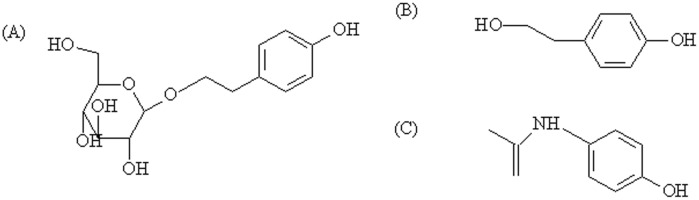
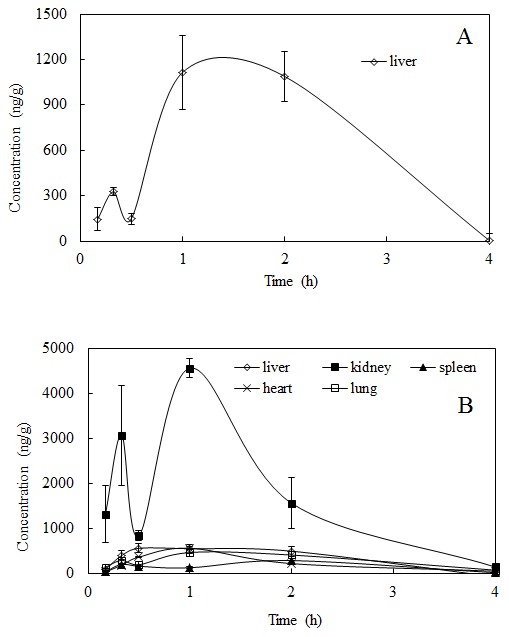
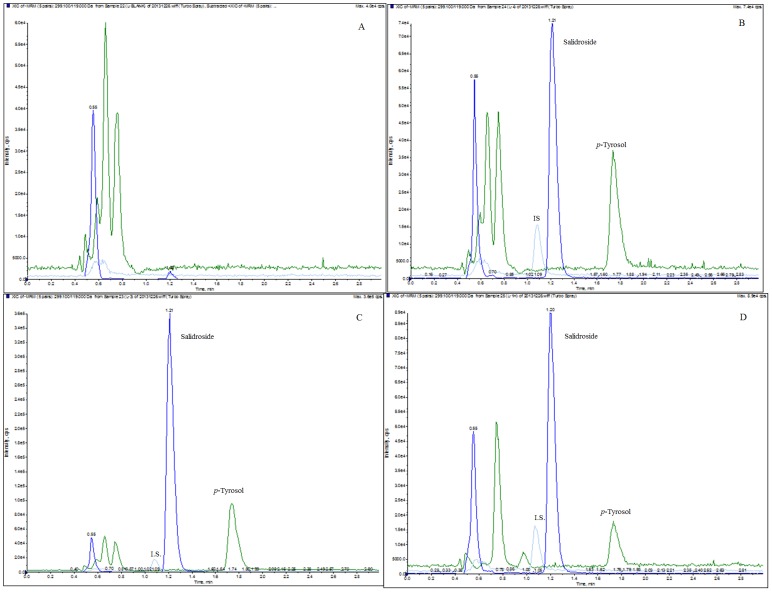
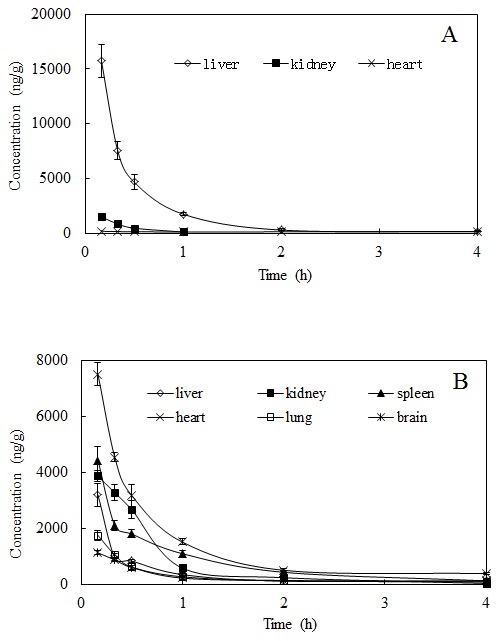
Salidroside is one of the major phenolic glycosides in Rhodiola, which has been reported to possess various biological activities. In the present study the in vivo deglycosylation metabolism of salidroside was investigated and its aglycone p-tyrosol but not the original salidroside was identified as the main form in rat tissues following the administration of salidroside. After the i.v. administration of salidroside at a dose of 50 mg/kg in rats, salidroside was quantified only in the liver, kidney and heart tissues. The highest level of p-tyrosol was detected in the heart, followed by the spleen, kidney, liver and lungs, in order. Salidroside was detected only in the liver, in contrast, p-tyrosol was detectable in most tissues except the brain, and the kidney tissues contained a significant amount of p-tyrosol compared to the other tissues after the i.g. administration of 100 mg/kg salidroside. The excretion behaviour revealed that the administrated salidroside mainly eliminated in the form of salidroside but not its aglycone metabolite p-tyrosol through urine. After i.v. and i.g. administration in rats, 64.00% and 23.80% of the total dose was excreted through urine in the form of salidroside, respectively. In addition, 0.19% and 2.25% of the dose was excreted in the form of p-tyrosol through urine after i.v. and i.g. administration, respectively. The faecal salidroside and p-tyrosol concentrations were 0.3% and 1.48% of the total dose after i.v. administration, respectively. After the i.g. administration of salidroside, trace salidroside and p-tyrosol were quantified in faeces within 72 h. In addition, the biliary excretion levels of salidroside after i.v. and i.g. administration were 2.86% and 0.02% of the dose, respectively. The obtained results show that salidroside was extensively metabolised to its aglycone p-tyrosol and distributed to various organs and the original salidroside was cleared rapidly through urine following the administration of salidroside.
红景天苷是红景天中的主要酚苷之一,据报道具有多种生物活性。在本研究中,对红景天苷的体内去糖基化代谢进行了研究,在给大鼠施用红景天苷后,其苷元对羟基苯乙醇被确定为大鼠组织中的主要形式,而非原始的红景天苷。以50mg/kg的剂量给大鼠静脉注射红景天苷后,仅在肝脏、肾脏和心脏组织中对红景天苷进行了定量。在心脏中检测到的对羟基苯乙醇水平最高,其次依次为脾脏、肾脏、肝脏和肺。相比之下,仅在肝脏中检测到红景天苷,而在口服100mg/kg红景天苷后,除大脑外,在大多数组织中均可检测到对羟基苯乙醇,并且与其他组织相比,肾脏组织中含有大量的对羟基苯乙醇。排泄行为表明,施用的红景天苷主要以红景天苷的形式而非其苷元代谢物对羟基苯乙醇通过尿液排出。在给大鼠静脉注射和口服后,总剂量的64.00%和23.80%分别以红景天苷的形式通过尿液排出。此外,静脉注射和口服后,分别有0.19%和2.25%的剂量以对羟基苯乙醇的形式通过尿液排出。静脉注射后,粪便中红景天苷和对羟基苯乙醇的浓度分别为总剂量的0.3%和1.48%。口服红景天苷后,在72小时内粪便中可定量检测到微量的红景天苷和对羟基苯乙醇。此外,静脉注射和口服后,红景天苷的胆汁排泄水平分别为剂量的2.86%和0.02%。所得结果表明,红景天苷被广泛代谢为其苷元对羟基苯乙醇并分布到各个器官,并且在施用红景天苷后,原始的红景天苷通过尿液迅速清除。