Barbet-Massin Emeline, Pell Andrew J, Retel Joren S, Andreas Loren B, Jaudzems Kristaps, Franks W Trent, Nieuwkoop Andrew J, Hiller Matthias, Higman Victoria, Guerry Paul, Bertarello Andrea, Knight Michael J, Felletti Michele, Le Marchand Tanguy, Kotelovica Svetlana, Akopjana Inara, Tars Kaspars, Stoppini Monica, Bellotti Vittorio, Bolognesi Martino, Ricagno Stefano, Chou James J, Griffin Robert G, Oschkinat Hartmut, Lesage Anne, Emsley Lyndon, Herrmann Torsten, Pintacuda Guido
Centre de RMN à Très Hauts Champs, Institut des Sciences Analytiques (CNRS, ENS Lyon, UCB Lyon 1), Université de Lyon , 69100 Villeurbanne, France.
J Am Chem Soc. 2014 Sep 3;136(35):12489-97. doi: 10.1021/ja507382j. Epub 2014 Aug 18.
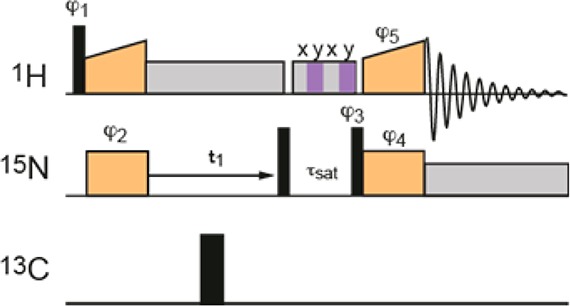
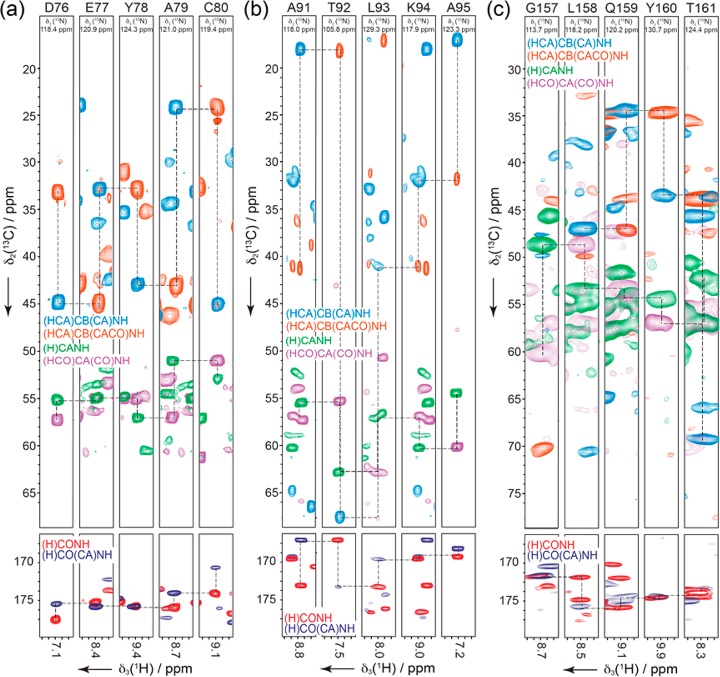
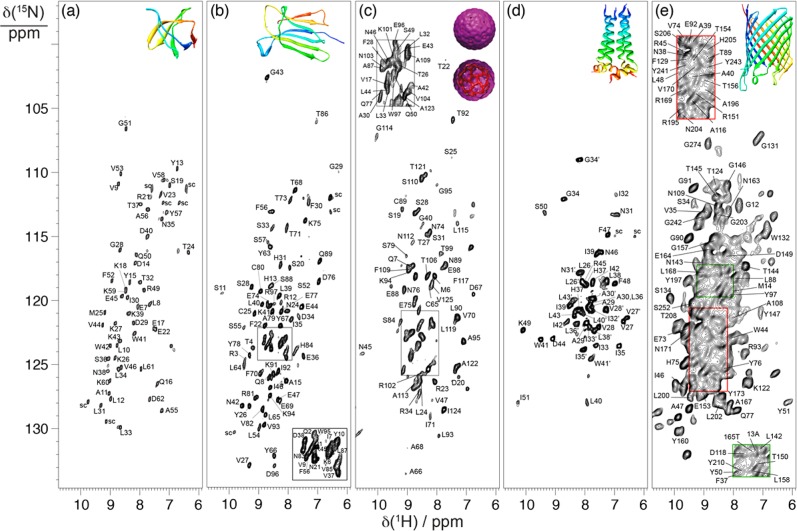
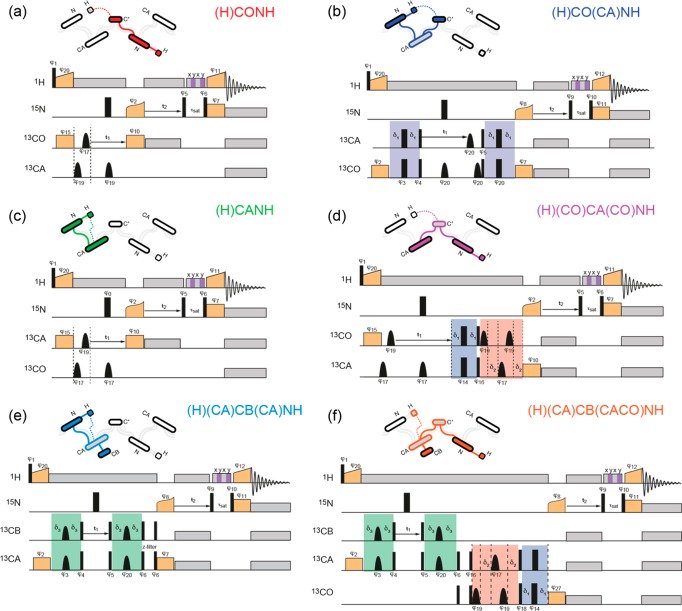
Using a set of six (1)H-detected triple-resonance NMR experiments, we establish a method for sequence-specific backbone resonance assignment of magic angle spinning (MAS) nuclear magnetic resonance (NMR) spectra of 5-30 kDa proteins. The approach relies on perdeuteration, amide (2)H/(1)H exchange, high magnetic fields, and high-spinning frequencies (ωr/2π ≥ 60 kHz) and yields high-quality NMR data, enabling the use of automated analysis. The method is validated with five examples of proteins in different condensed states, including two microcrystalline proteins, a sedimented virus capsid, and two membrane-embedded systems. In comparison to contemporary (13)C/(15)N-based methods, this approach facilitates and accelerates the MAS NMR assignment process, shortening the spectral acquisition times and enabling the use of unsupervised state-of-the-art computational data analysis protocols originally developed for solution NMR.
通过一组六个(1)H检测的三重共振核磁共振实验,我们建立了一种用于5 - 30 kDa蛋白质魔角旋转(MAS)核磁共振(NMR)谱序列特异性主链共振归属的方法。该方法依赖于全氘代、酰胺(2)H/(1)H交换、高磁场和高旋转频率(ωr/2π≥60 kHz),并产生高质量的NMR数据,从而能够进行自动化分析。该方法在五个处于不同凝聚态的蛋白质实例中得到验证,包括两个微晶蛋白质、一个沉降的病毒衣壳和两个膜嵌入系统。与当代基于(13)C/(15)N的方法相比,这种方法有助于并加速了MAS NMR归属过程,缩短了光谱采集时间,并能够使用最初为溶液NMR开发的无监督的先进计算数据分析协议。