Department of Neurodegenerative Disease, UCL Institute of Neurology, Queen Square, London WC1N 3BG, UK.
Max Planck Institute for Biology of Ageing, Joseph-Stelzmann-Strasse 9b, 50931 Cologne, Germany.
Science. 2014 Sep 5;345(6201):1192-1194. doi: 10.1126/science.1256800. Epub 2014 Aug 7.
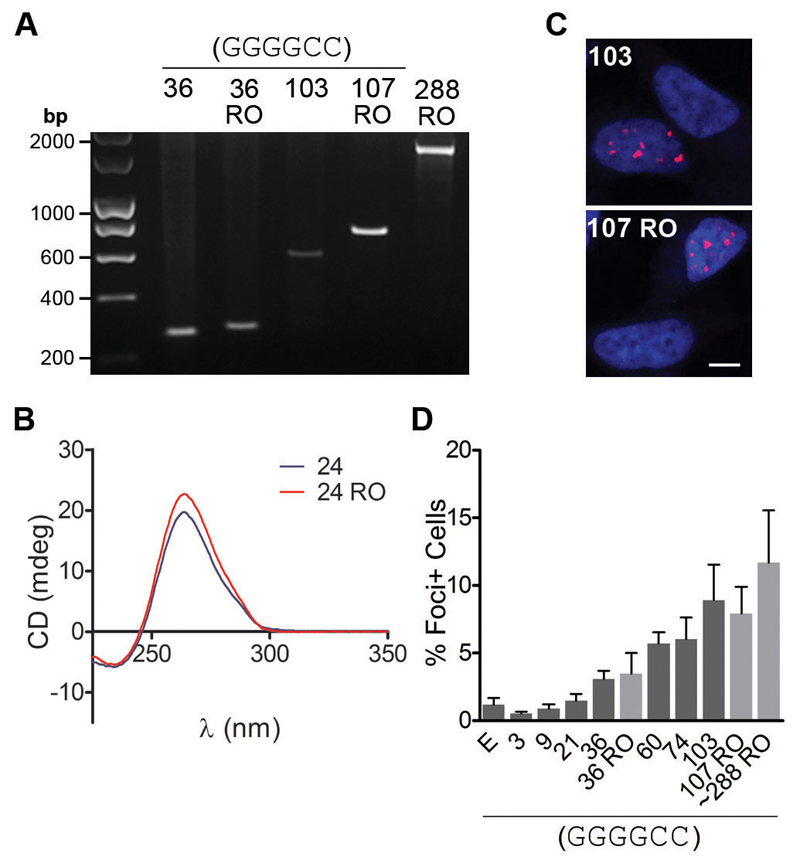
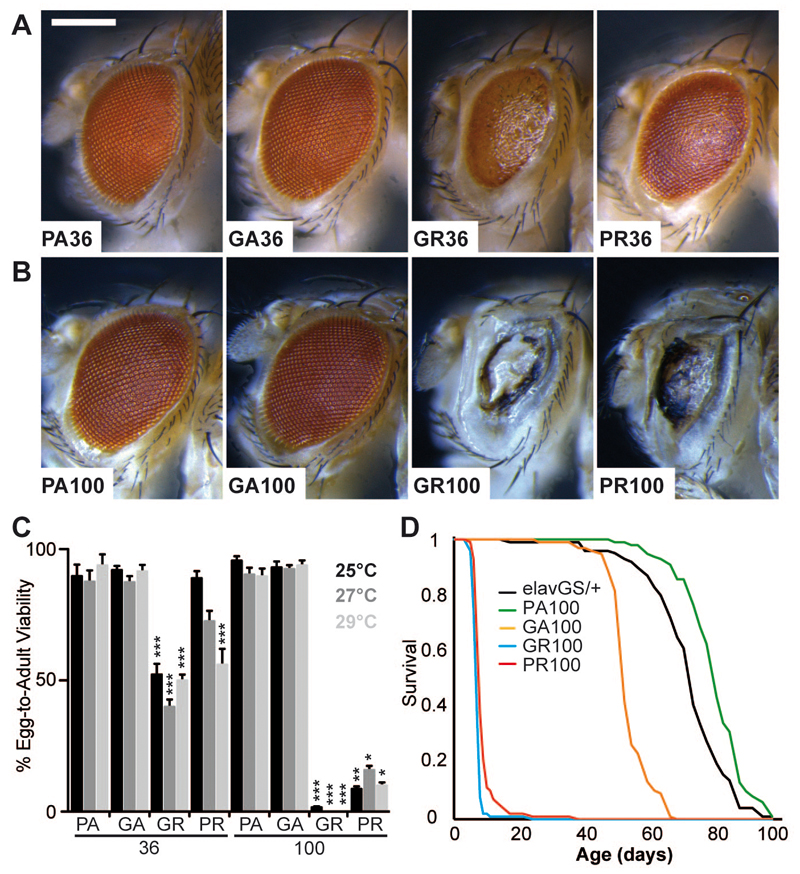
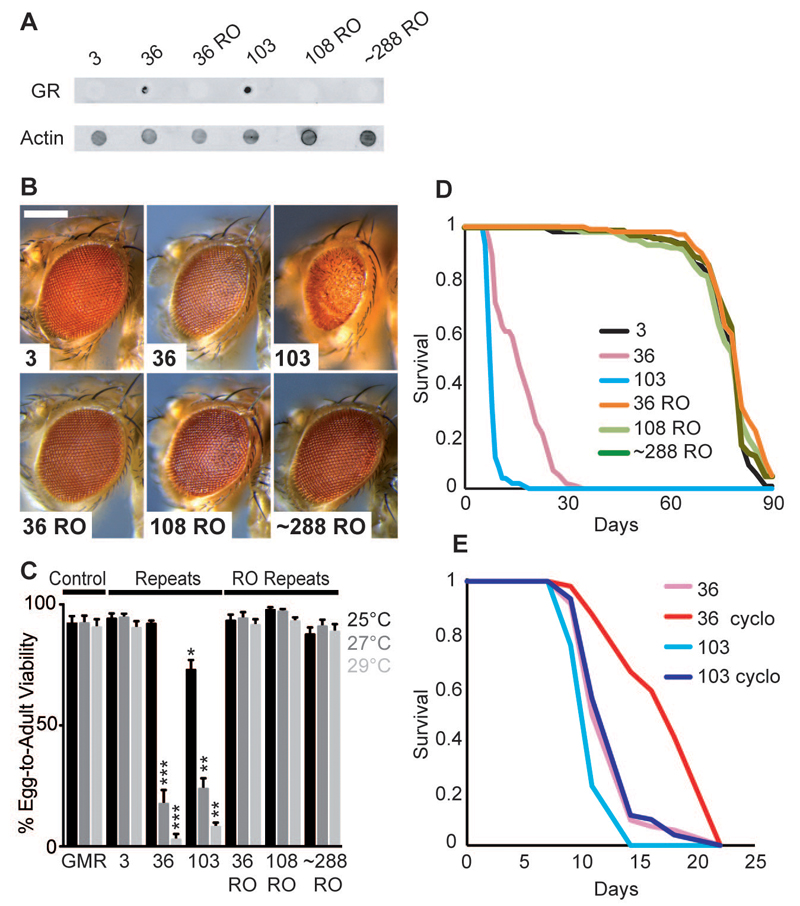
An expanded GGGGCC repeat in C9orf72 is the most common genetic cause of frontotemporal dementia and amyotrophic lateral sclerosis. A fundamental question is whether toxicity is driven by the repeat RNA itself and/or by dipeptide repeat proteins generated by repeat-associated, non-ATG translation. To address this question, we developed in vitro and in vivo models to dissect repeat RNA and dipeptide repeat protein toxicity. Expression of pure repeats, but not stop codon-interrupted "RNA-only" repeats in Drosophila caused adult-onset neurodegeneration. Thus, expanded repeats promoted neurodegeneration through dipeptide repeat proteins. Expression of individual dipeptide repeat proteins with a non-GGGGCC RNA sequence revealed that both poly-(glycine-arginine) and poly-(proline-arginine) proteins caused neurodegeneration. These findings are consistent with a dual toxicity mechanism, whereby both arginine-rich proteins and repeat RNA contribute to C9orf72-mediated neurodegeneration.
GGGCC 重复扩增是 C9orf72 最常见的额颞叶痴呆和肌萎缩侧索硬化症的遗传原因。一个基本问题是,毒性是否由重复 RNA 本身以及由重复相关的非 ATG 翻译产生的二肽重复蛋白驱动。为了解决这个问题,我们开发了体外和体内模型来剖析重复 RNA 和二肽重复蛋白毒性。在果蝇中表达纯重复序列,但不表达终止密码子中断的“仅 RNA”重复序列会导致成年发病的神经退行性变。因此,扩展的重复序列通过二肽重复蛋白促进神经退行性变。表达具有非 GGGGCC RNA 序列的单个二肽重复蛋白表明,聚(甘氨酸-精氨酸)和聚(脯氨酸-精氨酸)蛋白都引起神经退行性变。这些发现与双重毒性机制一致,即精氨酸丰富的蛋白和重复 RNA 都有助于 C9orf72 介导的神经退行性变。