Huang Xiwei, Guo Jinhong, Wang Xiaolong, Yan Mei, Kang Yuejun, Yu Hao
School of Electrical and Electronic Engineering, Nanyang Technological University, Singapore, Singapore.
School of Chemical and Biomedical Engineering, Nanyang Technological University, Singapore, Singapore.
PLoS One. 2014 Aug 11;9(8):e104539. doi: 10.1371/journal.pone.0104539. eCollection 2014.
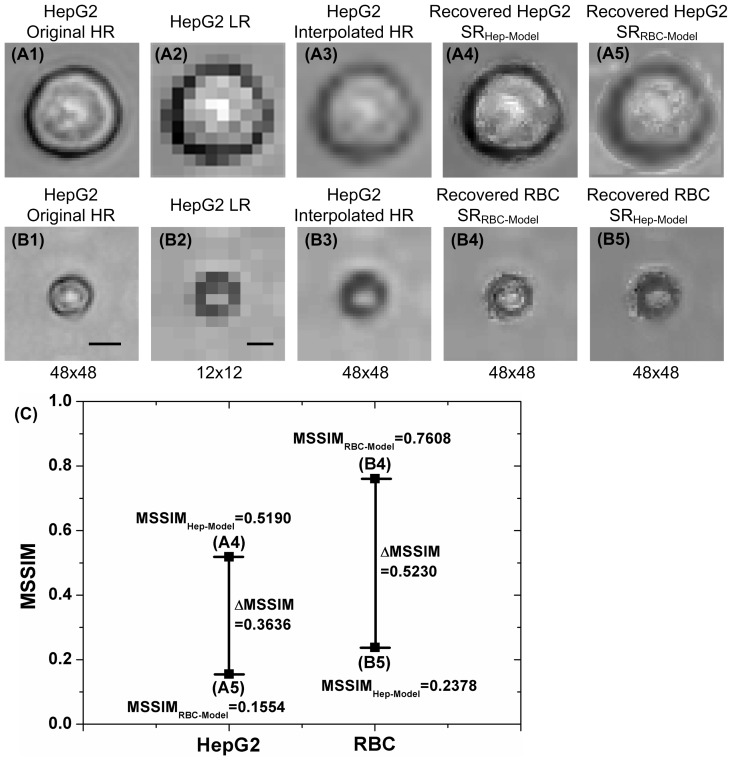
Lensless microfluidic imaging with super-resolution processing has become a promising solution to miniaturize the conventional flow cytometer for point-of-care applications. The previous multi-frame super-resolution processing system can improve resolution but has limited cell flow rate and hence low throughput when capturing multiple subpixel-shifted cell images. This paper introduces a single-frame super-resolution processing with on-line machine-learning for contact images of cells. A corresponding contact-imaging based microfluidic cytometer prototype is demonstrated for cell recognition and counting. Compared with commercial flow cytometer, less than 8% error is observed for absolute number of microbeads; and 0.10 coefficient of variation is observed for cell-ratio of mixed RBC and HepG2 cells in solution.
具有超分辨率处理的无透镜微流控成像已成为一种很有前景的解决方案,可将传统流式细胞仪小型化以用于即时护理应用。先前的多帧超分辨率处理系统可以提高分辨率,但在捕获多个亚像素移位的细胞图像时,细胞流速有限,因此通量较低。本文介绍了一种用于细胞接触图像的基于在线机器学习的单帧超分辨率处理方法。展示了一种相应的基于接触成像的微流控细胞仪原型,用于细胞识别和计数。与商用流式细胞仪相比,微珠绝对数量的误差小于8%;溶液中混合红细胞和HepG2细胞的细胞比率的变异系数为0.10。