Firdaus Rushna, Biswas Aritra, Saha Kallol, Mukherjee Anirban, Pal Falguni, Chaudhuri Sujit, Chandra Alok, Konar Asokananda, Sadhukhan Provash Chandra
I.C.M.R. Virus Unit Kolkata, ID and BG Hospital Campus, GB-4 (East Wing), 1st Floor, 57 Dr. Suresh Chandra Banerjee Road, Beliaghata, Kolkata, West Bengal 700010, India.
Department of Gastroenterology, AMRI Hospitals Salt Lake, JC - 16 & 17, Salt Lake City, Kolkata 700091, India.
Biomed Res Int. 2014;2014:491064. doi: 10.1155/2014/491064. Epub 2014 Jul 13.
Hepatitis C virus is the major cause of chronic hepatitis worldwide which finally leads to the development of hepatocellular carcinoma. Toll like receptors (TLRs) play an important role in the course of many viral infections, but the role of TLRs in HCV pathogenesis has not been well elucidated so far.
The aim of this study was to analyse the mRNA expression of TLRs 3, 7, and 8 in different stages of HCV infection including chronic, cirrhosis, interferon treated resolved, and relapsed cases.
Total RNA from whole blood was extracted and mRNA expression of TLRs 3, 7, and 8 genes was analyzed by quantitative real-time RT-PCR using β-Actin gene as an internal control.
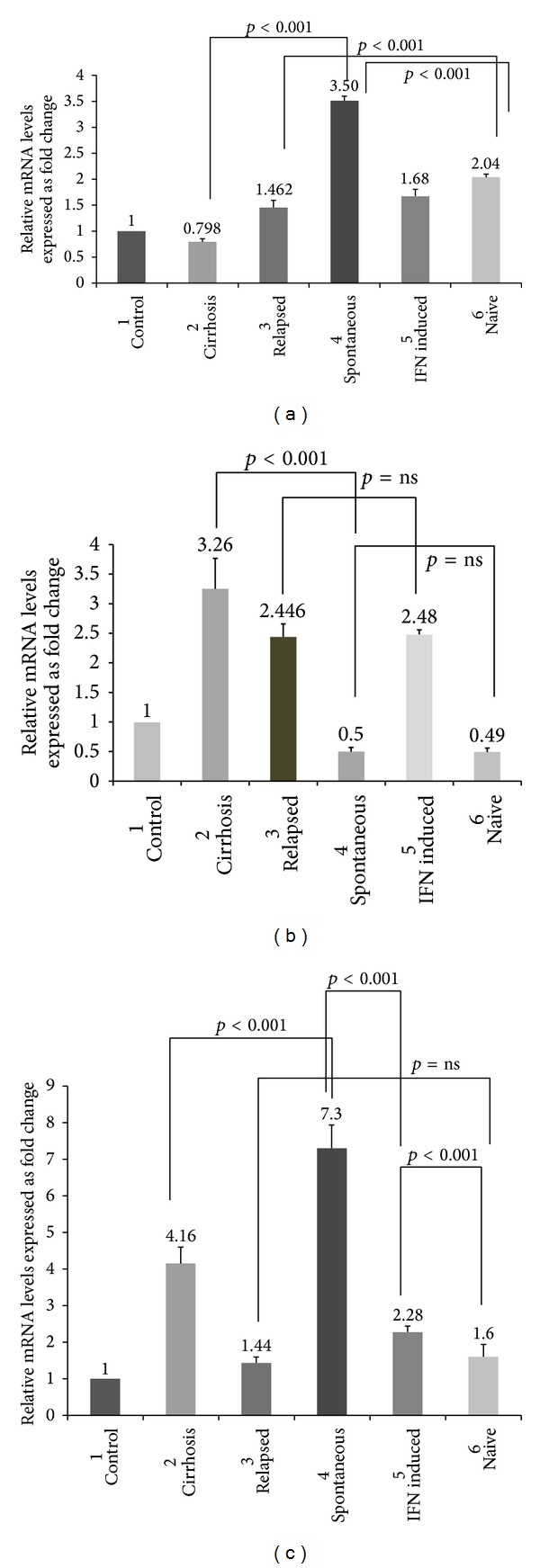
This study consisted of 100 HCV infected individuals and twenty healthy controls. TLR 3 expression was found to be significantly elevated in individuals who had spontaneously cleared the virus (p < 0.001), whereas TLR 7 was found to be 3.26 times more elevated in patients with cirrhosis of liver. In IFN induced individuals, TLR 8 expression levels were found to be 2.28-fold elevated as compared to control population.
TLRs 3, 7, and 8 are prime biomarker candidates for HCV infection mRNA expression analysis which might improve current therapeutic approaches.
丙型肝炎病毒是全球慢性肝炎的主要病因,最终可导致肝细胞癌的发生。Toll样受体(TLRs)在许多病毒感染过程中发挥重要作用,但TLRs在丙型肝炎病毒发病机制中的作用迄今尚未完全阐明。
本研究旨在分析丙型肝炎病毒感染不同阶段(包括慢性、肝硬化、干扰素治疗后缓解和复发病例)中TLR 3、7和8的mRNA表达情况。
提取全血中的总RNA,以β-肌动蛋白基因作为内对照,通过定量实时逆转录聚合酶链反应分析TLR 3、7和8基因的mRNA表达。
本研究包括100例丙型肝炎病毒感染个体和20例健康对照。发现病毒已自发清除的个体中TLR 3表达显著升高(p < 0.001),而肝硬化患者中TLR 7升高3.26倍。在干扰素诱导的个体中,与对照人群相比,TLR 8表达水平升高2.28倍。
TLR 3、7和8是丙型肝炎病毒感染mRNA表达分析的主要生物标志物候选物,可能会改善当前的治疗方法。