Schäfer Simon T, Gessner Sophia, Scherag André, Rump Katharina, Frey Ulrich H, Siffert Winfried, Westendorf Astrid M, Steinmann Jörg, Peters Jürgen, Adamzik Michael
Klinik für Anästhesiologie & Intensivmedizin, Universität Duisburg-Essen and Universitätsklinikum Essen, Essen, Germany.
Klinische Epidemiologie, Integriertes Forschungs- und Behandlungszentrum (IFB) Sepsis und Sepsisfolgen - Center for Sepsis Control and Care (CSCC), Universitätsklinikum Jena, Jena, Germany.
PLoS One. 2014 Aug 18;9(8):e104953. doi: 10.1371/journal.pone.0104953. eCollection 2014.
Previous investigations and meta-analyses on the effect of glucocorticoids on mortality in septic shock revealed mixed results. This heterogeneity might be evoked by genetic variations. Such candidate is a promoter polymorphism (-94ins/delATTG) of the gene encoding the ubiquitous transcription-factor nuclear-factor-κB (NF-κB) which binds to recognition elements in the promoter of several genes encoding for the innate immune-system. In turn, hydrocortisone inhibits NF-κB nuclear translocation and thus transcription of key immune-response regulators. Accordingly, we tested the hypotheses that hydrocortisone has a NFKB1 genotype dependent effect on 1) NF-κB1 nuclear translocation evoked by lipopolysaccharide (LPS) in monocytes in vitro, and 2) mortality in septic shock.
Monocytes of volunteers with the homozygous insertion (II; n = 5) or deletion (DD; n = 6) NFKB1 genotype were incubated with 10 µgml-1 LPS ± hydrocortisone (10-5M), and NF-κB1 nuclear translocation was assessed (immunofluorescence). Furthermore, we analyzed 30-day-mortality in 160 patients with septic shock stratified for both genotype and hydrocortisone therapy.
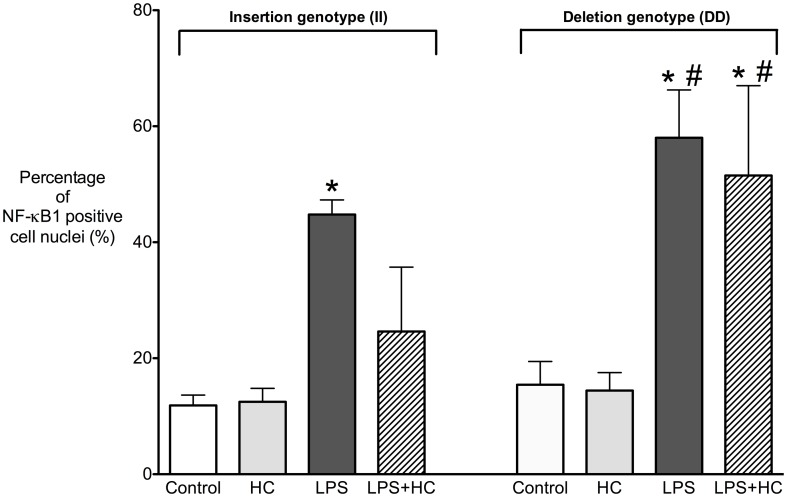
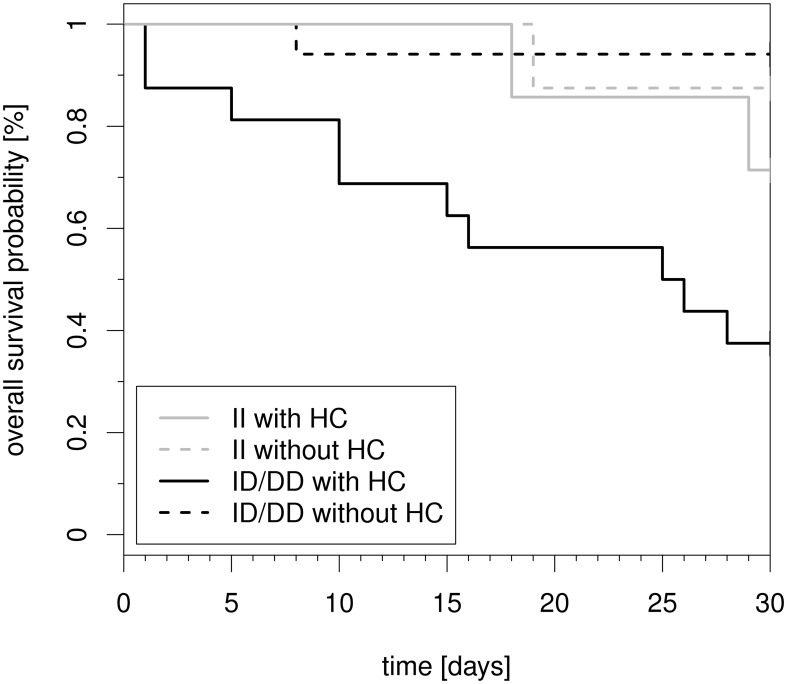
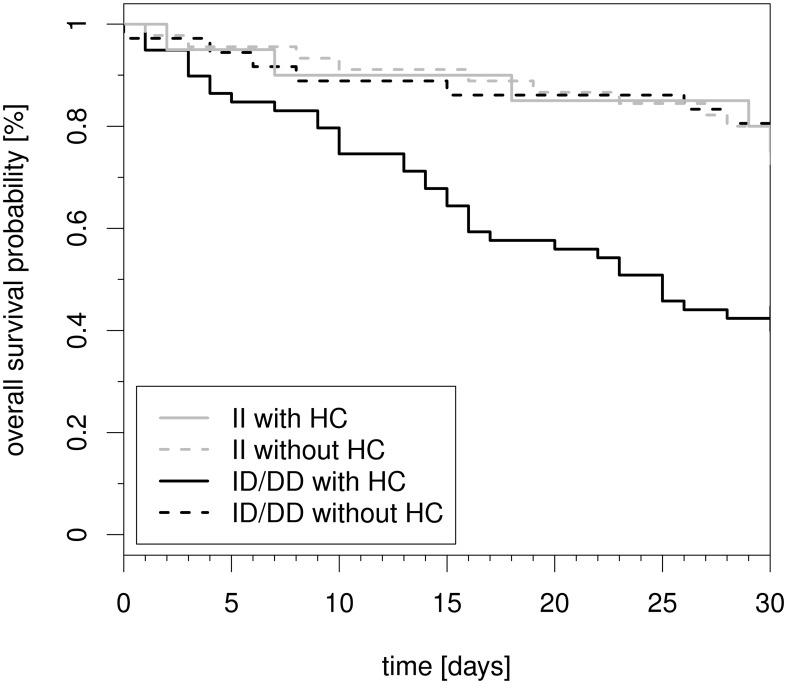
Hydrocortisone inhibited LPS induced nuclear translocation of NF-κB1 in II (25%±11;p = 0.0001) but not in DD genotypes (51%±15;p = n.s.). Onehundredandfour of 160 patients with septic shock received hydrocortisone, at the discretion of the intensivist. NFKB1 deletion allele carriers (ID/DD) receiving hydrocortisone had a much greater 30-day-mortality (57.6%) than II genotypes (24.4%; HR:3.18, 95%-CI:1.61-6.28;p = 0.001). In contrast, 30-day mortality was 22.2% in ID/DD and 25.0% in II genotypes without hydrocortisone therapy. Results were similar when using propensity score matching to account for possible bias in the intensivists' decision to administer hydrocortisone.
Hydrocortisone fails to inhibit LPS induced nuclear NF-κB1 translocation in deletion allele carriers of the NFKB1 promoter polymorphism (-94ins/delATTG). In septic shock, hydrocortisone treatment is associated with markedly increased 30-day-mortality only in such carriers. Accordingly, previous heterogeneous results regarding the benefit of hydrocortisone in septic shock may be reconciled by genetic variation of the NFKB1 promoter polymorphism.
先前关于糖皮质激素对感染性休克死亡率影响的调查和荟萃分析结果不一。这种异质性可能是由基因变异引起的。这样的一个候选基因是编码普遍存在的转录因子核因子-κB(NF-κB)的基因的启动子多态性(-94ins/delATTG),该转录因子可与几种编码先天免疫系统的基因启动子中的识别元件结合。反过来,氢化可的松可抑制NF-κB的核转位,从而抑制关键免疫反应调节因子的转录。因此,我们检验了以下假设:氢化可的松对1)体外脂多糖(LPS)诱导的单核细胞中NF-κB1的核转位以及2)感染性休克的死亡率具有NFKB1基因型依赖性影响。
将纯合插入(II;n = 5)或缺失(DD;n = 6)NFKB1基因型的志愿者的单核细胞与10 µg/ml LPS ± 氢化可的松(10⁻⁵M)一起孵育,并评估NF-κB1的核转位(免疫荧光法)。此外,我们分析了160例感染性休克患者按基因型和氢化可的松治疗分层后的30天死亡率。
氢化可的松可抑制LPS诱导的II基因型(25%±11;p = 0.0001)中NF-κB1的核转位,但不能抑制DD基因型(51%±15;p = 无统计学意义)中的核转位。160例感染性休克患者中有104例由重症监护医生酌情给予了氢化可的松治疗。接受氢化可的松治疗的NFKB1缺失等位基因携带者(ID/DD)的30天死亡率(57.6%)远高于II基因型(24.4%;风险比:3.18,95%置信区间:1.61 - 6.28;p = 0.001)。相比之下,未接受氢化可的松治疗的ID/DD基因型和II基因型的30天死亡率分别为22.2%和25.0%。使用倾向评分匹配来考虑重症监护医生决定给予氢化可的松治疗时可能存在的偏倚时,结果相似。
氢化可的松不能抑制NFKB1启动子多态性(-94ins/delATTG)缺失等位基因携带者中LPS诱导的核NF-κB1转位。在感染性休克中,仅在这些携带者中,氢化可的松治疗与30天死亡率显著增加相关。因此,先前关于氢化可的松在感染性休克中的益处的异质性结果可能通过NFKB1启动子多态性的基因变异得到解释。