Teixeira Priscila Camillo, Ducret Axel, Ferber Philippe, Gaertner Hubert, Hartley Oliver, Pagano Sabrina, Butterfield Michelle, Langen Hanno, Vuilleumier Nicolas, Cutler Paul
From the Pharma Research and Early Development, Roche Innovation Center, 4070 Basel, the Department of Genetics and Laboratory Medicine, Division of Laboratory Medicine, 1205 Geneva University Hospitals, 1205 Geneva, and
From the Pharma Research and Early Development, Roche Innovation Center, 4070 Basel.
J Biol Chem. 2014 Oct 10;289(41):28249-59. doi: 10.1074/jbc.M114.589002. Epub 2014 Aug 28.
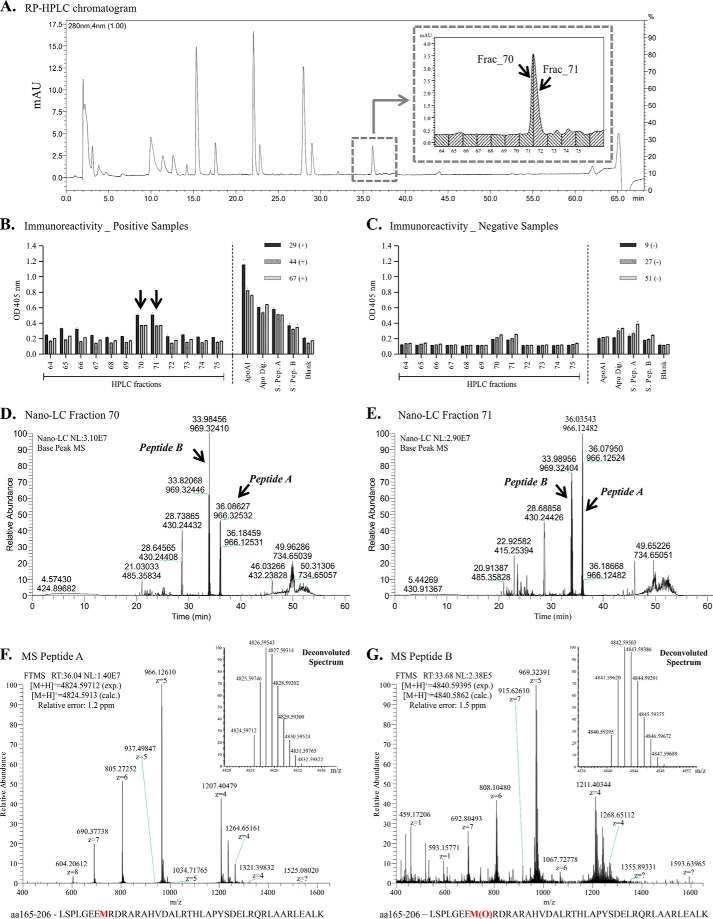
Autoantibodies to apolipoprotein A-I (anti-apoA-I IgG) have been shown to be both markers and mediators of cardiovascular disease, promoting atherogenesis and unstable atherosclerotic plaque. Previous studies have shown that high levels of anti-apoA-I IgGs are independently associated with major adverse cardiovascular events in patients with myocardial infarction. Autoantibody responses to apoA-I can be polyclonal and it is likely that more than one epitope may exist. To identify the specific immunoreactive peptides in apoA-I, we have developed a set of methodologies and procedures to isolate, purify, and identify novel apoA-I endogenous epitopes. First, we generated high purity apoA-I from human plasma, using thiophilic interaction chromatography followed by enzymatic digestion specifically at lysine or arginine residues. Immunoreactivity to the different peptides generated was tested by ELISA using serum obtained from patients with acute myocardial infarction and high titers of autoantibodies to native apoA-I. The immunoreactive peptides were further sequenced by mass spectrometry. Our approach successfully identified two novel immunoreactive peptides, recognized by autoantibodies from patients suffering from myocardial infarction, who contain a high titer of anti-apoA-I IgG. The discovery of these epitopes may open innovative prognostic and therapeutic opportunities potentially suitable to improve current cardiovascular risk stratification.
载脂蛋白A-I自身抗体(抗载脂蛋白A-I IgG)已被证明是心血管疾病的标志物和介质,可促进动脉粥样硬化的形成和不稳定动脉粥样硬化斑块的发展。先前的研究表明,高水平的抗载脂蛋白A-I IgG与心肌梗死患者的主要不良心血管事件独立相关。对载脂蛋白A-I的自身抗体反应可能是多克隆的,并且可能存在不止一个表位。为了鉴定载脂蛋白A-I中的特异性免疫反应性肽段,我们开发了一套方法和程序来分离、纯化和鉴定新的载脂蛋白A-I内源性表位。首先,我们使用嗜硫亲和色谱法从人血浆中制备高纯度的载脂蛋白A-I,然后在赖氨酸或精氨酸残基处进行酶切。使用急性心肌梗死患者的血清和针对天然载脂蛋白A-I的高滴度自身抗体,通过ELISA检测对不同肽段产生的免疫反应性。通过质谱对免疫反应性肽段进行进一步测序。我们的方法成功鉴定出两种新的免疫反应性肽段,它们被心肌梗死患者的自身抗体识别,这些患者含有高滴度的抗载脂蛋白A-I IgG。这些表位的发现可能会带来创新的预后和治疗机会,有可能改善当前的心血管风险分层。