Programa de Pós-Graduação em Ciências da Saúde, Universidade Federal do Amapá, 68903-419 Macapá, Amapá, Brazil.
BMC Ophthalmol. 2014 Aug 31;14:104. doi: 10.1186/1471-2415-14-104.
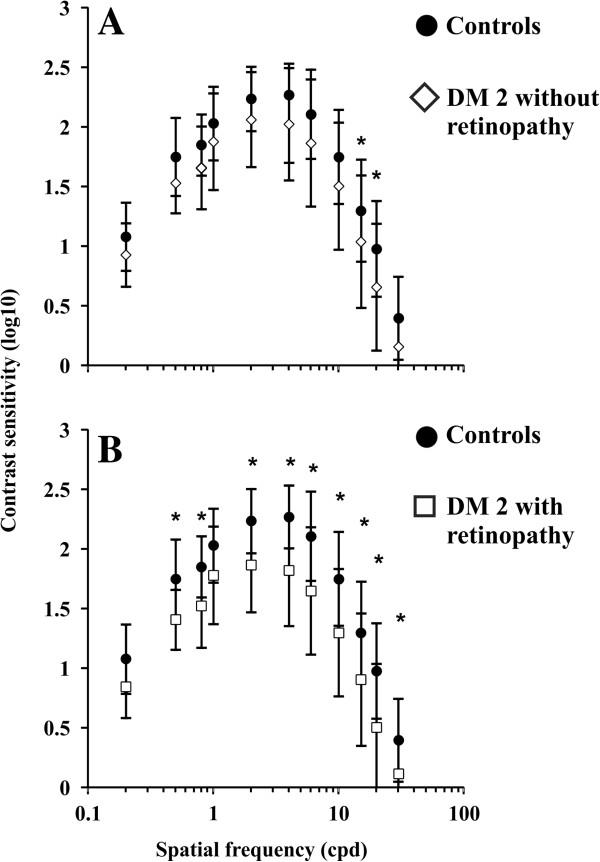
Luminance contrast sensitivity and colour vision are considered to have great predictive value in the evaluation of type 2 diabetic retinopathy. However, these two visual characteristics have seldom been investigated in the same group of patients. In the present study we measured contrast sensitivity and colour vision in a group of patients with type 2 diabetes and correlated the results with estimates of common metabolic markers for the disease. A subgroup of the patients had no clinical signs of retinopathy.
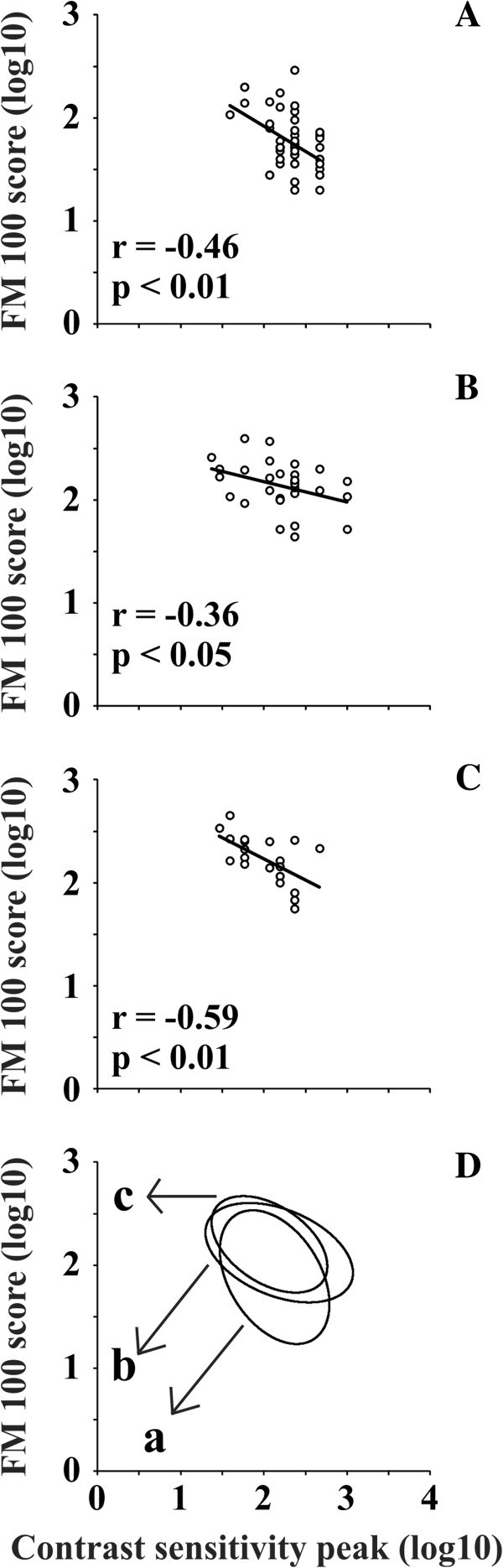
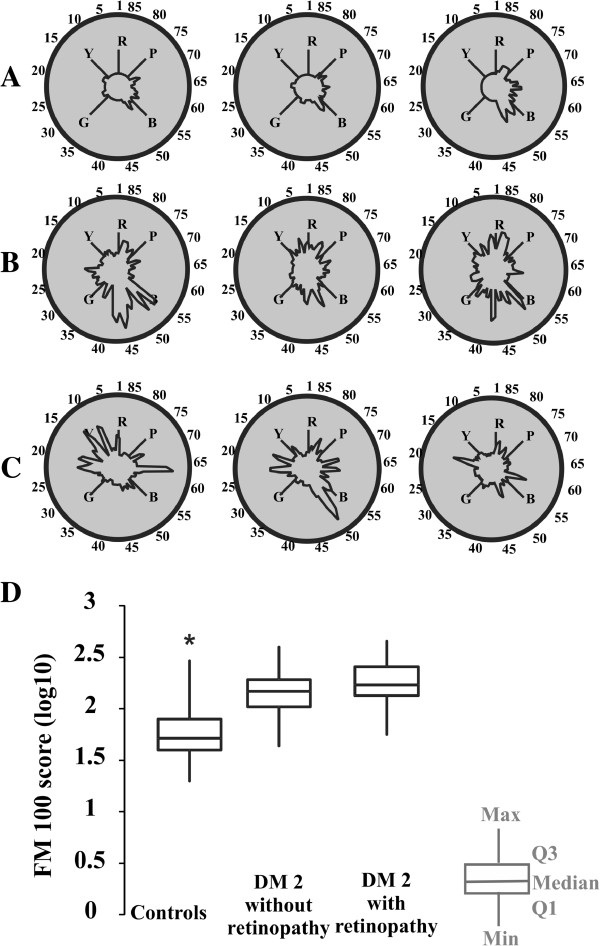
The vision of 27 patients (n = 50 eyes) with type 2 diabetes, with retinopathy (n = 20 eyes), or without retinopathy (n = 30 eyes) were evaluated using two psychophysical tests, the Farnsworth-Munsell 100 hue test (FM 100), and measurements of the luminance contrast sensitivity at 11 spatial frequencies. The results were compared with measurements obtained from an age-matched control group (n = 32), and were correlated with the level of glycated haemoglobin, glycaemic level, and time of disease onset. Signs of retinopathy were identified during the ophthalmological examinations.
Contrast sensitivity and colour vision impairments were present at different levels in diabetes patients. Eyes with retinopathy showed more severe vision loss than eyes without retinopathy. The FM 100 test was more sensitive for separation of patients from controls. Colour vision loss had no colour axes preference. The contrast sensitivity test appeared to have some advantage in differentiating patients with retinopathy from patients without retinopathy.
Both methods can be useful to follow the visual function of diabetic patients and should be used together to discriminate patients from controls, as well as to identify early signs of retinal damage.
亮度对比敏感度和色觉被认为对 2 型糖尿病视网膜病变的评估具有重要的预测价值。然而,这两种视觉特征在同一组患者中很少被同时研究。在本研究中,我们测量了一组 2 型糖尿病患者的对比敏感度和色觉,并将结果与该疾病的常见代谢标志物的估计值相关联。患者的一个亚组没有视网膜病变的临床迹象。
使用两种心理物理学测试评估 27 名(n=50 只眼)2 型糖尿病患者(伴视网膜病变 n=20 只眼,无视网膜病变 n=30 只眼)的视力,分别是 Farnsworth-Munsell 100 色调测试(FM 100)和 11 个空间频率的亮度对比敏感度测量。将结果与年龄匹配的对照组(n=32)的测量结果进行比较,并与糖化血红蛋白水平、血糖水平和疾病发病时间相关联。在眼科检查中发现了视网膜病变的迹象。
糖尿病患者的对比敏感度和色觉损伤程度不同。有视网膜病变的眼睛比没有视网膜病变的眼睛视力下降更严重。FM 100 测试在区分患者和对照组方面更敏感。色觉损失没有颜色轴偏好。对比敏感度测试似乎在区分有视网膜病变和无视网膜病变的患者方面具有一些优势。
这两种方法都可以用于监测糖尿病患者的视觉功能,应一起使用,以区分患者和对照组,并识别视网膜损伤的早期迹象。