Fontolan L, Morillon B, Liegeois-Chauvel C, Giraud Anne-Lise
1] Department of Neuroscience, University of Geneva, Biotech Campus, 9, Chemin des Mines, Geneva 1211, Switzerland [2].
1] Department of Psychiatry, Columbia University Medical Center, New York, New York 10032, USA [2].
Nat Commun. 2014 Sep 2;5:4694. doi: 10.1038/ncomms5694.
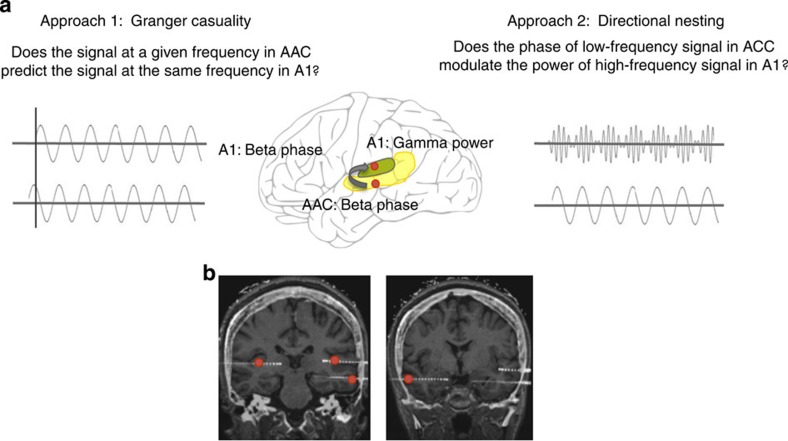
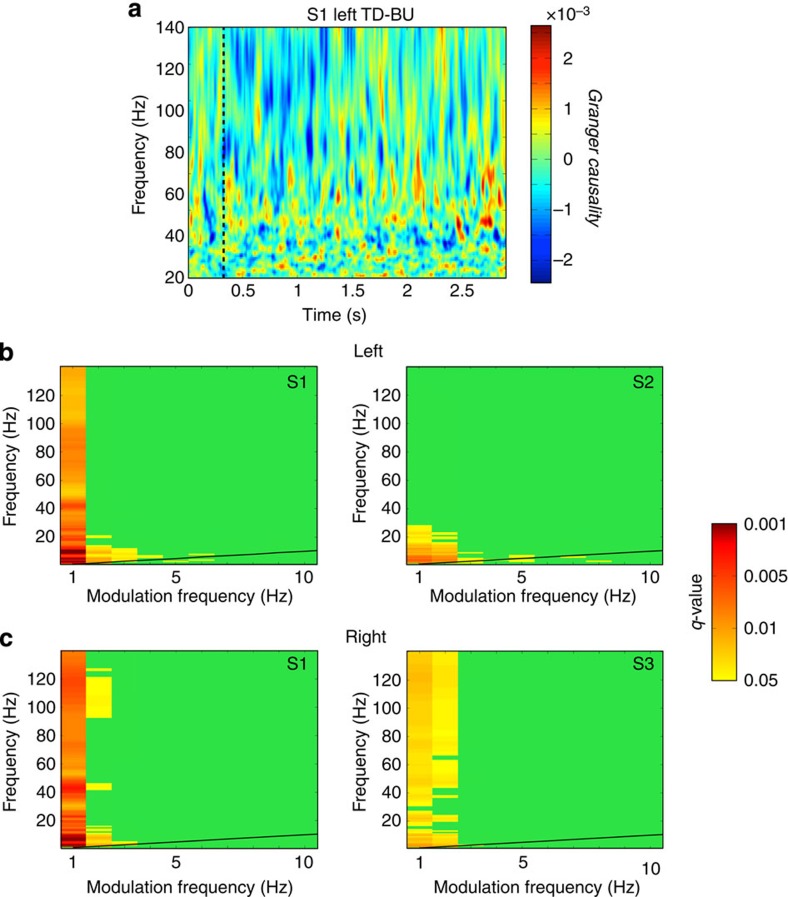
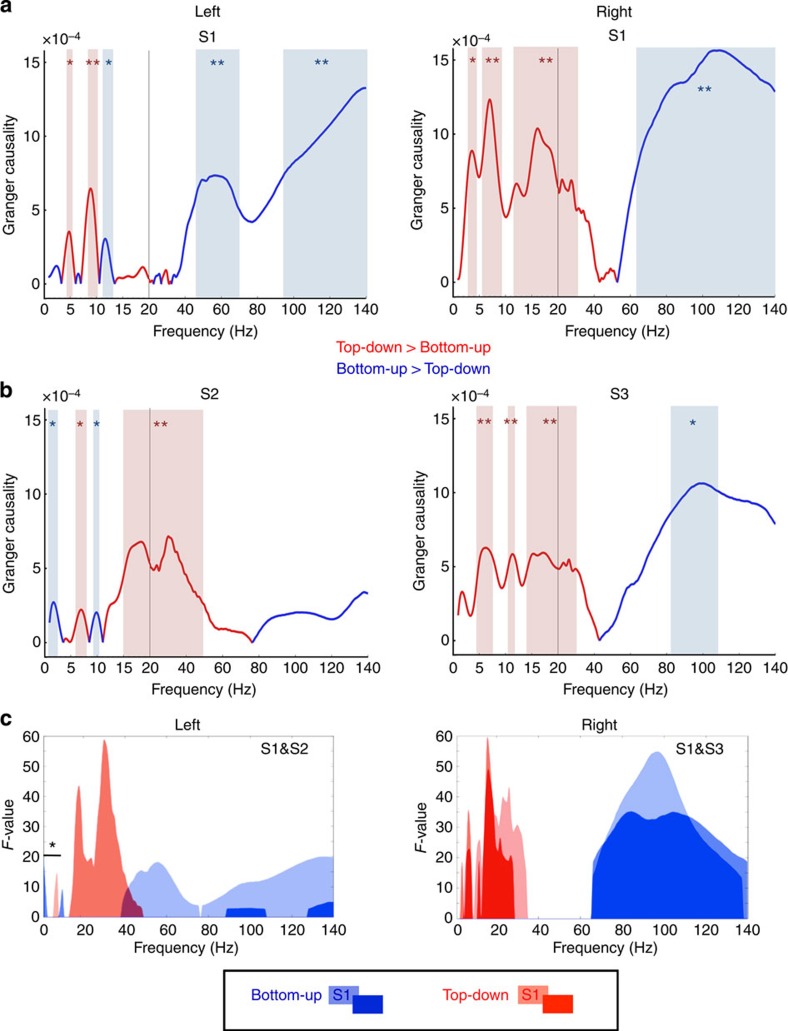
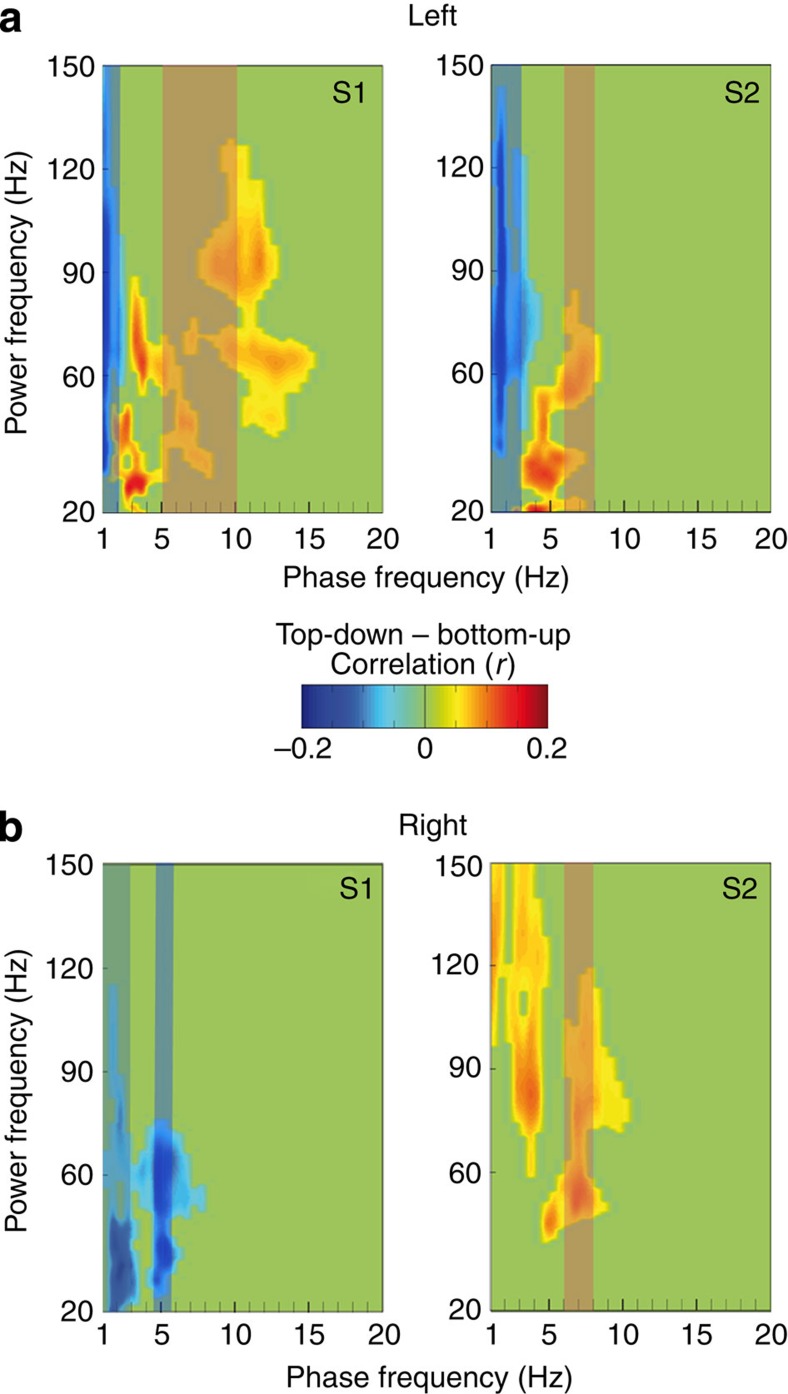
The fact that feed-forward and top-down propagation of sensory information use distinct frequency bands is an appealing assumption for which evidence remains scarce. Here we obtain human depth recordings from two auditory cortical regions in both hemispheres, while subjects listen to sentences, and show that information travels in each direction using separate frequency channels. Bottom-up and top-down propagation dominates in γ- and δ-β (<40 Hz) bands, respectively. The predominance of low frequencies for top-down information transfer is confirmed by cross-regional frequency coupling, which indicates that the power of γ-activity in A1 is modulated by the phase of δ-β activity sampled from association auditory cortex (AAC). This cross-regional coupling effect is absent in the opposite direction. Finally, we show that information transfer does not proceed continuously but by time windows where bottom-up or top-down processing alternatively dominates. These findings suggest that the brain uses both frequency- and time-division multiplexing to optimize directional information transfer.
感觉信息的前馈和自上而下传播使用不同频段这一事实,是一个引人关注的假设,但相关证据仍然稀少。在这里,我们在受试者听句子时,从两个半球的听觉皮层区域获取了人类深度记录,并表明信息在每个方向上通过单独的频率通道传播。自下而上和自上而下的传播分别在γ频段和δ-β(<40Hz)频段占主导。跨区域频率耦合证实了低频在自上而下信息传递中的优势,这表明初级听觉皮层(A1)中γ活动的功率受到从联合听觉皮层(AAC)采样的δ-β活动相位的调制。在相反方向上不存在这种跨区域耦合效应。最后,我们表明信息传递不是连续进行的,而是通过自下而上或自上而下处理交替占主导的时间窗口进行的。这些发现表明,大脑利用频率和时分复用技术来优化定向信息传递。