Kenney Shannon R, Napper Lucy E, LaBrie Joseph W
Department of Psychology, Loyola Marymount University , Los Angeles, CA , USA.
Am J Drug Alcohol Abuse. 2014 Sep;40(5):388-94. doi: 10.3109/00952990.2014.920849.
Participation in drinking games is associated with excessive drinking and alcohol risks. Despite the growing literature documenting the ubiquity and consequences of drinking games, limited research has examined the influence of psychosocial factors on the experience of negative consequences as the result of drinking game participation.
The current event-level study examined the relationships among drinking game participation, social anxiety, drinking refusal self-efficacy (DRSE) and alcohol-related consequences in a sample of college students.
Participants (n = 976) reported on their most recent drinking occasion in the past month in which they did not preparty.
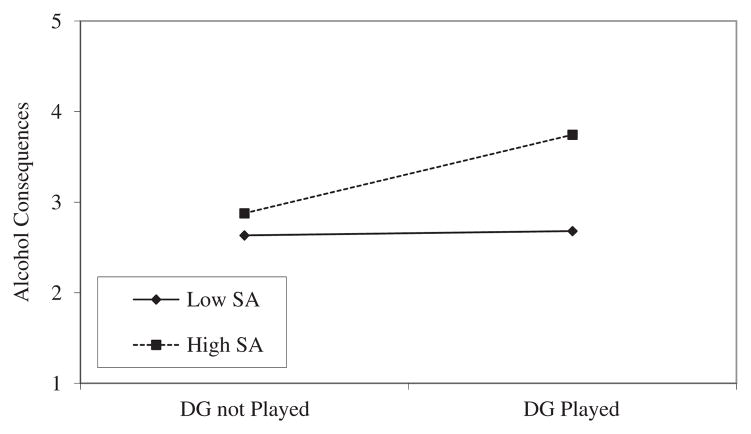
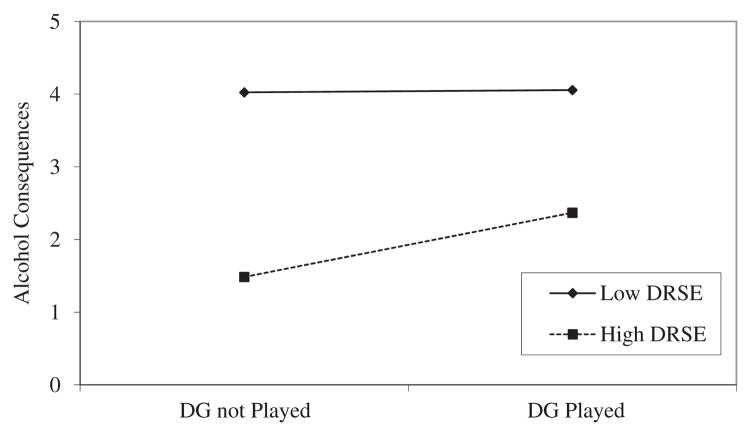
After controlling for sex, age, and typical drinking, higher levels of social anxiety, lower levels of DRSE, and playing drinking games predicted greater alcohol-related consequences. Moreover, two-way interactions (Social Anxiety × Drinking Games, DRSE × Drinking Games) demonstrated that social anxiety and DRSE each moderated the relationship between drinking game participation and alcohol-related consequences. Participation in drinking games resulted in more alcohol problems for students with high social anxiety, but not low social anxiety. Students with low DRSE experienced high levels of consequences regardless of whether they participated in drinking games; however, drinking game participation was associated with more consequences for students confident in their ability to resist drinking.
Findings highlight the important role that social anxiety and DRSE play in drinking game-related risk, and hence provide valuable implications for screening at-risk students and designing targeted harm reduction interventions that address social anxiety and drink refusal in the context of drinking games.
参与饮酒游戏与过度饮酒及酒精相关风险有关。尽管有越来越多的文献记录了饮酒游戏的普遍性及其后果,但对于心理社会因素对因参与饮酒游戏而产生负面后果体验的影响,相关研究却很有限。
当前的事件层面研究考察了大学生样本中饮酒游戏参与、社交焦虑、饮酒拒绝自我效能感(DRSE)与酒精相关后果之间的关系。
参与者(n = 976)报告了他们过去一个月内最近一次未提前饮酒的饮酒场合。
在控制了性别、年龄和典型饮酒量后,社交焦虑水平较高、DRSE水平较低以及玩饮酒游戏都预示着更大的酒精相关后果。此外,双向交互作用(社交焦虑×饮酒游戏、DRSE×饮酒游戏)表明,社交焦虑和DRSE均调节了饮酒游戏参与与酒精相关后果之间的关系。对于社交焦虑程度高的学生,参与饮酒游戏会导致更多的酒精问题,而社交焦虑程度低的学生则不然。无论是否参与饮酒游戏,DRSE水平低的学生都会经历较高程度的后果;然而,对于有信心拒绝饮酒的学生,参与饮酒游戏与更多后果相关。
研究结果突出了社交焦虑和DRSE在与饮酒游戏相关风险中所起的重要作用,因此为筛查高危学生以及设计有针对性的减少伤害干预措施提供了有价值的启示,这些干预措施在饮酒游戏背景下解决社交焦虑和饮酒拒绝问题。