Alcover M Magdalena, Ballart Cristina, Martín-Sánchez Joaquina, Serra Teresa, Castillejo Soledad, Portús Montserrat, Gállego Montserrat
Laboratori de Parasitologia, Facultat de Farmàcia, Universitat de Barcelona (Spain), Barcelona, Spain.
Parasit Vectors. 2014 Sep 4;7:421. doi: 10.1186/1756-3305-7-421.
Although the Mediterranean island of Majorca is an endemic area of leishmaniosis, there is a lack of up-to-date data on its sand fly fauna, the last report dating from 1989. The aim of the present study was to provide information on the current sand fly distribution, the potential environmental factors favoring the presence of Phlebotomus perniciosus and which areas are at risk of leishmaniosis.
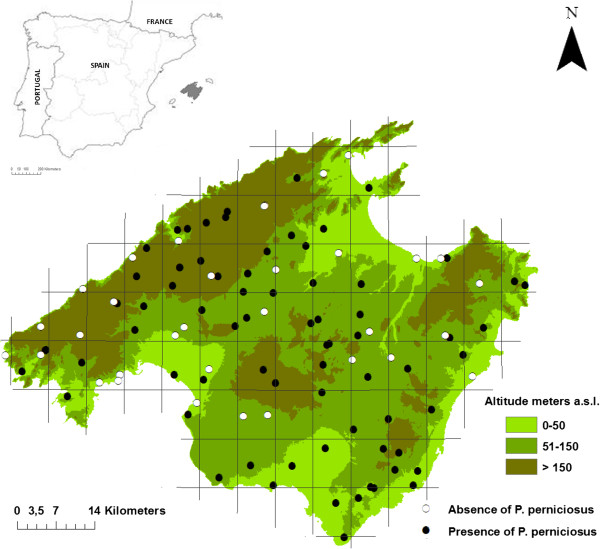
In July 2008 sand fly captures were carried out in Majorca with sticky castor oil interception traps. The capture stations were distributed in 77 grids (5x5 km2) covering the entire island. A total of 1,882 sticky traps were set among 111 stations. The characteristics of the stations were recorded and maps were designed using ArcGIS 9.2 software. The statistical analysis was carried out using a bivariate and multivariate logistic regression model.
The sand fly fauna of Majorca is composed of 4 species: Phlebotomus perniciosus, P sergenti, P. papatasi and Sergentomyia minuta. P. perniciosus, responsible for Leishmania infantum transmission, was captured throughout the island (frequency 69.4 %), from 6 to 772 m above sea level. Through logistic regression we estimated the probability of P. perniciosus presence at each sampling site as a function of environmental and meteorological factors. Although in the initial univariate analyses the probability of P. perniciosus presence appeared to be associated with a wide variety of factors, in the multivariate logistic regression model only altitude, settlement, aspect, drainage hole construction, adjacent flora and the proximity of a sheep farm were retained as positive predictors of the distribution of this species.
P. perniciosus was present throughout the island, and thereby the risk of leishmaniosis transmission. The probability of finding P. perniciosus was higher at altitudes ranging from 51 to 150 m.a.s.l., with adjacent garrigue shrub vegetation, at the edge of or between settlements, and in proximity to a sheep farm.
尽管地中海的马略卡岛是利什曼病的流行地区,但关于其白蛉种类的最新数据却很缺乏,上一次报告可追溯到1989年。本研究的目的是提供有关当前白蛉分布、有利于嗜人按蚊存在的潜在环境因素以及哪些地区存在利什曼病风险的信息。
2008年7月,在马略卡岛使用粘性蓖麻油拦截诱捕器对白蛉进行捕捉。捕捉站分布在覆盖全岛的77个网格(5×5平方公里)中。在111个站点共设置了1882个粘性诱捕器。记录了站点的特征,并使用ArcGIS 9.2软件绘制了地图。使用二元和多元逻辑回归模型进行统计分析。
马略卡岛的白蛉种类由4种组成:嗜人按蚊、赛氏按蚊、巴氏按蚊和微小司蛉。传播婴儿利什曼原虫的嗜人按蚊在全岛均有捕获(频率为69.4%),海拔高度从6米至772米。通过逻辑回归,我们估计了每个采样点嗜人按蚊存在的概率与环境和气象因素的函数关系。尽管在最初的单变量分析中,嗜人按蚊存在的概率似乎与多种因素有关,但在多元逻辑回归模型中,只有海拔、定居点、坡向、排水孔建设、相邻植物群和养羊场的 proximity 被保留为该物种分布的正向预测因子。
嗜人按蚊遍布全岛,因此存在利什曼病传播的风险。在海拔51至150米、有相邻的地中海常绿矮灌木丛植被、位于定居点边缘或之间以及靠近养羊场的地方,发现嗜人按蚊的概率更高。