Armato E, Ferri E, Pinzani A, Ulmer E
Department of Otorhinolaryngology, Hospitals of Mirano and Dolo (Venice), Italy;
Department of Radiology, Hospital of Dolo (Venice), Italy;
Acta Otorhinolaryngol Ital. 2014 Aug;34(4):288-91.
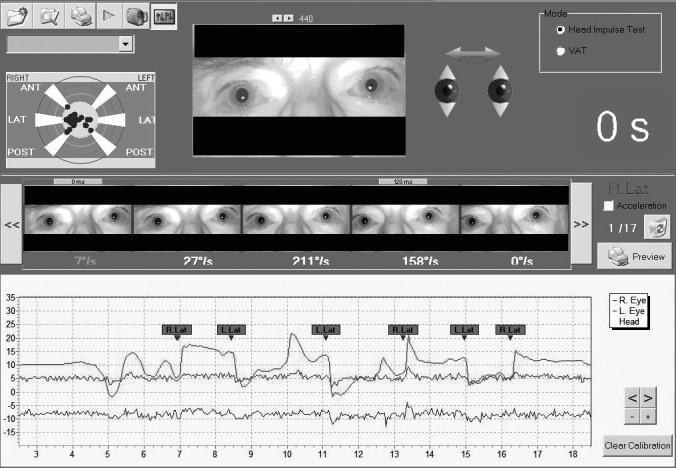
Dizziness and vertigo without neurological signs are typically due to a peripheral vestibular disease. Although the most common causes are benign, differential diagnosis must include potentially life-threatening central diseases such as cerebrovascular pathologies. A systemic clinical approach needs a careful work-up, bedside examination and appropriate instrumental investigation. The head impulse test (HIT) allows qualitative clinical assessment of canalar function; it has some limitations such as subjective evaluation, mainly in patients with a spontaneous nystagmus. A new device has been recently developed consisting of an infrared video camera (video-HIT) to provide quantitative instrumental assessment of the high-frequency vestibular-ocular reflex (VOR) gain. By reporting a case of cerebellar haemorrhage mimicking an acute peripheral vestibulopathy, the authors suggest that video-HIT may be considered a useful tool in differential diagnosis between vestibular neuritis and cerebellar vascular disease in patients with severe acute vertigo without central signs.
无神经体征的头晕和眩晕通常归因于外周前庭疾病。尽管最常见的病因是良性的,但鉴别诊断必须包括潜在危及生命的中枢性疾病,如脑血管病变。系统的临床方法需要仔细的检查、床边检查和适当的器械检查。摇头试验(HIT)可对半规管功能进行定性临床评估;它有一些局限性,如主观评估,主要是在有自发性眼球震颤的患者中。最近开发了一种新设备,由红外摄像机组成(视频HIT),以提供高频前庭眼反射(VOR)增益的定量器械评估。通过报告一例模仿急性外周前庭病的小脑出血病例,作者表明视频HIT可被视为在无中枢体征的严重急性眩晕患者中鉴别前庭神经炎和小脑血管疾病的有用工具。