Benden Mark E, Zhao Hongwei, Jeffrey Christina E, Wendel Monica L, Blake Jamilia J
School of Public Health, Texas A&M University Health Science Center, 1266 TAMU, College Station, TX 77843, USA.
Department of Educational Psychology, Texas A&M University, 4225 TAMU, College Station, TX 77843, USA.
Int J Environ Res Public Health. 2014 Sep 10;11(9):9361-75. doi: 10.3390/ijerph110909361.
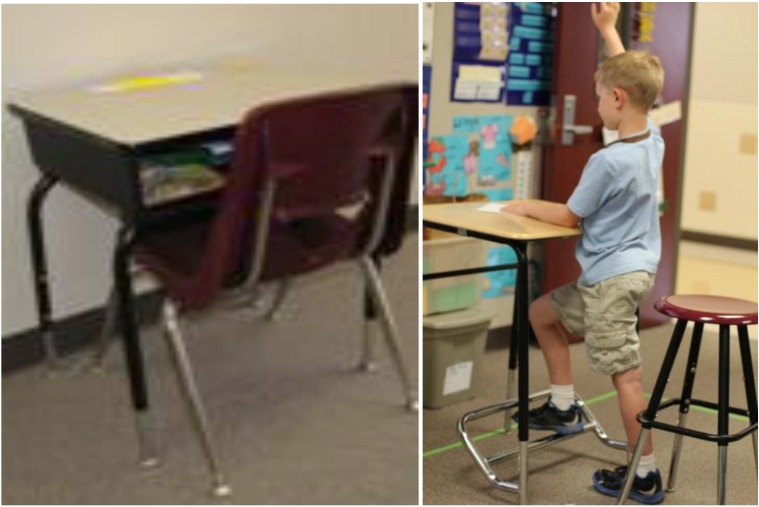
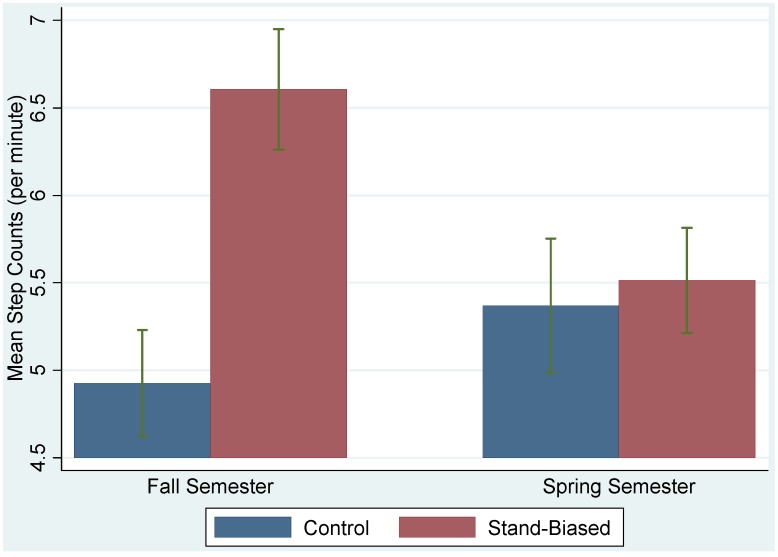
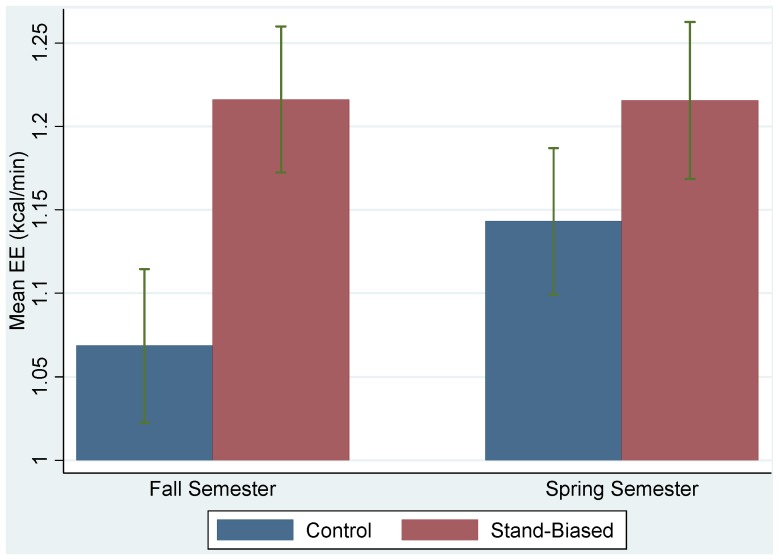
Due to the increasing prevalence of childhood obesity, the association between classroom furniture and energy expenditure as well as physical activity was examined using a standing-desk intervention in three central-Texas elementary schools. Of the 480 students in the 24 classrooms randomly assigned to either a seated or stand-biased desk equipped classroom, 374 agreed to participate in a week-long data collection during the fall and spring semesters. Each participant's data was collected using Sensewear® armbands and was comprised of measures of energy expenditure (EE) and step count. A hierarchical linear mixed effects model showed that children in seated desk classrooms had significantly lower (EE) and fewer steps during the standardized lecture time than children in stand-biased classrooms after adjusting for grade, race, and gender. The use of a standing desk showed a significant higher mean energy expenditure by 0.16 kcal/min (p < 0.0001) in the fall semester, and a higher EE by 0.08 kcal/min (p = 0.0092) in the spring semester.
由于儿童肥胖现象日益普遍,在德克萨斯州中部的三所小学中,通过一项站立式课桌干预措施,研究了教室家具与能量消耗以及身体活动之间的关联。在随机分配到配备坐姿或偏向站立式课桌教室的24间教室的480名学生中,有374名学生同意在秋季和春季学期参与为期一周的数据收集。使用Sensewear®臂带收集了每位参与者的数据,这些数据包括能量消耗(EE)和步数测量。一个分层线性混合效应模型显示,在调整了年级、种族和性别因素后,与偏向站立式课桌教室的儿童相比,坐姿课桌教室的儿童在标准化讲座时间内的能量消耗显著更低,步数也更少。在秋季学期,使用站立式课桌的平均能量消耗显著更高,高出0.16千卡/分钟(p < 0.0001),在春季学期,能量消耗高出0.08千卡/分钟(p = 0.0092)。