Tun Aung Win, Chaiyarit Sakdithep, Kaewsutthi Supannee, Katanyoo Wanphen, Chuenkongkaew Wanicha, Kuwano Masayoshi, Tomonaga Takeshi, Peerapittayamongkol Chayanon, Thongboonkerd Visith, Lertrit Patcharee
Department of Biochemistry, Faculty of Medicine Siriraj Hospital, Mahidol University, Bangkok, Thailand.
Medical Proteomics Unit, Office for Research and Development, Faculty of Medicine Siriraj Hospital, Mahidol University, Bangkok, Thailand.
PLoS One. 2014 Sep 12;9(9):e106779. doi: 10.1371/journal.pone.0106779. eCollection 2014.
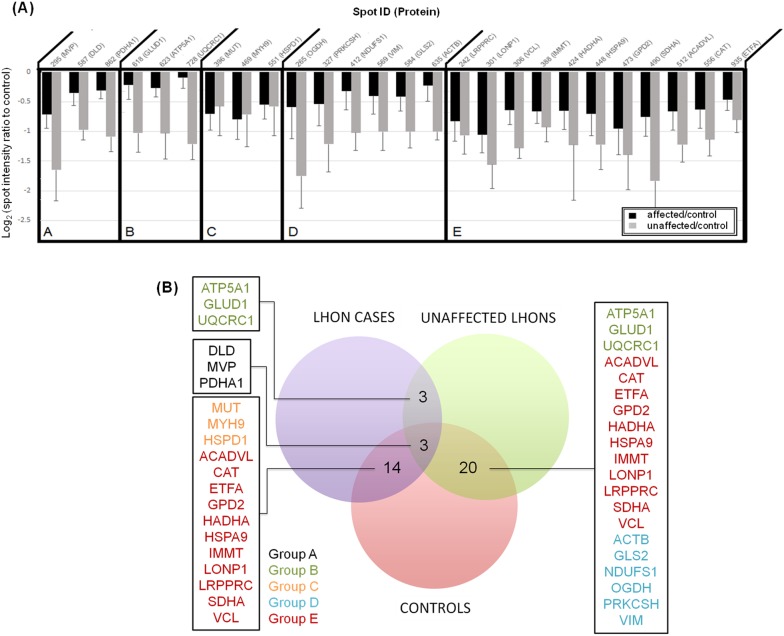
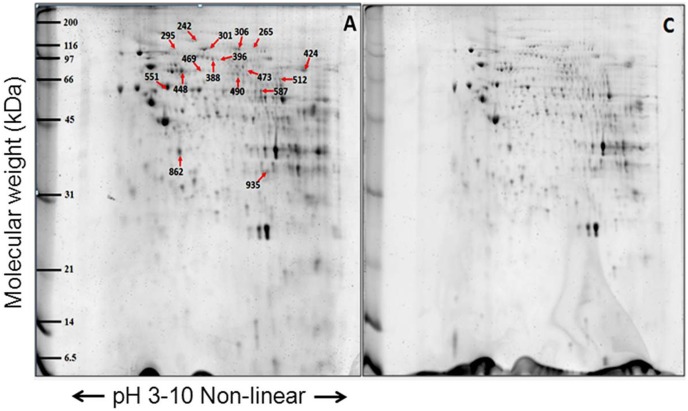
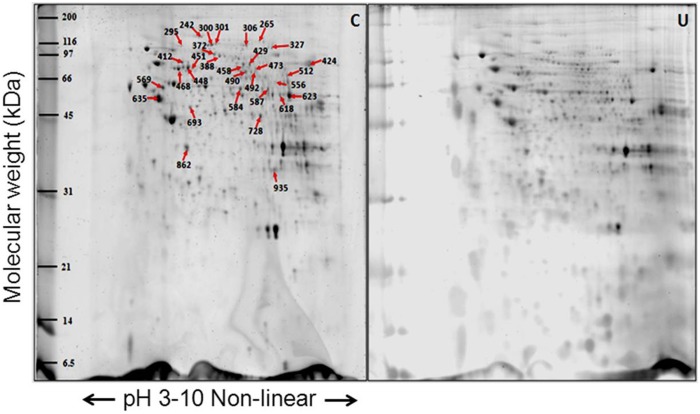
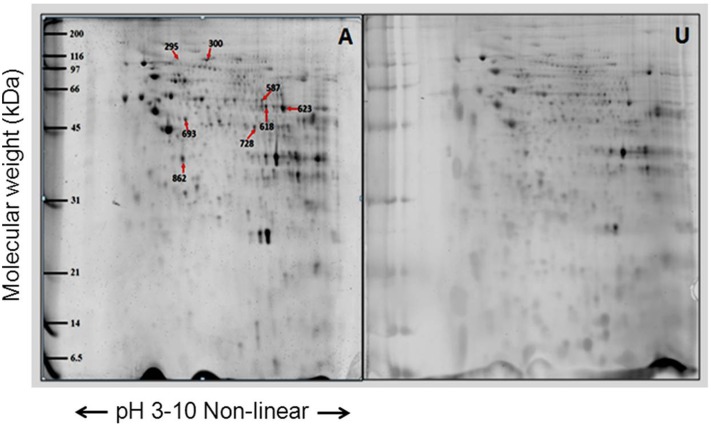
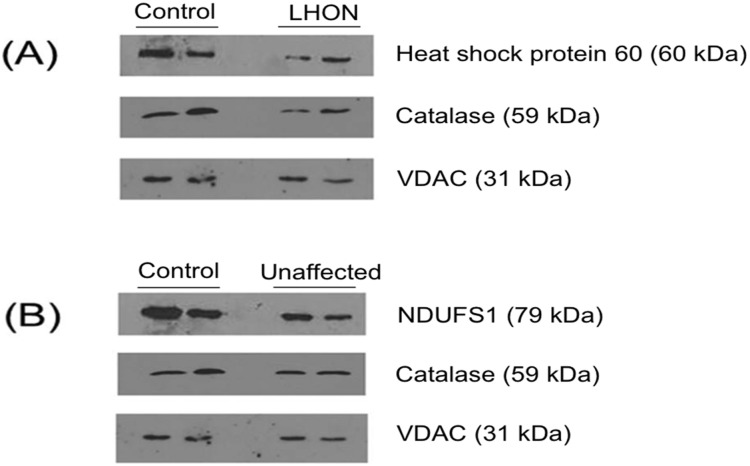
Leber's Hereditary Optic Neuropathy (LHON) is one of the commonest mitochondrial diseases. It causes total blindness, and predominantly affects young males. For the disease to develop, it is necessary for an individual to carry one of the primary mtDNA mutations 11778G>A, 14484T>C or 3460G>A. However these mutations are not sufficient to cause disease, and they do not explain the characteristic features of LHON such as the higher prevalence in males, incomplete penetrance, and relatively later age of onset. In order to explore the roles of nuclear encoded mitochondrial proteins in development of LHON, we applied a proteomic approach to samples from affected and unaffected individuals from 3 pedigrees and from 5 unrelated controls. Two-dimensional electrophoresis followed by MS/MS analysis in the mitochondrial lysate identified 17 proteins which were differentially expressed between LHON cases and unrelated controls, and 24 proteins which were differentially expressed between unaffected relatives and unrelated controls. The proteomic data were successfully validated by western blot analysis of 3 selected proteins. All of the proteins identified in the study were mitochondrial proteins and most of them were down regulated in 11778G>A mutant fibroblasts. These proteins included: subunits of OXPHOS enzyme complexes, proteins involved in intermediary metabolic processes, nucleoid related proteins, chaperones, cristae remodelling proteins and an anti-oxidant enzyme. The protein profiles of both the affected and unaffected 11778G>A carriers shared many features which differed from those of unrelated control group, revealing similar proteomic responses to 11778G>A mutation in both affected and unaffected individuals. Differentially expressed proteins revealed two broad groups: a cluster of bioenergetic pathway proteins and a cluster involved in protein quality control system. Defects in these systems are likely to impede the function of retinal ganglion cells, and may lead to the development of LHON in synergy with the primary mtDNA mutation.
莱伯遗传性视神经病变(LHON)是最常见的线粒体疾病之一。它会导致完全失明,且主要影响年轻男性。个体要患上这种疾病,必须携带原发性线粒体DNA(mtDNA)突变之一,即11778G>A、14484T>C或3460G>A。然而,这些突变并不足以引发疾病,也无法解释LHON的特征,比如男性患病率较高、不完全外显率以及相对较晚的发病年龄。为了探究核编码线粒体蛋白在LHON发病过程中的作用,我们对来自3个家系的患病个体和未患病个体以及5名无关对照的样本采用了蛋白质组学方法。在线粒体裂解物中进行二维电泳,随后进行串联质谱(MS/MS)分析,结果鉴定出17种在LHON病例与无关对照之间差异表达的蛋白质,以及24种在未患病亲属与无关对照之间差异表达的蛋白质。通过对3种选定蛋白质进行蛋白质免疫印迹分析,成功验证了蛋白质组学数据。该研究中鉴定出的所有蛋白质均为线粒体蛋白,其中大多数在11778G>A突变的成纤维细胞中表达下调。这些蛋白质包括:氧化磷酸化酶复合物的亚基、参与中间代谢过程的蛋白质、类核相关蛋白质、伴侣蛋白、嵴重塑蛋白以及一种抗氧化酶。11778G>A携带者中患病和未患病个体的蛋白质谱具有许多与无关对照组不同的特征,这表明患病和未患病个体对11778G>A突变具有相似的蛋白质组学反应。差异表达的蛋白质可分为两大类:一组是生物能量代谢途径蛋白,另一组是参与蛋白质质量控制系统的蛋白。这些系统的缺陷可能会阻碍视网膜神经节细胞的功能,并可能与原发性mtDNA突变协同作用,导致LHON的发生。