Cahill Lindsay S, Laliberté Christine L, Liu Xue Jun, Bishop Jonathan, Nieman Brian J, Mogil Jeffrey S, Sorge Robert E, Jones Catherine D, Salter Michael W, Henkelman R Mark
Mouse Imaging Centre, Hospital for Sick Children, 25 Orde Street, Toronto, Ontario, Canada.
Mol Pain. 2014 Sep 13;10:60. doi: 10.1186/1744-8069-10-60.
Genetic polymorphisms, gender and age all influence the risk of developing chronic neuropathic pain following peripheral nerve injury (PNI). It is known that there are significant inter-strain differences in pain hypersensitivity in strains of mice after PNI. In response to PNI, one of the earliest events is thought to be the disruption of the blood-spinal cord barrier (BSCB). The study of BSCB integrity after PNI may lead to a better understanding of the mechanisms that contribute to chronic pain.
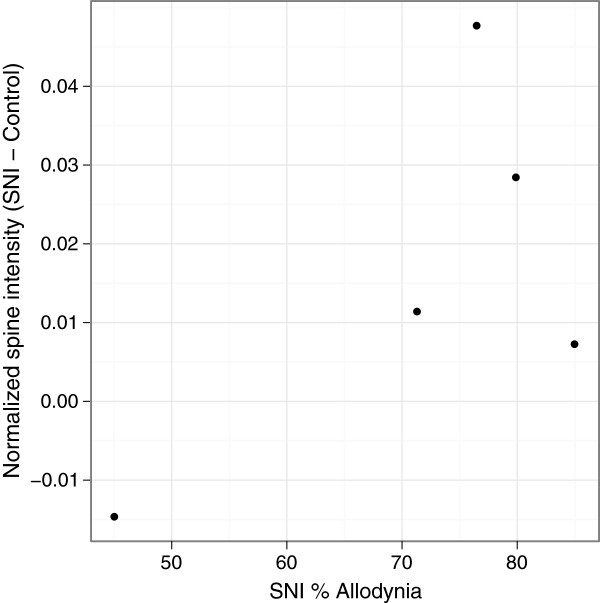
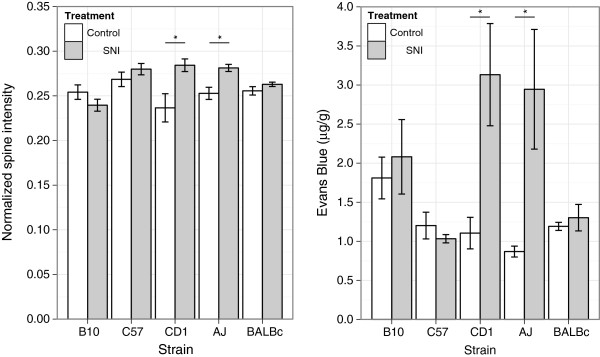
Here we used in vivo dynamic contrast-enhanced magnetic resonance imaging (DCE-MRI) to establish a timecourse for BSCB permeability following PNI, produced by performing a spared nerve injury (SNI). From this longitudinal study, we found that the SNI group had a significant increase in BSCB permeability over time throughout the entire spinal cord. The BSCB opening had a delayed onset and the increase in permeability was transient, returning to control levels just over one day after the surgery. We also examined inter-strain differences in BSCB permeability using five mouse strains (B10, C57BL/6J, CD-1, A/J and BALB/c) that spanned the range of pain hypersensitivity. We found a significant increase in BSCB permeability in the SNI group that was dependent on strain but that did not correlate with the reported strain differences in PNI-induced tactile hypersensitivity. These results were consistent with a previous experiment using Evans Blue dye to independently assess the status of the BSCB permeability.
DCE-MRI provides a sensitive and non-invasive method to follow BSCB permeability in the same group of mice over time. Examining differences between mouse strains, we demonstrated that there is an important genetically-based control of the PNI-induced increase in BSCB permeability and that the critical genetic determinants of BSCB opening after PNI are distinct from those that determine genetic variability in PNI-induced pain hypersensitivity.
基因多态性、性别和年龄都会影响外周神经损伤(PNI)后发生慢性神经性疼痛的风险。已知在PNI后的小鼠品系中,疼痛超敏反应存在显著的品系间差异。对PNI的反应中,最早发生的事件之一被认为是血脊髓屏障(BSCB)的破坏。研究PNI后BSCB的完整性可能有助于更好地理解导致慢性疼痛的机制。
在此,我们使用体内动态对比增强磁共振成像(DCE-MRI),通过进行保留神经损伤(SNI)来建立PNI后BSCB通透性随时间变化的过程。从这项纵向研究中,我们发现SNI组在整个脊髓中,BSCB通透性随时间显著增加。BSCB开放有延迟发作,通透性增加是短暂的,在手术后一天多一点就恢复到对照水平。我们还使用了五个跨越疼痛超敏反应范围的小鼠品系(B10、C57BL/6J、CD-1、A/J和BALB/c)来研究BSCB通透性的品系间差异。我们发现SNI组中BSCB通透性显著增加,这取决于品系,但与报道的PNI诱导的触觉超敏反应中的品系差异无关。这些结果与先前使用伊文思蓝染料独立评估BSCB通透性状态的实验一致。
DCE-MRI提供了一种敏感且非侵入性的方法,可随时间跟踪同一组小鼠的BSCB通透性。通过检查小鼠品系之间的差异,我们证明了PNI诱导的BSCB通透性增加存在基于基因的重要调控,并且PNI后BSCB开放的关键基因决定因素与那些决定PNI诱导的疼痛超敏反应中基因变异性的因素不同。