Raes Patricia, Bauer Daniel, Schöppe Franziska, Fischer Martin R
Ludwig Maximilian University of Munich, Faculty of Medicine, Office of the Dean, Munich, Germany.
Clinic of the Ludwig Maximilian University of Munich, Institute for Medical Education, Munich, Germany.
GMS Z Med Ausbild. 2014 Aug 15;31(3):Doc28. doi: 10.3205/zma000920. eCollection 2014.
Medical education is gaining in significance internationally. A growing interest in the field has been observed in German-speaking countries (Austria, Germany, Switzerland) since the early 2000s. This interest is not, however, reflected in an increase in the number of publications on medical education of German-speaking authors in international professional journals. The following investigation examines the potential use of active participant numbers of German-speaking researchers at AMEE conferences as a means of measuring said development.
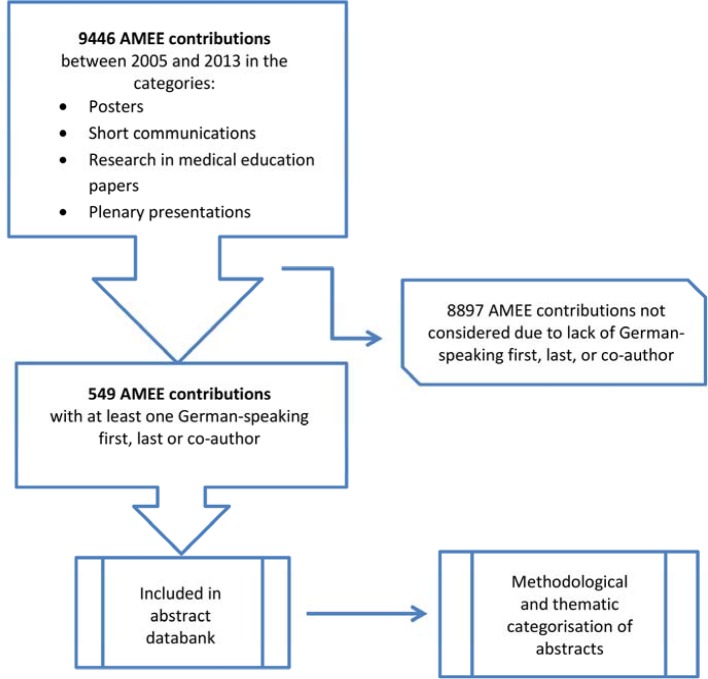
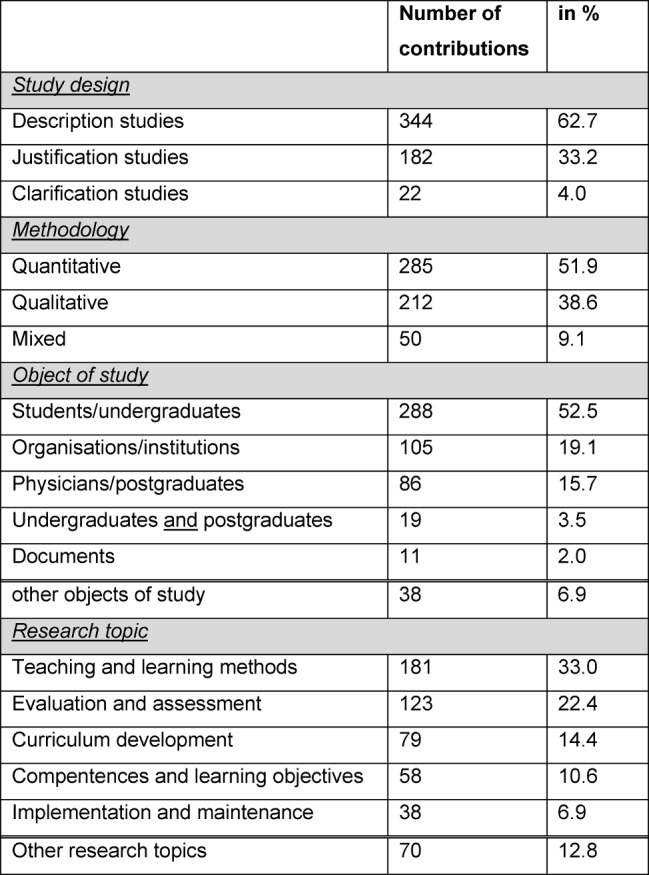
The AMEE conference proceedings from the categories poster presentations, short communications, research papers and plenary presentations from the years 2005-2013 were examined for evidence of Austrian, German and Swiss participation. The abstracts were subsequently analysed in terms of content and categorised according to study design, methodology, object of study, and research topic.
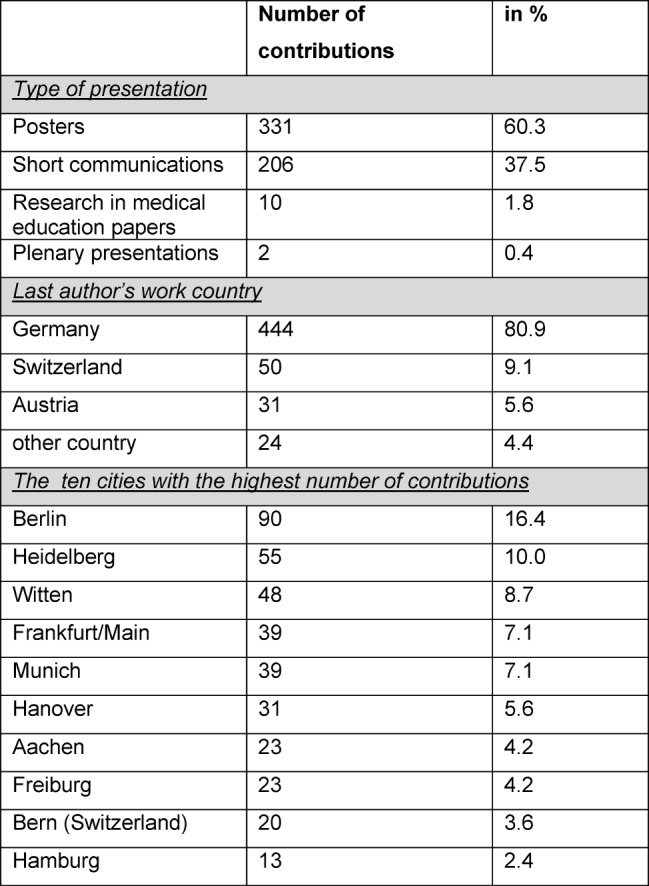
Of the 9,446 analysed abstracts, 549 contributions show at least one first, last or co-author from Austria, Germany or Switzerland. The absolute number of contributions per conference varied between 44 in 2010 and 77 in 2013. The percentage fluctuated between 10% in 2005 and 4.1% in 2010. From the year 2010 onwards, however, participation increased continually. The research was predominantly descriptive (62.7%). Studies on fundamental questions of teaching and learning (clarification studies) were less frequent (4.0%). For the most part, quantitative methods (51.9%) were implemented in addressing subjects such as learning and teaching methods (33%), evaluation and assessment (22.4%) or curriculum development (14.4%). The study population was usually comprised of students (52.5%).
The number of contributions from Austria, Germany and Switzerland peak at the beginning and at the end of the evaluated period of time. A continual increase in active participation since 2005 was not observed. These observations do not reflect the actual increase of interest in medical education research in German-speaking countries.
医学教育在国际上的重要性日益凸显。自21世纪初以来,德语国家(奥地利、德国、瑞士)对该领域的兴趣与日俱增。然而,这种兴趣并未反映在国际专业期刊上德语作者关于医学教育的出版物数量的增加上。以下调查探讨了将参加AMEE会议的德语研究人员的实际参会人数作为衡量上述发展的一种手段的潜在用途。
对2005年至2013年海报展示、简短交流、研究论文和全会报告等类别的AMEE会议论文集进行审查,以查找奥地利、德国和瑞士参与的证据。随后对摘要进行内容分析,并根据研究设计、方法、研究对象和研究主题进行分类。
在9446篇分析摘要中,549篇论文至少有一位来自奥地利、德国或瑞士的第一作者、最后作者或共同作者。每次会议的投稿绝对数量在2010年的44篇和2013年的77篇之间变化。百分比在2005年的10%和2010年的4.1%之间波动。然而,从2010年起,参与度持续上升。研究主要是描述性的(62.7%)。关于教学基本问题的研究(阐释性研究)较少(4.0%)。在研究学习与教学方法(33%)、评估与评价(22.4%)或课程开发(14.4%)等主题时,大多采用定量方法(51.9%)。研究对象通常是学生(52.5%)。
奥地利、德国和瑞士的投稿数量在评估时间段的开始和结束时达到峰值。未观察到自2005年以来实际参与度的持续增长。这些观察结果并未反映出德语国家对医学教育研究兴趣的实际增长情况。