• 文献检索
  • 文档翻译
  • 深度研究
  • 学术资讯
  • Suppr Zotero 插件Zotero 插件
  • 邀请有礼
  • 套餐&价格
  • 历史记录
应用&插件
Suppr Zotero 插件Zotero 插件浏览器插件Mac 客户端Windows 客户端微信小程序
定价
高级版会员购买积分包购买API积分包
服务
文献检索文档翻译深度研究API 文档MCP 服务
关于我们
关于 Suppr公司介绍联系我们用户协议隐私条款
关注我们

Suppr 超能文献

核心技术专利:CN118964589B侵权必究
粤ICP备2023148730 号-1Suppr @ 2026

文献检索

告别复杂PubMed语法,用中文像聊天一样搜索,搜遍4000万医学文献。AI智能推荐,让科研检索更轻松。

立即免费搜索

文件翻译

保留排版,准确专业,支持PDF/Word/PPT等文件格式,支持 12+语言互译。

免费翻译文档

深度研究

AI帮你快速写综述,25分钟生成高质量综述,智能提取关键信息,辅助科研写作。

立即免费体验

医学教育中的“新”方法已传播到德语区中欧地区了吗:一项调查。

Have "new" methods in medical education reached German-speaking Central Europe: a survey.

作者信息

Fandler Martin, Habersack Marion, Dimai Hans P

机构信息

Office of the Vice Rector for Teaching & Studies, Medical University of Graz, Auenbruggerplatz 2, 8036 Graz, Austria.

出版信息

BMC Med Educ. 2014 Aug 16;14:172. doi: 10.1186/1472-6920-14-172.

DOI:10.1186/1472-6920-14-172
PMID:25129398
原文链接:https://pmc.ncbi.nlm.nih.gov/articles/PMC4236571/
Abstract

BACKGROUND

Simulation-based-training (SBT) in the education of health professionals is discussed as an effective alternative for knowledge and skills enhancement as well as for the establishment of a secure learning environment, for learners and patients. In the Anglo-American region, SBT and simulation and training centers (STC) are numbered as standard for medical training. In German-speaking Central Europe, priority is still given to the establishment of SBT and STC. The purpose of this study was (i) to survey the status quo relating to the existence and facilities of simulation and training centers at medical universities in German-speaking Central Europe and (ii) the evaluation of training methods, especially in the area of emergency medicine skills.

METHODS

All public and private medical universities or medical faculties in Germany (36), Austria (4) and German-speaking Switzerland (3) were interviewed. In the survey, information regarding the existence and facilities of STCs and information with regards to the use of SBT in the area of emergency medicine was requested. The questions were partly posed in a closed-ended-, in an open-ended- and in a multiple choice format (with the possibility of selecting more than one answer).

RESULTS

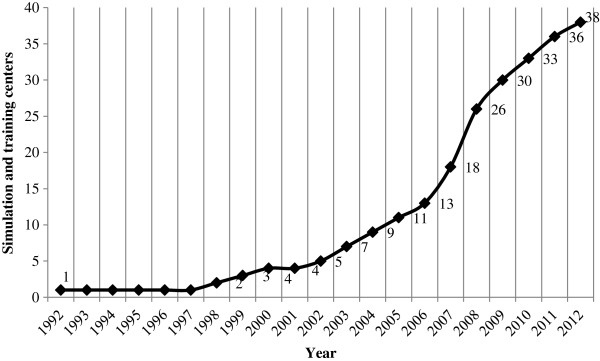
Of a total of 43 contacted medical universities/medical faculties, 40 ultimately participated in the survey. As decisive for the establishment of a STC the potential to improve the clinical-practical training and the demand by students were listed. Obligatory training in a STC during the first and sixth academic year was confirmed only by 12 institutions, before the first invasive procedure on patients by 17 institutions. 13 institutions confirmed the use of the STC for the further training of physicians and care-staff. Training for the acute care and emergency medicine skills in the field of pediatrics, for the most part, occurs decentralized.

CONCLUSIONS

New methods in medical training have reached German-speaking Central Europe, but the simulation and training centers vary in size, equipment or regarding their integration into the obligatory curriculum as much as the number and variety of the offering to be trained voluntarily or on an obligatory basis.

摘要

背景

在卫生专业人员教育中,基于模拟的培训(SBT)被认为是增强知识和技能以及为学习者和患者建立安全学习环境的有效替代方法。在英美地区,SBT和模拟培训中心(STC)被视为医学培训的标准。在讲德语的中欧地区,仍优先考虑建立SBT和STC。本研究的目的是:(i)调查讲德语的中欧地区医科大学模拟培训中心的现状及其设施情况;(ii)评估培训方法,尤其是在急诊医学技能领域的培训方法。

方法

对面德国(36所)、奥地利(4所)和讲德语的瑞士(3所)的所有公立和私立医科大学或医学院进行了访谈。在调查中,询问了有关STC的现状和设施信息,以及急诊医学领域中SBT的使用情况。问题部分采用封闭式、开放式和多项选择格式(可选择多个答案)。

结果

在总共联系的43所医科大学/医学院中,最终有40所参与了调查。对于建立STC,列出了改善临床实践培训的潜力和学生的需求作为决定性因素。只有12所机构确认在第一和第六学年必须在STC进行培训,17所机构确认在首次对患者进行侵入性操作之前必须在STC培训。13所机构确认使用STC对医生和护理人员进行进一步培训。儿科急性护理和急诊医学技能培训大多是分散进行的。

结论

医学培训的新方法已进入讲德语的中欧地区,但模拟培训中心在规模、设备、融入必修课程的程度以及自愿或必修培训项目的数量和种类方面各不相同。
https://cdn.ncbi.nlm.nih.gov/pmc/blobs/9b50/4236571/1a75ac22126c/1472-6920-14-172-1.jpg

相似文献

1
Have "new" methods in medical education reached German-speaking Central Europe: a survey.医学教育中的“新”方法已传播到德语区中欧地区了吗:一项调查。
BMC Med Educ. 2014 Aug 16;14:172. doi: 10.1186/1472-6920-14-172.
2
Simulated patients in medical education - a survey on the current status in Germany, Austria and Switzerland.医学教育中的模拟患者——关于德国、奥地利和瑞士现状的调查
GMS J Med Educ. 2019 May 16;36(3):Doc27. doi: 10.3205/zma001235. eCollection 2019.
3
[Evidence-based medicine teaching activities in the German-speaking area: a survey].[德语区的循证医学教学活动:一项调查]
Z Evid Fortbild Qual Gesundhwes. 2013;107(1):5-12. doi: 10.1016/j.zefq.2012.12.005. Epub 2013 Jan 15.
4
Undergraduate ultrasound education at German-speaking medical faculties: a survey.德语区医学院校的本科超声教育:一项调查
GMS J Med Educ. 2019 Aug 15;36(4):Doc34. doi: 10.3205/zma001242. eCollection 2019.
5
[Full-scale simulation in German medical schools and anesthesia residency programs : Status quo].[德国医学院校和麻醉住院医师培训项目中的全规模模拟:现状]
Anaesthesist. 2017 Jan;66(1):11-20. doi: 10.1007/s00101-016-0251-7. Epub 2016 Dec 9.
6
[Catalogue of learning goals for pregraduate education in geriatric medicine. A recommendation of the German Geriatric Society (DGG), the German Society of Gerontology and Geriatrics (DGGG), the Austrian Society of Geriatrics and Gerontology (ÖGGG) and the Swiss Society of Geriatric Medicine (SFGG) on the basis of recommendations of the European Union of Medical Specialists Geriatric Medicine Section (UEMS-GMS) 2013].[老年医学研究生教育学习目标目录。德国老年医学会(DGG)、德国老年学与老年医学学会(DGGG)、奥地利老年学与老年医学学会(ÖGGG)以及瑞士老年医学会(SFGG)基于欧洲医学专家联盟老年医学分会(UEMS-GMS)2013年建议所做的推荐]
Z Gerontol Geriatr. 2014 Nov;47(7):570-6. doi: 10.1007/s00391-014-0809-4.
7
The active participation of German-speaking countries in conferences of the Association for Medical Education in Europe (AMEE) between 2005 and 2013: a reflection of the development of medical education research?2005年至2013年间德语国家对欧洲医学教育协会(AMEE)会议的积极参与:医学教育研究发展的一种反映?
GMS Z Med Ausbild. 2014 Aug 15;31(3):Doc28. doi: 10.3205/zma000920. eCollection 2014.
8
Desire and reality--teaching and assessing communicative competencies in undergraduate medical education in German-speaking Europe--a survey.愿望与现实——德语区欧洲本科医学教育中沟通能力的教学与评估——一项调查
GMS Z Med Ausbild. 2015 Nov 16;32(5):Doc56. doi: 10.3205/zma000998. eCollection 2015.
9
[Undergraduate teaching of anaesthesiology : a nationwide survey in Germany].[德国麻醉学本科教学:一项全国性调查]
Anaesthesist. 2012 Mar;61(3):202-6, 209-14. doi: 10.1007/s00101-012-1993-5. Epub 2012 Mar 21.
10
Developments in spiritual care education in German--speaking countries.德语国家精神关怀教育的发展。
BMC Med Educ. 2014 Jun 5;14:112. doi: 10.1186/1472-6920-14-112.

引用本文的文献

1
Readiness for and Response to Coronavirus Disease 2019 Among Pediatric Healthcare Providers: The Role of Simulation for Pandemics and Other Disasters.儿科医护人员对 2019 年冠状病毒病的准备和应对:模拟在大流行和其他灾害中的作用。
Pediatr Crit Care Med. 2021 Jun 1;22(6):e333-e338. doi: 10.1097/PCC.0000000000002649.
2
Use of simulation-based medical training in Swiss pediatric hospitals: a national survey.瑞士儿科医院中基于模拟的医学培训的使用:一项全国性调查。
BMC Med Educ. 2017 Jun 17;17(1):104. doi: 10.1186/s12909-017-0940-1.
3
Training of practical skills - implementation in the D-A-CH-Region.

本文引用的文献

1
Creating new realities in healthcare: the status of simulation-based training as a patient safety improvement strategy.在医疗保健领域创造新的现实:基于模拟的培训作为患者安全改进策略的现状。
BMJ Qual Saf. 2013 Jun;22(6):449-52. doi: 10.1136/bmjqs-2013-002112.
2
Technology-enhanced simulation to assess health professionals: a systematic review of validity evidence, research methods, and reporting quality.技术增强模拟评估卫生专业人员:有效性证据、研究方法和报告质量的系统评价。
Acad Med. 2013 Jun;88(6):872-83. doi: 10.1097/ACM.0b013e31828ffdcf.
3
Use of simulation-based teaching methodologies in US colleges and schools of pharmacy.
实践技能培训——在德语区(德国、奥地利、瑞士)的实施情况
GMS J Med Educ. 2016 Nov 15;33(5):Doc69. doi: 10.3205/zma001068. eCollection 2016.
美国药学院校中基于模拟的教学方法的使用。
Am J Pharm Educ. 2013 Apr 12;77(3):53. doi: 10.5688/ajpe77353.
4
Rationale, scope, and 20-year experience of vascular surgical training with lifelike pulsatile flow models.具有逼真脉动流模型的血管外科培训的理由、范围和 20 年经验。
J Vasc Surg. 2013 May;57(5):1422-8. doi: 10.1016/j.jvs.2012.11.113.
5
Teaching medical students a clinical approach to altered mental status: simulation enhances traditional curriculum.教学医学生改变精神状态的临床方法:模拟增强传统课程。
Med Educ Online. 2013 Apr 3;18:1-8. doi: 10.3402/meo.v18i0.19775.
6
High-reliability emergency response teams in the hospital: improving quality and safety using in situ simulation training.医院高可靠性应急反应团队:运用现场模拟培训提高质量和安全。
BMJ Qual Saf. 2013 Jun;22(6):507-14. doi: 10.1136/bmjqs-2012-000931. Epub 2013 Mar 1.
7
Interns' success with clinical procedures in infants after simulation training.模拟训练后实习医生在婴儿临床操作中的成功率。
Pediatrics. 2013 Mar;131(3):e811-20. doi: 10.1542/peds.2012-0607. Epub 2013 Feb 25.
8
Effectiveness of simulator-based echocardiography training of noncardiologists in congenital heart diseases.基于模拟器的先天性心脏病非心脏病专家超声心动图培训的有效性。
Echocardiography. 2013 Jul;30(6):693-8. doi: 10.1111/echo.12118. Epub 2013 Jan 24.
9
Errors as allies: error management training in health professions education.错误即盟友:医学专业教育中的差错管理培训。
BMJ Qual Saf. 2013 Jun;22(6):516-9. doi: 10.1136/bmjqs-2012-000945. Epub 2013 Jan 3.
10
Leaders' and followers' individual experiences during the early phase of simulation-based team training: an exploratory study.领导者和追随者在基于模拟的团队培训早期阶段的个人体验:一项探索性研究。
BMJ Qual Saf. 2013 Jun;22(6):459-67. doi: 10.1136/bmjqs-2012-000949. Epub 2013 Jan 3.