Romagny Sébastien, Thomas-Danguin Thierry, Coureaud Gérard
Centre des Sciences du Goût et de l'Alimentation (Research Center for Taste and Feeding Behaviour), Dijon, France.
PLoS One. 2014 Sep 23;9(9):e107560. doi: 10.1371/journal.pone.0107560. eCollection 2014.
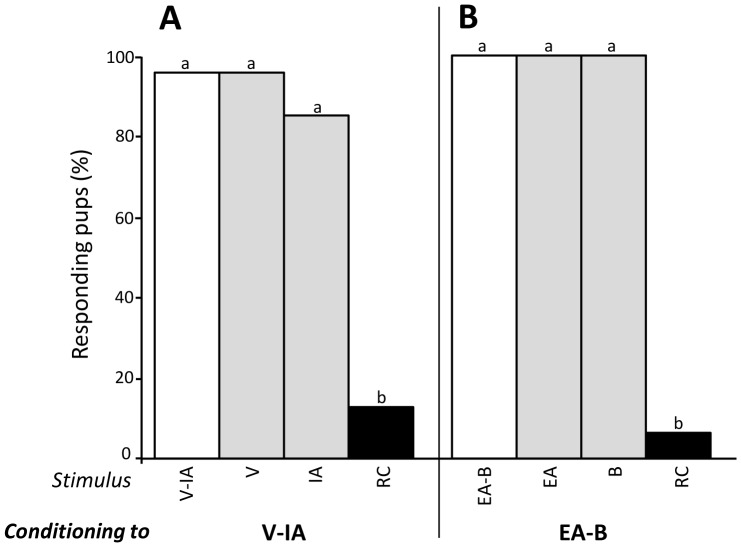
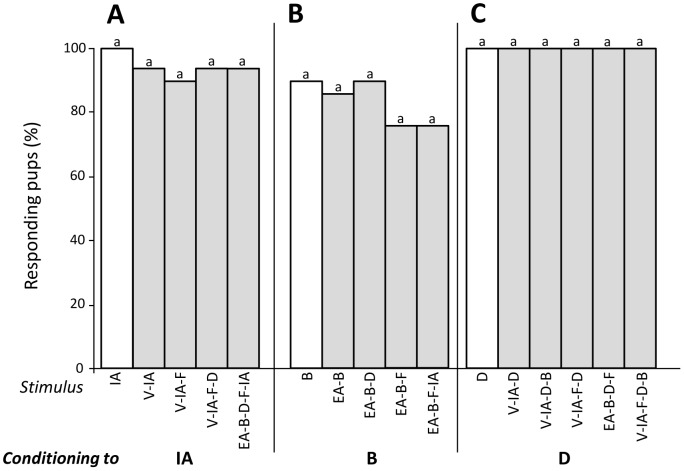
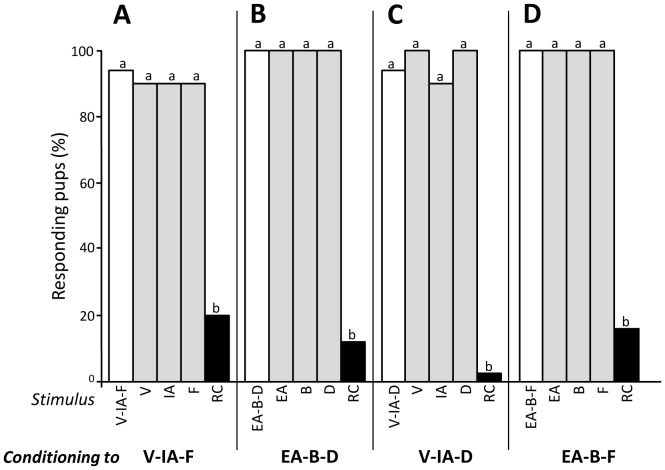
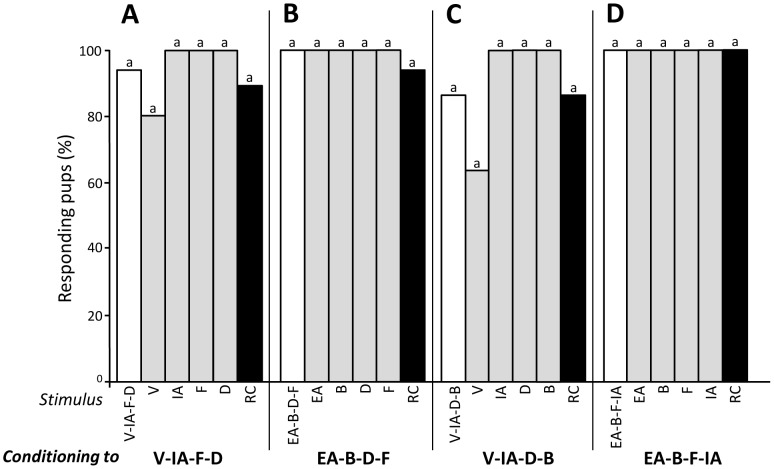
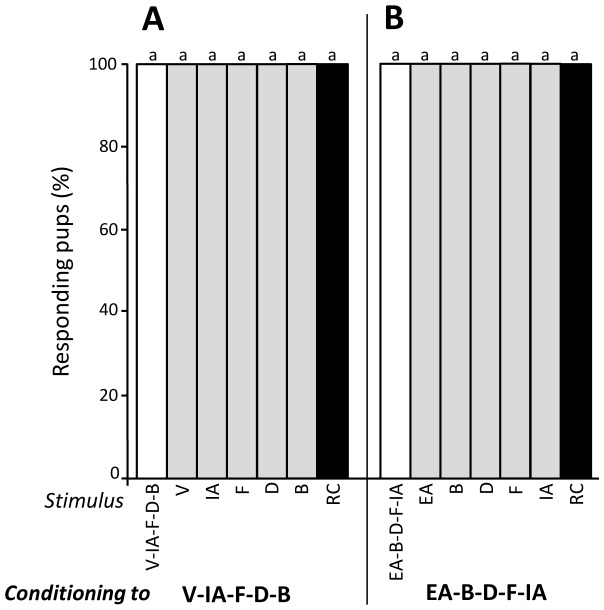
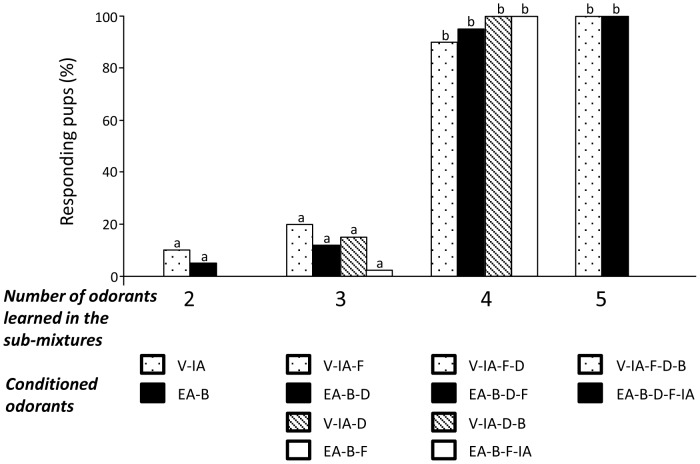
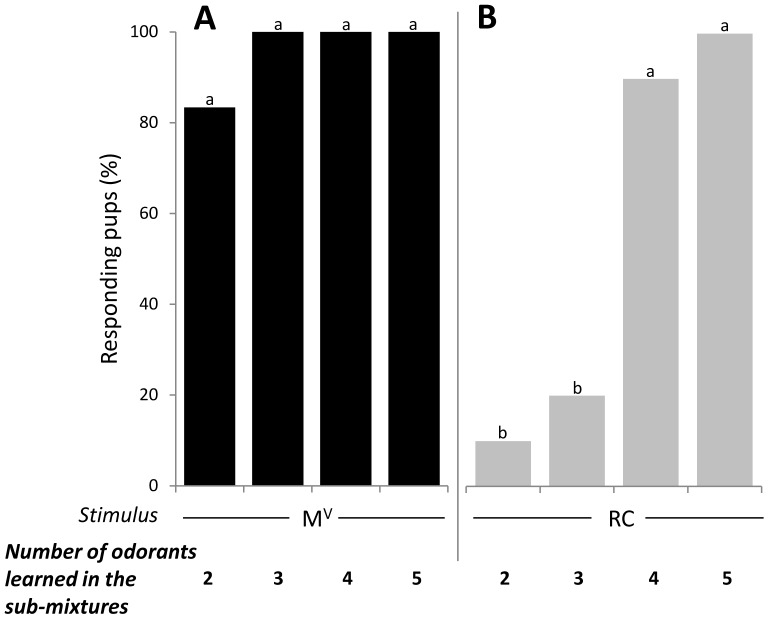
Perception of odors, i.e. usually of mixtures of odorants, is elemental (the odorants' odor qualities are perceived in the mixture) or configural (the odor quality of the mixture differs from the one of each odorant). In human adults, the Red Cordial (RC) mixture is a configurally-processed, 6-odorant mixture. It evokes a red cordial odor quality while none of the elements carries that odor. Interestingly, in newborn rabbits, the same RC mixture is weak configurally perceived: the newborns behaviorally respond to all the elements after conditioning to the whole mixture, but not to the mixture after conditioning to a single element. Thus, they perceive in the RC mixture both the odor quality of the RC configuration and the quality of each element. Here, we aimed to determine whether this perception is modulated by quantitative (number of elements) and/or qualitative bits of information (nature of elements) previously learned by the animals. Newborns were conditioned to RC sub-mixtures of different complexity and composition before behavioral testing to RC. Pups generalized their sucking-related response to RC after learning at least 4 odorants. In contrast, after conditioning to sub-mixtures of another 6-odorant mixture, the elementally perceived MV mixture, pups responded to MV after learning one or two odorants. The different generalization to RC and MV mixtures after learning some of their elements is discussed according to three hypotheses: i) the configural perception of RC sub-mixtures, ii) the ratio of familiar/unfamiliar individual information elementally and configurally perceived, iii) the perception of RC becoming purely elemental. The results allow the first hypothesis to be dismissed, while further experiments are required to distinguish between the remaining two.
对气味的感知,即通常对气味混合物的感知,是元素性的(在混合物中能感知到各气味剂的气味特性)或整体性的(混合物的气味特性与每种气味剂的不同)。在成年人类中,红甜酒(RC)混合物是一种经整体性处理的六气味剂混合物。它能唤起红甜酒的气味特性,而其中任何一种成分都不具有那种气味。有趣的是,在新生兔子中,同样的RC混合物的整体性感知较弱:新生兔子在对整个混合物进行条件反射后,对所有成分都有行为反应,但在对单个成分进行条件反射后,对混合物却没有反应。因此,它们在RC混合物中既能感知到RC构型的气味特性,也能感知到每种成分的特性。在此,我们旨在确定这种感知是否受到动物先前学习的定量(成分数量)和/或定性信息(成分性质)的调节。在对RC进行行为测试之前,让新生兔子对不同复杂性和组成的RC子混合物进行条件反射。幼崽在学习了至少4种气味剂后,会将与吮吸相关的反应推广到RC上。相比之下,在对另一种六气味剂混合物——元素性感知的MV混合物的子混合物进行条件反射后,幼崽在学习了一两种气味剂后就对MV有反应了。根据三种假设讨论了在学习了RC和MV混合物的一些成分后对它们的不同推广情况:i)RC子混合物的整体性感知;ii)元素性和整体性感知中熟悉/不熟悉的个体信息的比例;iii)RC的感知变得完全是元素性的。结果排除了第一种假设,而需要进一步的实验来区分剩下的两种假设。