Greisen Stinne Ravn, Schelde Karen Kræmmer, Rasmussen Tue Kruse, Kragstrup Tue Wenzel, Stengaard-Pedersen Kristian, Hetland Merete Lund, Hørslev-Petersen Kim, Junker Peter, Østergaard Mikkel, Deleuran Bent, Hvid Malene
Arthritis Res Ther. 2014 Sep 24;16(5):434. doi: 10.1186/s13075-014-0434-z.
A key phenomenon in rheumatoid arthritis is the formation of lymphoid follicles in the inflamed synovial membrane. C-X-C motif chemokine 13 (CXCL13) is central in this process as it attracts C-X-C chemokine receptor type 5 (CXCR5)-expressing B cells and T follicular helper cells to the follicle. We here examine the role of CXCL13 and its association with disease in patients with treatment-naïve early rheumatoid arthritis.
Plasma samples from patients in the OPERA trial were examined for CXCL13 at treatment initiation and after 6 months of treatment with either methotrexate plus placebo (DMARD) (n = 37) or methotrexate plus adalimumab (DMARD + ADA) (n = 39). Treatment outcome was evaluated after 1 and 2 years. CXCL13 plasma levels in healthy volunteers (n = 38) were also examined.
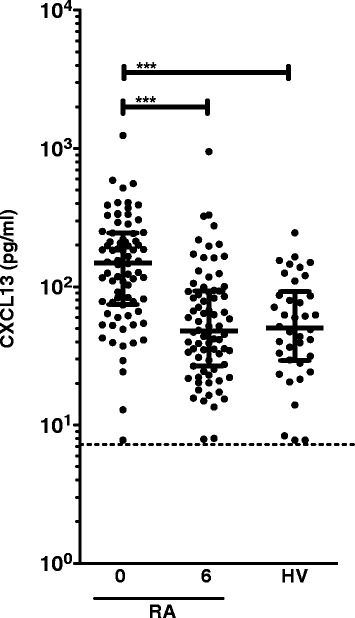
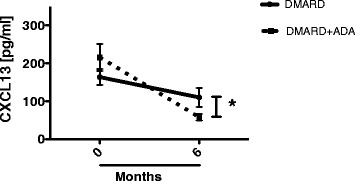
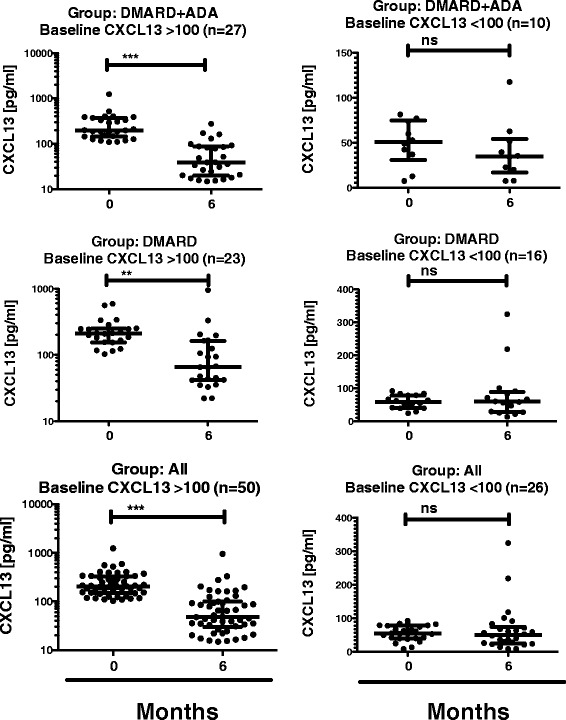
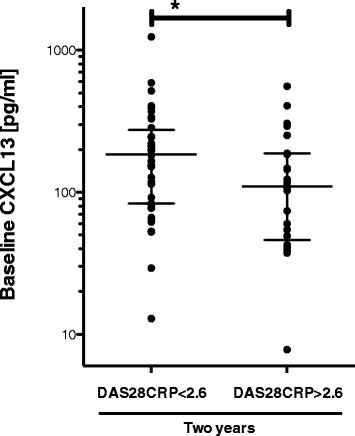
Baseline CXCL13 plasma levels were increased in early rheumatoid arthritis patients in comparison with healthy volunteers. Also, plasma CXCL13 correlated positively with disease activity parameters; swollen joint count 28 (rho = 0.34) and 40 (rho = 0.39), visual analog score (rho = 0.38) and simplified disease activity index (rho = 0.25) (all P <0.05). CXCL13 levels decreased a significantly twofold more in the DMARD + ADA group than in the DMARD group. Baseline CXCL13 plasma levels in the DMARD group correlated inversely with disease activity parameters; disease activity score in 28 joints, four variables, C-reactive protein based (DAS28CRP) (rho = 0.58, P < 0.05) at 12 months. High baseline CXCL13 was associated with remission (DAS28CRP less than 2.6) after 2 years.
In treatment-naïve early rheumatoid arthritis patients, plasma CXCL13 levels were associated with joint inflammation. Furthermore, patients with high baseline plasma CXCL13 levels had an improved chance of remission after 2 years. We propose that high CXCL13 concentrations indicate recent onset of inflammation that may respond better to early aggressive treatment. Thus, high levels of CXCL13 could reflect the 'the window of opportunity' for optimal treatment effect.
Clinicaltrial.gov NCT00660647. Registered 10 April 2008.
类风湿性关节炎的一个关键现象是在炎症滑膜中形成淋巴滤泡。C-X-C基序趋化因子13(CXCL13)在这一过程中起核心作用,因为它能将表达C-X-C趋化因子受体5(CXCR5)的B细胞和滤泡辅助性T细胞吸引至滤泡。我们在此研究未经治疗的早期类风湿性关节炎患者中CXCL13的作用及其与疾病的关联。
对OPERA试验中患者的血浆样本在治疗开始时以及用甲氨蝶呤加安慰剂(改善病情抗风湿药)(n = 37)或甲氨蝶呤加阿达木单抗(改善病情抗风湿药 + 阿达木单抗)(n = 39)治疗6个月后检测CXCL13。在1年和2年后评估治疗结果。还检测了健康志愿者(n = 38)的血浆CXCL13水平。
与健康志愿者相比,早期类风湿性关节炎患者的基线血浆CXCL13水平升高。此外,血浆CXCL13与疾病活动参数呈正相关;28个肿胀关节计数(rho = 0.34)和40个肿胀关节计数(rho = 0.39)、视觉模拟评分(rho = 0.38)以及简化疾病活动指数(rho = 0.25)(均P <0.05)。改善病情抗风湿药 + 阿达木单抗组中CXCL13水平下降幅度比改善病情抗风湿药组显著多两倍。改善病情抗风湿药组的基线血浆CXCL13水平与疾病活动参数呈负相关;12个月时基于28个关节、四个变量、C反应蛋白的疾病活动评分(DAS28CRP)(rho = 0.58,P <0.05)。高基线CXCL13与2年后的缓解(DAS28CRP小于2.6)相关。
在未经治疗的早期类风湿性关节炎患者中,血浆CXCL13水平与关节炎症相关。此外,基线血浆CXCL13水平高的患者在2年后缓解的机会更大。我们提出高CXCL13浓度表明炎症近期发作,可能对早期积极治疗反应更好。因此,高CXCL13水平可能反映出实现最佳治疗效果的“机会窗口”。
Clinicaltrial.gov NCT00660647。2008年4月10日注册。