INSERM U955, Equipe 3, Créteil F-94010, France.
BMC Pharmacol Toxicol. 2014 Sep 25;15:53. doi: 10.1186/2050-6511-15-53.
The respiratory properties of perfluorocarbons (PFC) have been widely studied for liquid ventilation in humans and animals. Several PFC were tested but their tolerance may depend on the species. Here, the effects of a single administration of liquid PFC into pig lungs were assessed and compared. Three different PFC having distinct evaporative and spreading coefficient properties were evaluated (Perfluorooctyl bromide [PFOB], perfluorodecalin [PFD] and perfluoro-N-octane [PFOC]).
Pigs were anesthetized and submitted to mechanical ventilation. They randomly received an intra-tracheal administration of 15 ml/kg of either PFOB, PFD or PFOC with 12 h of mechanical ventilation before awakening and weaning from ventilation. A Control group was submitted to mechanical ventilation with no PFC administration. All animals were followed during 4 days after the initial PFC administration to investigate gas exchanges and clinical recovery. They were ultimately euthanized for histological analyses and assessment of PFC residual concentrations within the lungs using dual nuclei fluorine and hydrogen Magnetic Resonance Imaging (MRI). Sixteen animals were included (4/group).
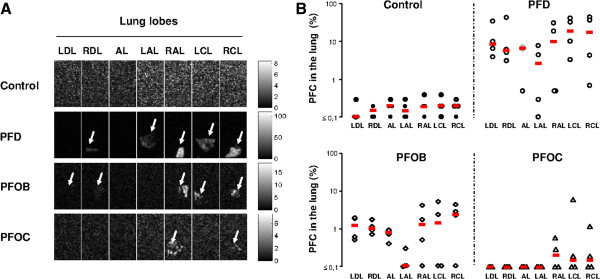
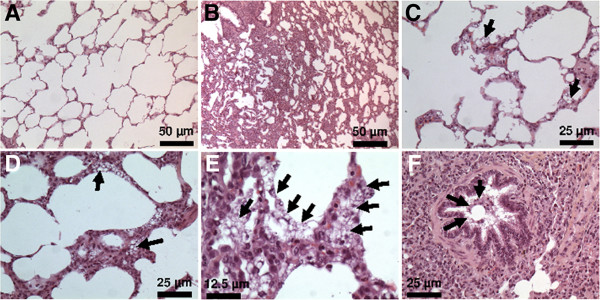
In the PFD group, animals tended to be hypoxemic after awakening. In PFOB and PFOC groups, blood gases were not significantly different from the Control group after awakening. The poor tolerance of PFD was likely related to a large amount of residual PFC, as observed using MRI in all lung samples (≈10% of lung volume). This percentage was lower in the PFOB group (≈1%) but remained significantly greater than in the Control group. In the PFOC group, the percentage of residual PFC was not significantly different from that of the Control group (≈0.1%). Histologically, the most striking feature was an alveolar infiltration with foam macrophages, especially in the groups treated by PFD or PFOB.
Of the three tested perfluorocarbons, PFOC offered the best tolerance in terms of lung function, gas exchanges and residuum in the lung. PFOC was rapidly cleared from the lungs and virtually disappeared after 4 days whereas PFOB persisted at significant levels and led to foam macrophage infiltration. PFOC could be relevant for short term total liquid ventilation with a rapid weaning.
全氟化碳(PFC)的呼吸特性已在人和动物的液体通气中得到广泛研究。已经测试了几种 PFC,但它们的耐受性可能取决于物种。在这里,评估并比较了单次给予猪肺液体 PFC 的效果。评估了具有不同蒸发和扩散系数特性的三种不同 PFC(全氟辛基溴化物[PFOB]、全氟癸烷[PFD]和全氟辛烷[PFOC])。
猪被麻醉并接受机械通气。它们随机接受气管内给予 15ml/kg 的 PFOB、PFD 或 PFOC,然后进行 12 小时的机械通气,然后唤醒并从通气中脱离。对照组接受机械通气而不给予 PFC。所有动物在初始 PFC 给药后 4 天内进行随访,以研究气体交换和临床恢复情况。最后,对动物进行安乐死,使用双核氟和氢磁共振成像(MRI)评估肺内 PFC 残留浓度并进行组织学分析。共纳入 16 只动物(每组 4 只)。
在 PFD 组中,动物在唤醒后往往会出现低氧血症。在 PFOB 和 PFOC 组中,唤醒后血气与对照组无显著差异。PFD 的耐受性差可能与 MRI 观察到的所有肺样本中大量残留 PFC(≈10%的肺容量)有关。PFOB 组的百分比较低(≈1%),但仍明显高于对照组。在 PFOC 组中,残留 PFC 的百分比与对照组无显著差异(≈0.1%)。组织学上,最显著的特征是肺泡浸润泡沫巨噬细胞,尤其是在 PFD 或 PFOB 治疗组。
在三种测试的全氟化碳中,PFOC 在肺功能、气体交换和肺残留方面表现出最佳的耐受性。PFOC 从肺部迅速清除,4 天后几乎消失,而 PFOB 则持续存在且导致泡沫巨噬细胞浸润。PFOC 可用于短期全液体通气,快速脱机。