LeBon Lauren, Lee Tom V, Sprinzak David, Jafar-Nejad Hamed, Elowitz Michael B
Howard Hughes Medical Institute, California Institute of Technology, Pasadena, United States.
Department of Molecular and Human Genetics, Baylor College of Medicine, Houston, United States.
Elife. 2014 Sep 25;3:e02950. doi: 10.7554/eLife.02950.
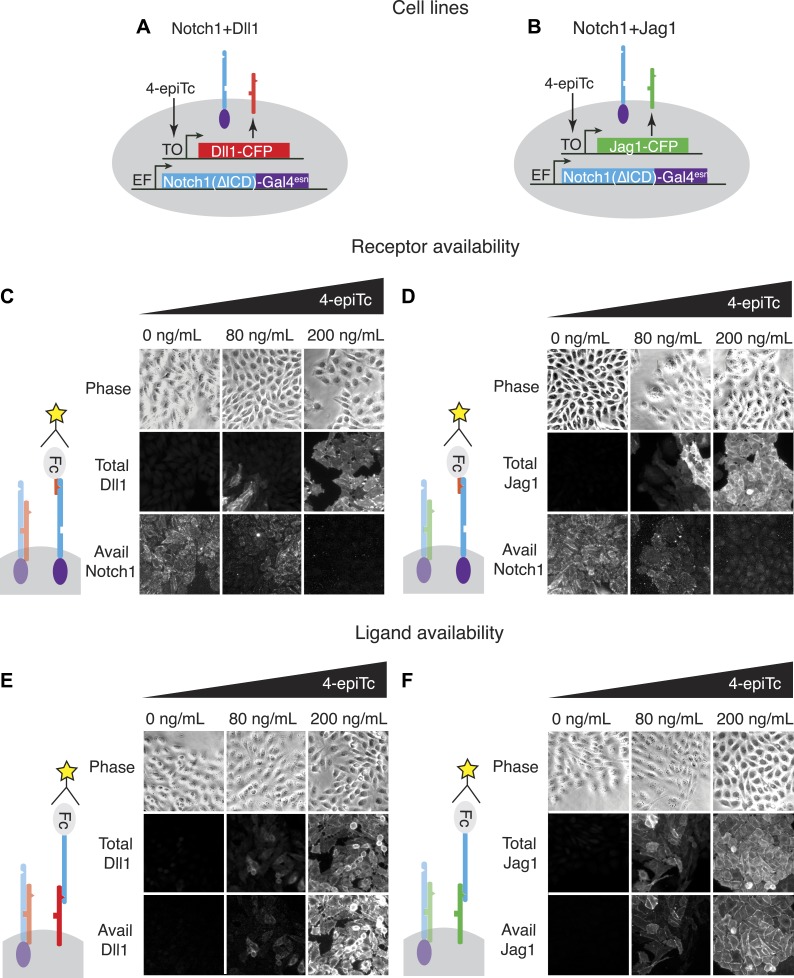
The Notch signaling pathway consists of multiple types of receptors and ligands, whose interactions can be tuned by Fringe glycosyltransferases. A major challenge is to determine how these components control the specificity and directionality of Notch signaling in developmental contexts. Here, we analyzed same-cell (cis) Notch-ligand interactions for Notch1, Dll1, and Jag1, and their dependence on Fringe protein expression in mammalian cells. We found that Dll1 and Jag1 can cis-inhibit Notch1, and Fringe proteins modulate these interactions in a way that parallels their effects on trans interactions. Fringe similarly modulated Notch-ligand cis interactions during Drosophila development. Based on these and previously identified interactions, we show how the design of the Notch signaling pathway leads to a restricted repertoire of signaling states that promote heterotypic signaling between distinct cell types, providing insight into the design principles of the Notch signaling system, and the specific developmental process of Drosophila dorsal-ventral boundary formation.
Notch信号通路由多种类型的受体和配体组成,其相互作用可由边缘糖基转移酶调节。一个主要挑战是确定这些组分如何在发育环境中控制Notch信号的特异性和方向性。在这里,我们分析了Notch1、Dll1和Jag1的同细胞(顺式)Notch-配体相互作用,以及它们在哺乳动物细胞中对边缘蛋白表达的依赖性。我们发现Dll1和Jag1可以顺式抑制Notch1,并且边缘蛋白以与其对反式相互作用的影响相似的方式调节这些相互作用。在果蝇发育过程中,边缘蛋白同样调节了Notch-配体顺式相互作用。基于这些以及先前确定的相互作用,我们展示了Notch信号通路的设计如何导致有限的信号状态组合,从而促进不同细胞类型之间的异型信号传导,为Notch信号系统的设计原则以及果蝇背腹边界形成的特定发育过程提供了见解。