Lozano Reymundo, Hare Emma B, Hagerman Randi J
MIND Institute, UC Davis Medical Center, Sacramento, CA, USA ; Department of Pediatrics, UC Davis Medical Center, Sacramento, CA, USA.
Neuropsychiatr Dis Treat. 2014 Sep 16;10:1769-79. doi: 10.2147/NDT.S42919. eCollection 2014.
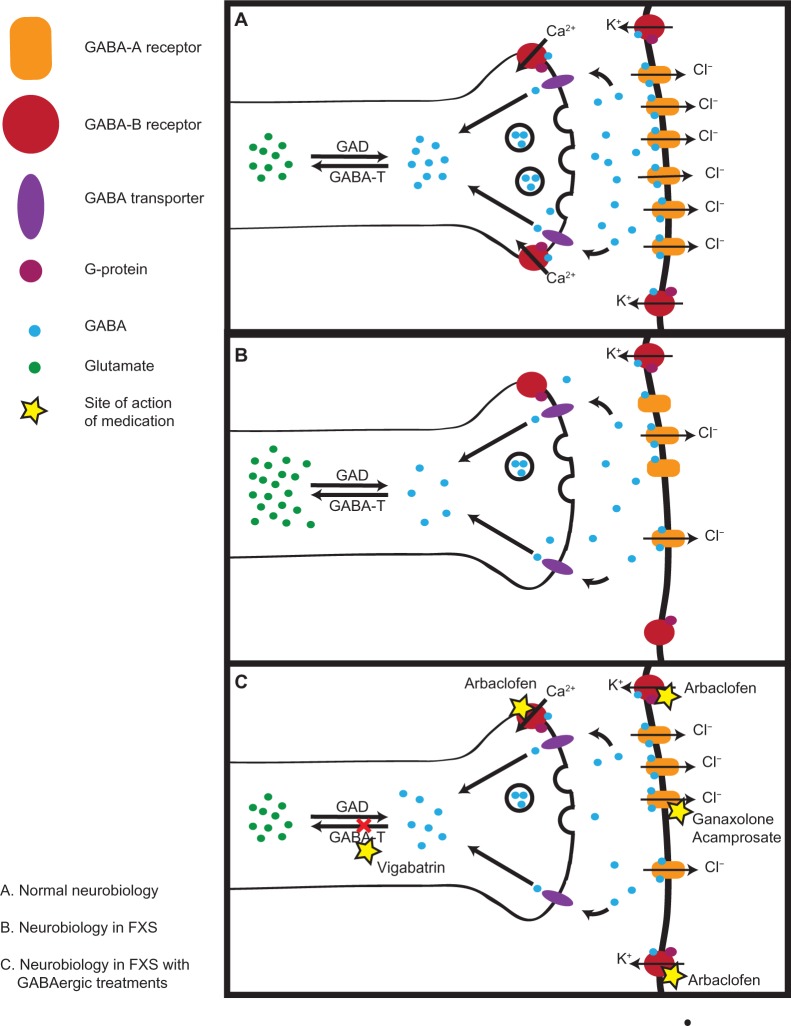
Fragile X syndrome (FXS) is the most common genetic cause of intellectual disability and the most common single-gene cause of autism. It is caused by mutations on the fragile X mental retardation gene (FMR1) and lack of fragile X mental retardation protein, which in turn, leads to decreased inhibition of translation of many synaptic proteins. The metabotropic glutamate receptor (mGluR) hypothesis states that the neurological deficits in individuals with FXS are due mainly to downstream consequences of overstimulation of the mGluR pathway. The main efforts have focused on mGluR5 targeted treatments; however, investigation on the gamma-aminobutyric acid (GABA) system and its potential as a targeted treatment is less emphasized. The fragile X mouse models (Fmr1-knock out) show decreased GABA subunit receptors, decreased synthesis of GABA, increased catabolism of GABA, and overall decreased GABAergic input in many regions of the brain. Consequences of the reduced GABAergic input in FXS include oversensitivity to sensory stimuli, seizures, and anxiety. Deficits in the GABA receptors in different regions of the brain are associated with behavioral and attentional processing deficits linked to anxiety and autistic behaviors. The understanding of the neurobiology of FXS has led to the development of targeted treatments for the core behavioral features of FXS, which include social deficits, inattention, and anxiety. These symptoms are also observed in individuals with autism and other neurodevelopmental disorders, therefore the targeted treatments for FXS are leading the way in the treatment of other neurodevelopmental syndromes and autism. The GABAergic system in FXS represents a target for new treatments. Herein, we discuss the animal and human trials of GABAergic treatment in FXS. Arbaclofen and ganaxolone have been used in individuals with FXS. Other potential GABAergic treatments, such as riluzole, gaboxadol, tiagabine, and vigabatrin, will be also discussed. Further studies are needed to determine the safety and efficacy of GABAergic treatments for FXS.
脆性X综合征(FXS)是智力残疾最常见的遗传病因,也是自闭症最常见的单基因病因。它由脆性X智力低下基因(FMR1)突变引起,导致脆性X智力低下蛋白缺乏,进而致使许多突触蛋白的翻译抑制作用减弱。代谢型谷氨酸受体(mGluR)假说认为,FXS患者的神经功能缺陷主要源于mGluR通路过度刺激的下游后果。主要研究工作集中在针对mGluR5的治疗;然而,对γ-氨基丁酸(GABA)系统及其作为靶向治疗的潜力的研究较少受到重视。脆性X小鼠模型(Fmr1基因敲除)显示,GABA亚基受体减少、GABA合成减少、GABA分解代谢增加,且大脑许多区域的GABA能输入总体减少。FXS中GABA能输入减少的后果包括对感觉刺激过度敏感、癫痫发作和焦虑。大脑不同区域的GABA受体缺陷与与焦虑和自闭症行为相关的行为及注意力加工缺陷有关。对FXS神经生物学的理解已促成针对FXS核心行为特征(包括社交缺陷、注意力不集中和焦虑)的靶向治疗的发展。这些症状也见于自闭症和其他神经发育障碍患者,因此FXS的靶向治疗正在引领其他神经发育综合征和自闭症的治疗。FXS中的GABA能系统是新治疗方法的一个靶点。在此,我们讨论FXS中GABA能治疗的动物试验和人体试验。阿巴氯芬和加奈索酮已用于FXS患者。还将讨论其他潜在的GABA能治疗方法。需要进一步研究以确定GABA能治疗对FXS的安全性和有效性。