Chua Eric Chern-Pin, Yeo Sing-Chen, Lee Ivan Tian-Guang, Tan Luuan-Chin, Lau Pauline, Tan Sara S, Ho Mien Ivan, Gooley Joshua J
Program in Neuroscience and Behavioral Disorders, Duke-NUS Graduate Medical School Singapore, Singapore, 169857, Singapore.
National Neuroscience Institute, Singapore, 308433, Singapore.
Physiol Rep. 2014 Sep 28;2(9). doi: 10.14814/phy2.12129. Print 2014 Sep 1.
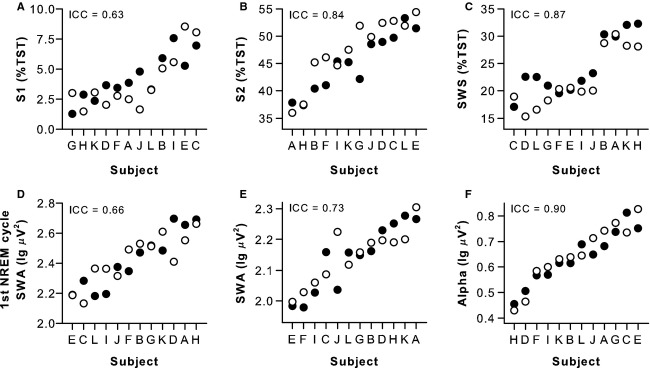
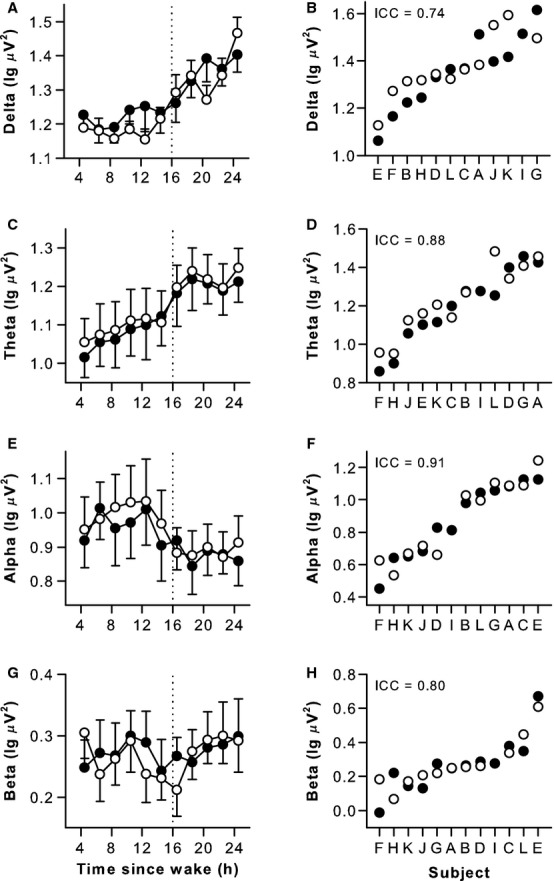
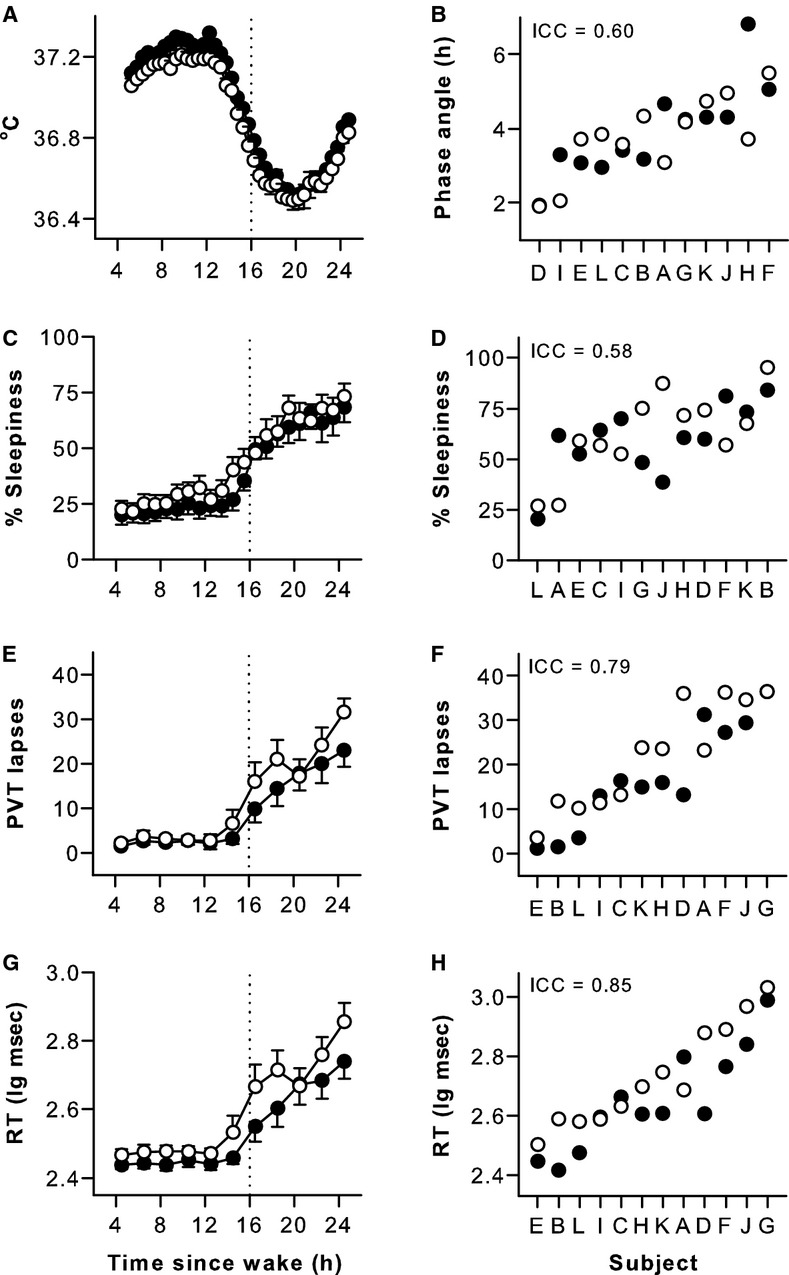
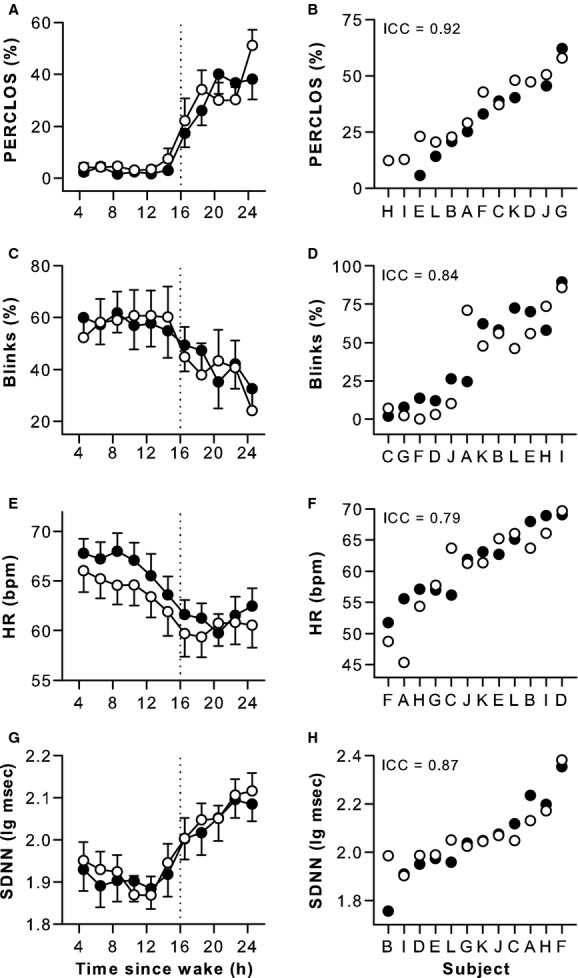
Some individuals show severe cognitive impairment when sleep deprived, whereas others are able to maintain a high level of performance. Such differences are stable and trait-like, but it is not clear whether these findings generalize to physiologic responses to sleep loss. Here, we analyzed individual differences in behavioral and physiologic measures in healthy ethnic-Chinese male volunteers (n = 12; aged 22-30 years) who were kept awake for at least 26 h in a controlled laboratory environment on two separate occasions. Every 2 h, sustained attention performance was assessed using a 10-min psychomotor vigilance task (PVT), and sleepiness was estimated objectively by determining percentage eyelid closure over the pupil over time (PERCLOS) and blink rate. Between-subject differences in heart rate and its variability, and electroencephalogram (EEG) spectral power were also analyzed during each PVT. To assess stability of individual differences, intraclass correlation coefficients (ICC) were determined using variance components analysis. Consistent with previous work, individual differences in PVT performance were reproducible across study visits, as were baseline sleep measures prior to sleep deprivation. In addition, stable individual differences were observed during sleep deprivation for PERCLOS, blink rate, heart rate and its variability, and EEG spectral power in the alpha frequency band, even after adjusting for baseline differences in these measures (range, ICC = 0.67-0.91). These findings establish that changes in ocular, ECG, and EEG signals are highly reproducible across a night of sleep deprivation, hence raising the possibility that, similar to behavioral measures, physiologic responses to sleep loss are trait-like.
一些人在睡眠剥夺时会出现严重的认知障碍,而另一些人则能够保持较高的表现水平。这种差异是稳定的且类似特质,但尚不清楚这些发现是否能推广到对睡眠剥夺的生理反应上。在此,我们分析了健康的中国男性志愿者(n = 12;年龄22 - 30岁)在两个不同场合于受控实验室环境中至少保持26小时清醒状态下的行为和生理测量的个体差异。每2小时,使用10分钟的精神运动警觉任务(PVT)评估持续注意力表现,并通过确定随时间瞳孔上眼睑闭合百分比(PERCLOS)和眨眼率来客观估计嗜睡程度。在每次PVT期间,还分析了心率及其变异性以及脑电图(EEG)频谱功率的个体间差异。为了评估个体差异的稳定性,使用方差成分分析确定组内相关系数(ICC)。与先前的研究一致,PVT表现的个体差异在各次研究访视中均可重复,睡眠剥夺前的基线睡眠测量也是如此。此外,即使在调整了这些测量的基线差异后(范围,ICC = 0.67 - 0.91),在睡眠剥夺期间仍观察到PERCLOS、眨眼率、心率及其变异性以及α频段EEG频谱功率存在稳定的个体差异。这些发现表明,在一夜的睡眠剥夺期间,眼部、心电图和脑电图信号的变化具有高度可重复性,因此增加了与行为测量类似,对睡眠剥夺的生理反应是类似特质的可能性。