
在实验性沙漠条件下,骆驼(单峰驼)体温节律的日常调节。
Daily regulation of body temperature rhythm in the camel (Camelus dromedarius) exposed to experimental desert conditions.
作者信息
Bouâouda Hanan, Achâaban Mohamed R, Ouassat Mohammed, Oukassou Mohammed, Piro Mohamed, Challet Etienne, El Allali Khalid, Pévet Paul
机构信息
Department of Neurobiology of Rhythms, CNRS UPR 3212, Institute for Cellular and Integrative Neurosciences, University of Strasbourg, Strasbourg, France Comparative Anatomy Unit (URAC CNRST 49), Hassan II Agronomy and Veterinary Institute, Rabat, Morocco.
Comparative Anatomy Unit (URAC CNRST 49), Hassan II Agronomy and Veterinary Institute, Rabat, Morocco.
出版信息
Physiol Rep. 2014 Sep 28;2(9). doi: 10.14814/phy2.12151. Print 2014 Sep 1.
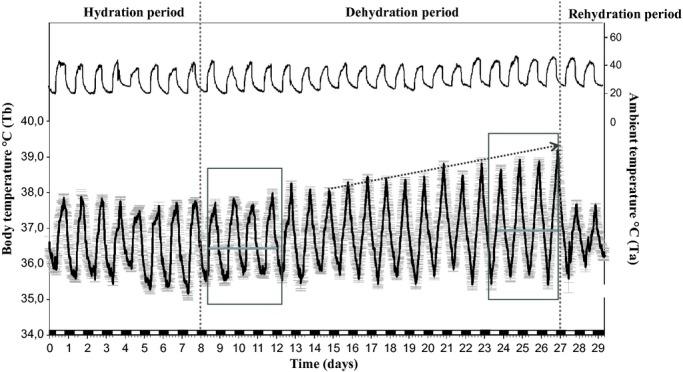
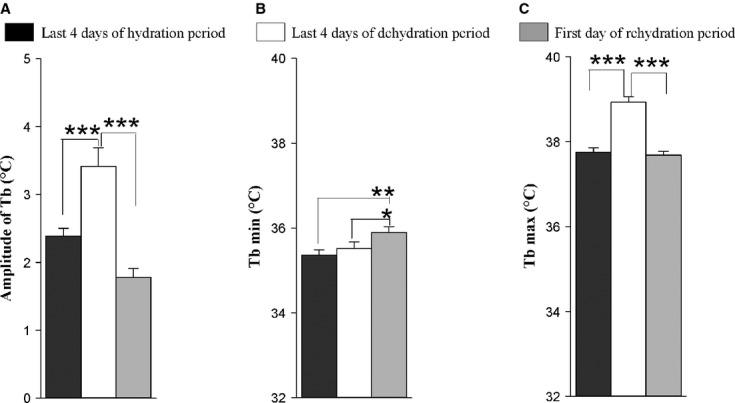
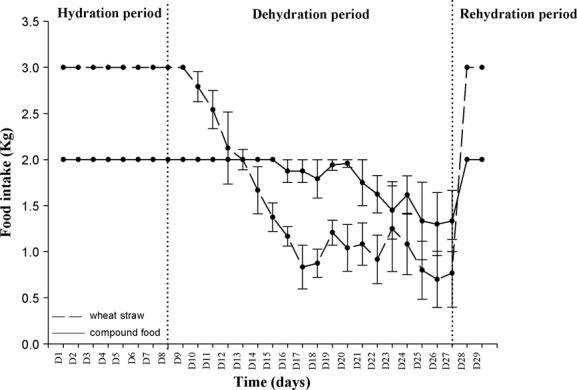
In the present work, we have studied daily rhythmicity of body temperature (Tb) in Arabian camels challenged with daily heat, combined or not with dehydration. We confirm that Arabian camels use heterothermy to reduce heat gain coupled with evaporative heat loss during the day. Here, we also demonstrate that this mechanism is more complex than previously reported, because it is characterized by a daily alternation (probably of circadian origin) of two periods of poikilothermy and homeothermy. We also show that dehydration induced a decrease in food intake plays a role in this process. Together, these findings highlight that adaptive heterothermy in the Arabian camel varies across the diurnal light-dark cycle and is modulated by timing of daily heat and degrees of water restriction and associated reduction of food intake. The changed phase relationship between the light-dark cycle and the Tb rhythm observed during the dehydration process points to a possible mechanism of internal desynchronization during the process of adaptation to desert environment. During these experimental conditions mimicking the desert environment, it will be possible in the future to determine if induced high-amplitude ambient temperature (Ta) rhythms are able to compete with the zeitgeber effect of the light-dark cycle.
在本研究中,我们对遭受每日高温(无论是否伴有脱水)的阿拉伯骆驼的体温(Tb)日节律进行了研究。我们证实,阿拉伯骆驼利用异温性来减少白天的热量获取,并结合蒸发散热。在此,我们还证明这种机制比先前报道的更为复杂,因为它的特征是两个变温期和恒温期的每日交替(可能源自昼夜节律)。我们还表明,脱水导致的食物摄入量减少在这一过程中起作用。这些发现共同凸显出,阿拉伯骆驼的适应性异温性在昼夜明暗周期中有所不同,并受到每日高温时间、水分限制程度以及相关食物摄入量减少的调节。在脱水过程中观察到的明暗周期与Tb节律之间变化的相位关系,表明在适应沙漠环境的过程中可能存在内部去同步化机制。在这些模拟沙漠环境的实验条件下,未来有可能确定诱导的高振幅环境温度(Ta)节律是否能够与明暗周期的授时效应相竞争。





 Zotero 插件