Attanasi Alessandro, Cavagna Andrea, Del Castello Lorenzo, Giardina Irene, Grigera Tomas S, Jelić Asja, Melillo Stefania, Parisi Leonardo, Pohl Oliver, Shen Edward, Viale Massimiliano
Istituto Sistemi Complessi, Consiglio Nazionale delle Ricerche, UOS Sapienza, 00185 Rome, Italy ; Dipartimento di Fisica, Universit a Sapienza, 00185 Rome, Italy.
Istituto Sistemi Complessi, Consiglio Nazionale delle Ricerche, UOS Sapienza, 00185 Rome, Italy ; Dipartimento di Fisica, Universit a Sapienza, 00185 Rome, Italy ; Initiative for the Theoretical Sciences, The Graduate Center, City University of New York, 10016 New York, USA.
Nat Phys. 2014 Sep 1;10(9):615-698. doi: 10.1038/nphys3035.
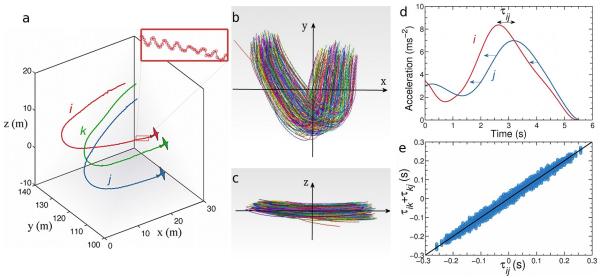
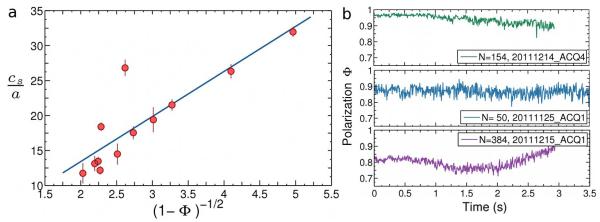
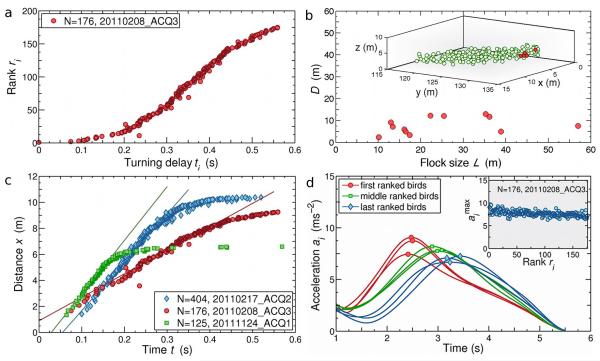
Collective decision-making in biological systems requires all individuals in the group to go through a behavioural change of state. During this transition fast and robust transfer of information is essential to prevent cohesion loss. The mechanism by which natural groups achieve such robustness, though, is not clear. Here we present an experimental study of starling flocks performing collective turns. We find that information about direction changes propagates across the flock with a linear dispersion law and negligible attenuation, hence minimizing group decoherence. These results contrast starkly with current models of collective motion, which predict diffusive transport of information. Building on spontaneous symmetry breaking and conservation laws arguments, we formulate a new theory that correctly reproduces linear and undamped propagation. Essential to the new framework is the inclusion of the birds' behavioural inertia. The new theory not only explains the data, but also predicts that information transfer must be faster the stronger the group's orientational order, a prediction accurately verified by the data. Our results suggest that swift decision-making may be the adaptive drive for the strong behavioural polarization observed in many living groups.
生物系统中的集体决策需要群体中的所有个体经历行为状态的改变。在这个转变过程中,快速而稳健的信息传递对于防止凝聚力丧失至关重要。然而,自然群体实现这种稳健性的机制尚不清楚。在这里,我们展示了一项关于椋鸟群进行集体转向的实验研究。我们发现,有关方向变化的信息以线性扩散规律在鸟群中传播,且衰减可忽略不计,从而将群体退相干降至最低。这些结果与当前的集体运动模型形成鲜明对比,后者预测信息的扩散传输。基于自发对称性破缺和守恒定律的论证,我们提出了一种新理论,该理论能正确再现线性且无阻尼的传播。新框架的关键在于纳入鸟类的行为惯性。新理论不仅解释了数据,还预测群体的定向秩序越强,信息传递必定越快,这一预测得到了数据的准确验证。我们的结果表明,快速决策可能是许多生物群体中观察到的强烈行为极化的适应性驱动力。