Scliar Marilia O, Gouveia Mateus H, Benazzo Andrea, Ghirotto Silvia, Fagundes Nelson J R, Leal Thiago P, Magalhães Wagner C S, Pereira Latife, Rodrigues Maira R, Soares-Souza Giordano B, Cabrera Lilia, Berg Douglas E, Gilman Robert H, Bertorelle Giorgio, Tarazona-Santos Eduardo
BMC Evol Biol. 2014 Sep 30;14:174. doi: 10.1186/s12862-014-0174-3.
Archaeology reports millenary cultural contacts between Peruvian Coast-Andes and the Amazon Yunga, a rainforest transitional region between Andes and Lower Amazonia. To clarify the relationships between cultural and biological evolution of these populations, in particular between Amazon Yungas and Andeans, we used DNA-sequence data, a model-based Bayesian approach and several statistical validations to infer a set of demographic parameters.
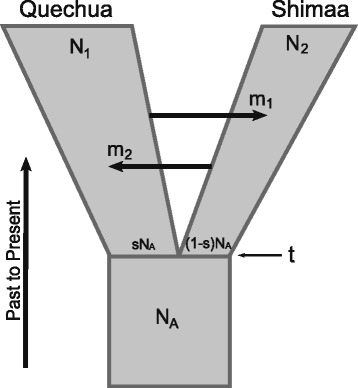
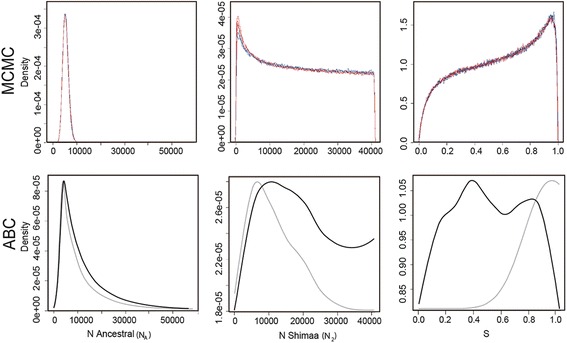
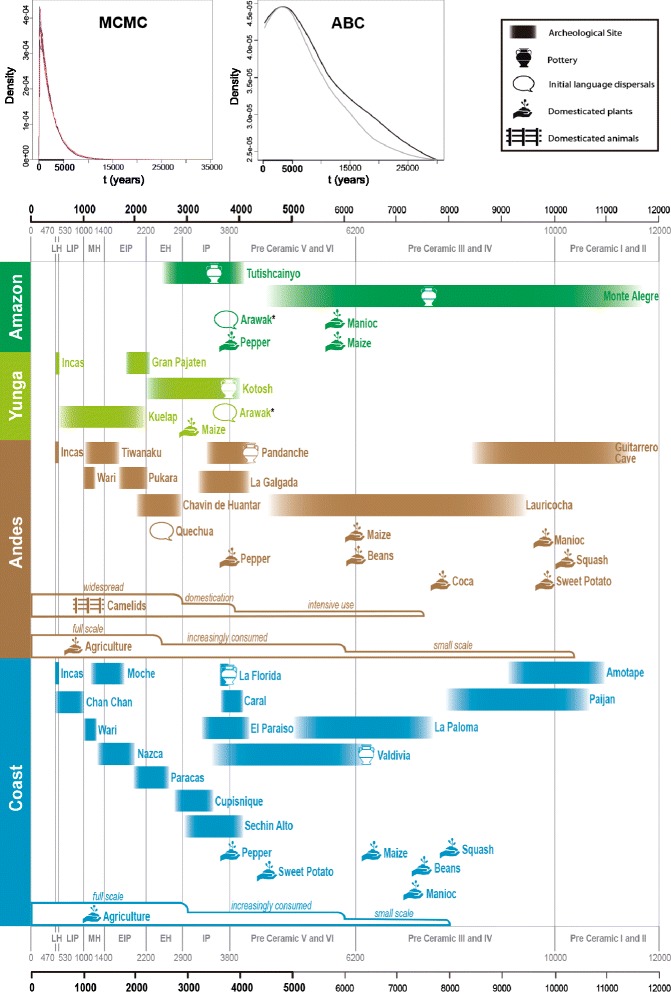
We found that the genetic diversity of the Shimaa (an Amazon Yunga population) is a subset of that of Quechuas from Central-Andes. Using the Isolation-with-Migration population genetics model, we inferred that the Shimaa ancestors were a small subgroup that split less than 5300 years ago (after the development of complex societies) from an ancestral Andean population. After the split, the most plausible scenario compatible with our results is that the ancestors of Shimaas moved toward the Peruvian Amazon Yunga and incorporated the culture and language of some of their neighbors, but not a substantial amount of their genes. We validated our results using Approximate Bayesian Computations, posterior predictive tests and the analysis of pseudo-observed datasets.
We presented a case study in which model-based Bayesian approaches, combined with necessary statistical validations, shed light into the prehistoric demographic relationship between Andeans and a population from the Amazon Yunga. Our results offer a testable model for the peopling of this large transitional environmental region between the Andes and the Lower Amazonia. However, studies on larger samples and involving more populations of these regions are necessary to confirm if the predominant Andean biological origin of the Shimaas is the rule, and not the exception.
考古学报告了秘鲁海岸 - 安第斯山脉与亚马逊云加(安第斯山脉和下亚马逊地区之间的雨林过渡区域)之间千年的文化交流。为了阐明这些人群的文化与生物进化之间的关系,特别是亚马逊云加人与安第斯人之间的关系,我们使用了DNA序列数据、基于模型的贝叶斯方法以及多种统计验证来推断一组人口统计学参数。
我们发现,希马阿人(一个亚马逊云加人群体)的遗传多样性是来自安第斯山脉中部的克丘亚人的遗传多样性的一个子集。使用隔离 - 迁移群体遗传学模型,我们推断希马阿人的祖先在不到5300年前(在复杂社会发展之后)从一个安第斯祖先群体中分裂出来,是一个小的亚群体。分裂之后,与我们的结果最合理的情况是,希马阿人的祖先向秘鲁亚马逊云加地区迁移,并融入了一些邻居的文化和语言,但没有融入大量他们的基因。我们使用近似贝叶斯计算、后验预测检验和对伪观测数据集的分析来验证我们的结果。
我们展示了一个案例研究,其中基于模型的贝叶斯方法与必要的统计验证相结合,揭示了安第斯人与来自亚马逊云加的一个群体之间的史前人口统计学关系。我们的结果为安第斯山脉和下亚马逊地区之间这个大型过渡环境区域的人口迁移提供了一个可检验的模型。然而,有必要对更大的样本以及涉及这些地区更多群体的研究进行验证,以确认希马阿人主要源自安第斯人的生物学起源是普遍规律而非个例。