
三叶因子3促进转移播散并预示乳腺癌患者的不良生存结局。
Trefoil factor 3 promotes metastatic seeding and predicts poor survival outcome of patients with mammary carcinoma.
作者信息
Pandey Vijay, Wu Zheng-Sheng, Zhang Min, Li Rui, Zhang Jian, Zhu Tao, Lobie Peter E
出版信息
Breast Cancer Res. 2014 Sep 30;16(5):429. doi: 10.1186/s13058-014-0429-3.
INTRODUCTION
Recurrence or early metastasis remains the predominant cause of mortality in patients with estrogen receptor positive (ER+) mammary carcinoma (MC). However, the molecular mechanisms underlying the initial progression of ER+ MC to metastasis remains poorly understood. Trefoil factor 3 (TFF3) is an estrogen-responsive oncogene in MC. Herein, we provide evidence for a functional role of TFF3 in metastatic progression of ER+ MC.
METHODS
The association of TFF3 expression with clinicopathological parameters and survival outcome in a cohort of MC patients was assessed by immunohistochemistry. The expression of TFF3 in MCF7 and T47D cells was modulated by forced expression or siRNA-mediated depletion of TFF3. mRNA and protein levels were determined using qPCR and western blot. The functional effect of modulation of TFF3 expression in MC cells was determined in vitro and in vivo. Mechanistic analyses were performed using reporter constructs, modulation of signal transducer and activator of transcription 3 (STAT3) expression, and pharmacological inhibitors against c-SRC and STAT3 activity.
RESULTS
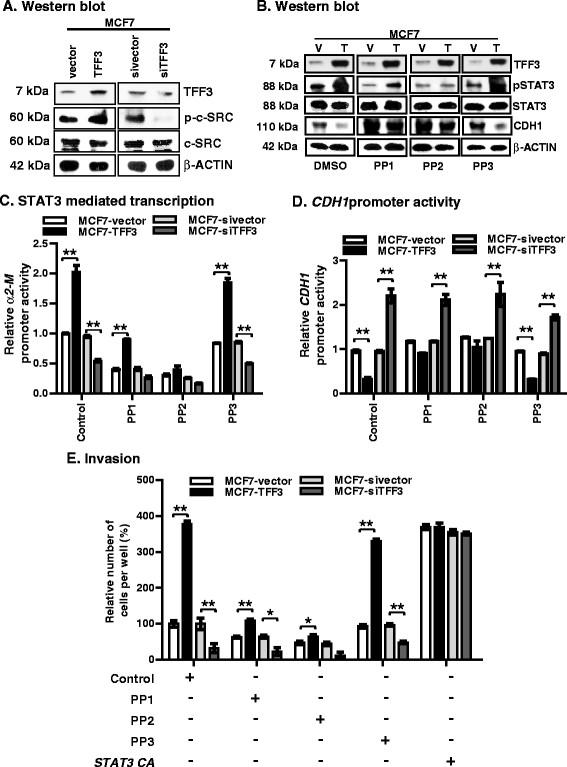
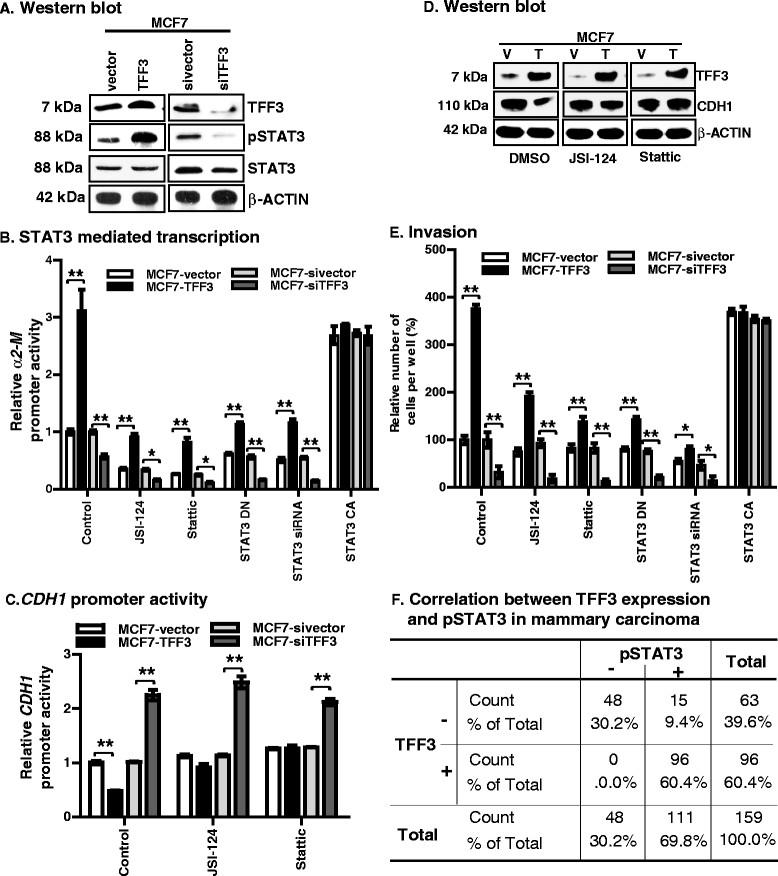
TFF3 protein expression was positively associated with larger tumour size, lymph node metastasis, higher stage, and poor survival outcome. Forced expression of TFF3 in ER+ MC cells stimulated colony scattering, cell adhesion to a Collagen I-coated matrix, colony formation on a Collagen I- or Matrigel-coated matrix, endothelial cell adhesion, and transmigration through an endothelial cell barrier. In vivo, forced expression of TFF3 in MCF7 cells stimulated the formation of metastatic nodules in animal lungs. TFF3 regulation of the mRNA levels of epithelial, mesenchymal, and metastatic-related genes in ER+ MC cells were consistent with the altered cell behaviour. Forced expression of TFF3 in ER+ MC cells stimulated phosphorylation of c-SRC that subsequently increased STAT3 activity, which lead to the downregulation of E-cadherin. siRNA-mediated depletion of TFF3 reduced the invasiveness of ER+ MC cells.
CONCLUSIONS
TFF3 expression predicts metastasis and poor survival outcome of patients with MC and functionally stimulates cellular invasion and metastasis of ER+ MC cells. Adjuvant functional inhibition of TFF3 may therefore be considered to ameliorate outcome of ER+ MC patients.
引言
复发或早期转移仍然是雌激素受体阳性(ER+)乳腺癌(MC)患者死亡的主要原因。然而,ER+ MC初始进展至转移的分子机制仍知之甚少。三叶因子3(TFF3)是MC中的一种雌激素反应性癌基因。在此,我们提供了TFF3在ER+ MC转移进展中发挥功能作用的证据。
方法
通过免疫组织化学评估MC患者队列中TFF3表达与临床病理参数及生存结果的相关性。通过强制表达或siRNA介导的TFF3缺失来调节MCF7和T47D细胞中TFF3的表达。使用qPCR和蛋白质印迹法测定mRNA和蛋白质水平。在体外和体内确定调节MC细胞中TFF3表达的功能效应。使用报告基因构建体、调节信号转导和转录激活因子3(STAT3)表达以及针对c-SRC和STAT3活性的药理抑制剂进行机制分析。
结果
TFF3蛋白表达与肿瘤体积较大、淋巴结转移、分期较高及生存结果较差呈正相关。在ER+ MC细胞中强制表达TFF3可刺激集落散射、细胞与I型胶原包被基质的黏附、在I型胶原或基质胶包被基质上的集落形成、内皮细胞黏附以及通过内皮细胞屏障的迁移。在体内,在MCF7细胞中强制表达TFF3可刺激动物肺部转移结节的形成。TFF3对ER+ MC细胞中上皮、间充质和转移相关基因mRNA水平的调节与细胞行为改变一致。在ER+ MC细胞中强制表达TFF3可刺激c-SRC磷酸化,随后增加STAT3活性,导致E-钙黏蛋白下调。siRNA介导的TFF3缺失降低了ER+ MC细胞的侵袭性。
结论
TFF3表达可预测MC患者的转移和不良生存结果,并在功能上刺激ER+ MC细胞的细胞侵袭和转移。因此,可考虑对TFF3进行辅助功能抑制以改善ER+ MC患者的预后。


 Zotero 插件