
精准肿瘤学中的当前生物信息学工具
Current Bioinformatics Tools in Precision Oncology.
作者信息
Wolde Tesfaye, Bhardwaj Vipul, Pandey Vijay
机构信息
Institute of Biopharmaceutical and Health Engineering Tsinghua Shenzhen International Graduate School Tsinghua University Shenzhen China.
Tsinghua Shenzhen International Graduate School Tsinghua University Shenzhen China.
出版信息
MedComm (2020). 2025 Jul 9;6(7):e70243. doi: 10.1002/mco2.70243. eCollection 2025 Jul.
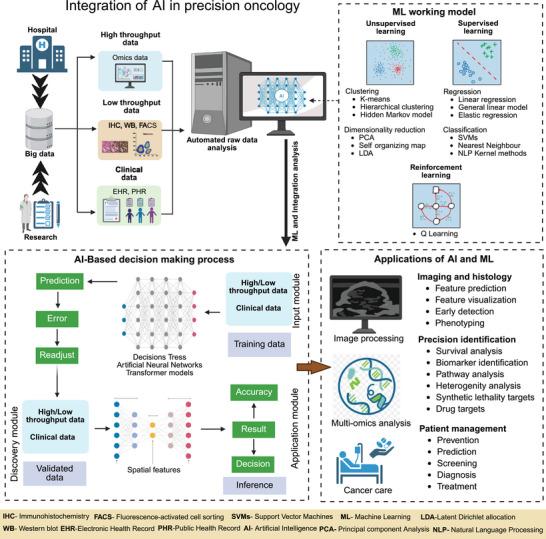
Integrating bioinformatics tools has profoundly transformed precision oncology by identifying essential molecular targets for personalized treatment. The rapid development of high-throughput sequencing and multiomics technologies creates complex datasets that require robust computational methods to extract meaningful insights. Nonetheless, the clinical application of multiomics data continues to pose significant challenges. This review explores advanced bioinformatics tools utilized within multiomics, emphasizing their pivotal role in discovering cancer biomarkers. Cloud-based platforms, such as Galaxy and DNAnexus, facilitate streamlined data processing, while single-cell analysis software, including Seurat, identifies rare cellular subpopulations. Further integration of artificial intelligence with machine learning approaches improves predictive modeling and diagnostic accuracy. Spatial omics technologies correlate molecular signatures within tumor microenvironments, guiding treatment strategies. Bioinformatics integrates these technologies to establish a new standard in precision oncology, thereby enhancing therapy efficacy. Collaborative initiatives between The Cancer Genome Atlas and cBioPortal expedite advancements through the sharing open data and implementing standardized methodologies. Advancing multiomics integration techniques alongside improved computational capabilities is essential for discovering new biomarkers and refining precision medicine strategies. Future efforts should focus on merging multiomics techniques with innovative computational methods to drive novel biomarker discovery and improve precision medicine applications.
整合生物信息学工具通过识别个性化治疗的关键分子靶点,深刻改变了精准肿瘤学。高通量测序和多组学技术的快速发展产生了复杂的数据集,需要强大的计算方法来提取有意义的见解。尽管如此,多组学数据的临床应用仍然面临重大挑战。本综述探讨了多组学中使用的先进生物信息学工具,强调了它们在发现癌症生物标志物方面的关键作用。基于云的平台,如Galaxy和DNAnexus,促进了简化的数据处理,而单细胞分析软件,包括Seurat,可识别罕见的细胞亚群。人工智能与机器学习方法的进一步整合提高了预测建模和诊断准确性。空间组学技术关联肿瘤微环境中的分子特征,指导治疗策略。生物信息学整合这些技术,在精准肿瘤学中建立了新的标准,从而提高了治疗效果。癌症基因组图谱和cBioPortal之间的合作计划通过共享开放数据和实施标准化方法加速了进展。推进多组学整合技术以及提高计算能力对于发现新的生物标志物和完善精准医学策略至关重要。未来的努力应集中在将多组学技术与创新计算方法相结合,以推动新型生物标志物的发现并改善精准医学应用。


 Zotero 插件