Behling-Kelly E
Department of Population Medicine and Diagnostic Sciences, College of Veterinary Medicine, Cornell University, Ithaca, NY.
J Vet Intern Med. 2014 Nov-Dec;28(6):1692-8. doi: 10.1111/jvim.12450. Epub 2014 Oct 1.
People with renal disease develop a dyslipidemia that contributes to progression of renal injury and development of cardiovascular disease. Lipoproteins in dogs with renal disease have not been investigated.
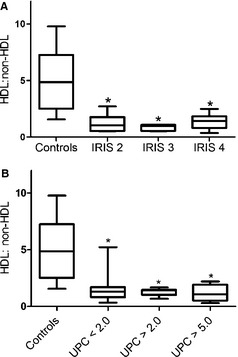
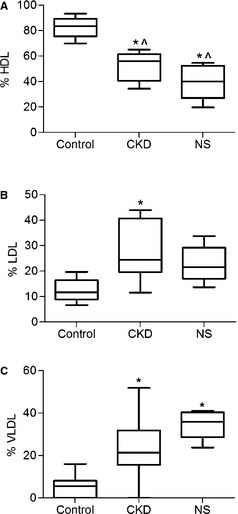
Dogs with chronic kidney disease (CKD) have dyslipidemia characterized by increased lower density lipoproteins and decreased high-density lipoproteins (HDLs). The degree of dyslipidemia is positively correlated with severity of disease, as reflected by serum creatinine concentration.
Prospective study of client-owned dogs presented to the Cornell University Hospital for Animals: 29 dogs with confirmed CKD, 5 dogs with nephrotic syndrome (NS), and 12 healthy control dogs presented for routine vaccinations, dental cleaning, or owned by students.
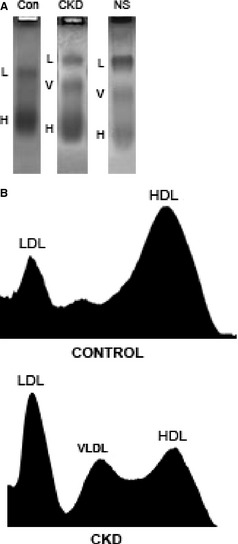
Lipoprotein electrophoresis was used to quantify relative proportions of the 3 main classes of lipoproteins in canine serum: low-density lipoproteins (LDL), very low-density lipoproteins (VLDL), and HDL. Serum cholesterol and creatinine concentrations; urinalysis and urine protein-to-creatinine ratio were measured by standard methods.
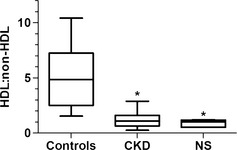
Dyslipidemia was consistently found in dogs with CKD and NS and was characterized by a decrease in HDL and variable increases in LDL and VLDL. Dogs with NS had a proportionately greater increase in the VLDL fraction, as compared with dogs with CKD.
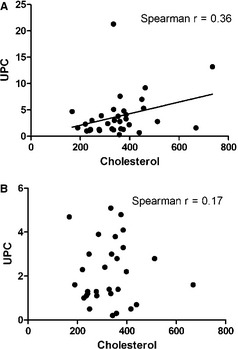
Dyslipidemia similar to that documented in people with renal disease occurs in dogs with CKD, despite serum cholesterol concentrations often being within the reference interval. The contribution of altered lipoproteins to the pathogenesis of renal disease in dogs warrants additional study.
肾病患者会出现血脂异常,这会促进肾损伤的进展以及心血管疾病的发生。尚未对患有肾病的犬类的脂蛋白进行研究。
患有慢性肾病(CKD)的犬类存在血脂异常,其特征为低密度脂蛋白增加和高密度脂蛋白(HDL)减少。血脂异常的程度与疾病严重程度呈正相关,血清肌酐浓度可反映这一点。
对送至康奈尔大学动物医院的客户拥有的犬类进行前瞻性研究:29只确诊为CKD的犬、5只患有肾病综合征(NS)的犬以及12只因常规疫苗接种、牙齿清洁前来就诊或由学生拥有的健康对照犬。
采用脂蛋白电泳法对犬血清中3种主要脂蛋白类别(低密度脂蛋白(LDL)、极低密度脂蛋白(VLDL)和HDL)的相对比例进行定量。采用标准方法测量血清胆固醇和肌酐浓度、进行尿液分析以及测定尿蛋白与肌酐比值。
在患有CKD和NS的犬中始终发现血脂异常,其特征为HDL降低以及LDL和VLDL不同程度升高。与患有CKD的犬相比,患有NS的犬的VLDL部分升高幅度更大。
尽管血清胆固醇浓度通常在参考区间内,但患有CKD的犬会出现与肾病患者中记录的类似的血脂异常。脂蛋白改变对犬类肾病发病机制的影响值得进一步研究。