Namavari Mohammad, Gowrishankar Gayatri, Hoehne Aileen, Jouannot Erwan, Gambhir Sanjiv S
Molecular Imaging Program at Stanford, Departments of Radiology and Bioengineering, Bio-X Program, Stanford University, 318 Campus Dr., Clark Center E-150, Stanford, CA, USA.
Mol Imaging Biol. 2015 Apr;17(2):168-76. doi: 10.1007/s11307-014-0793-5.
To develop novel positron emission tomography (PET) agents for visualization and therapy monitoring of bacterial infections.
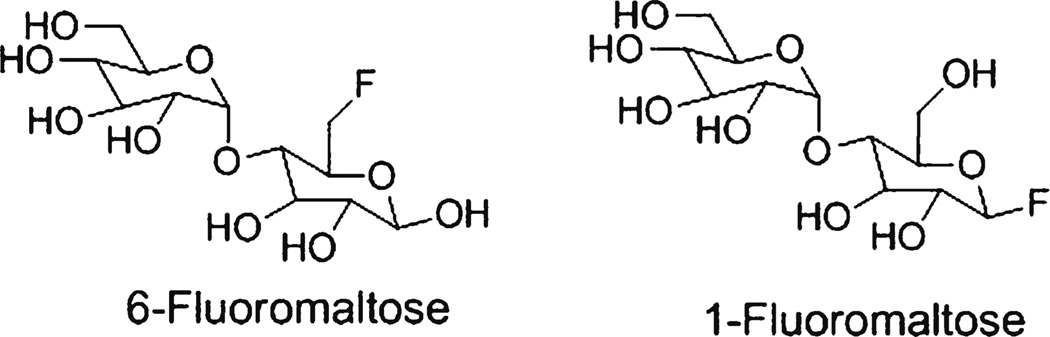
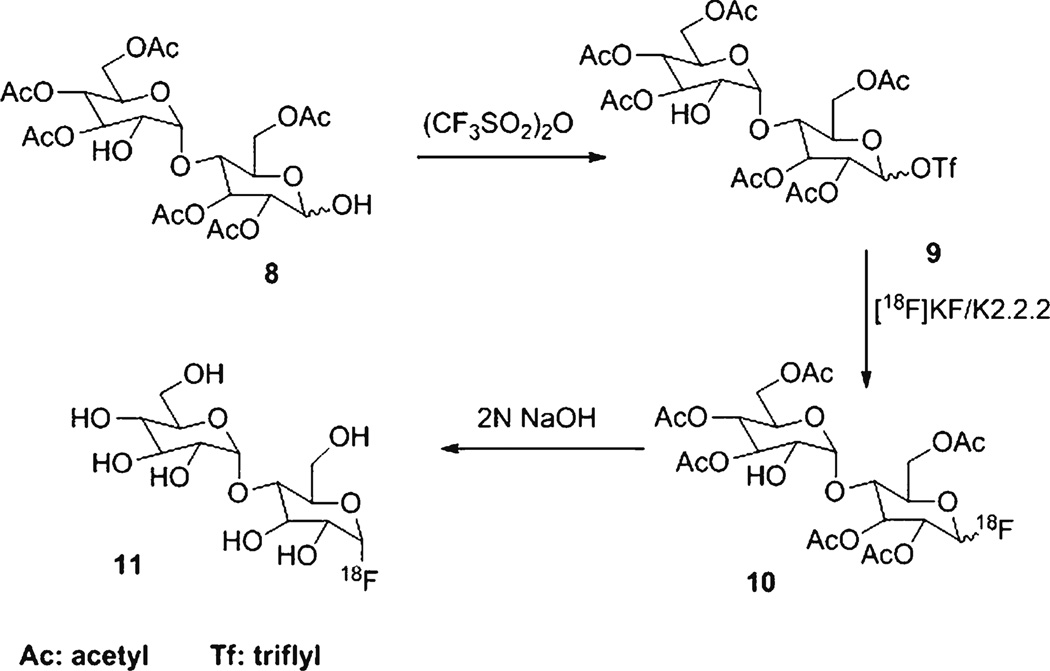
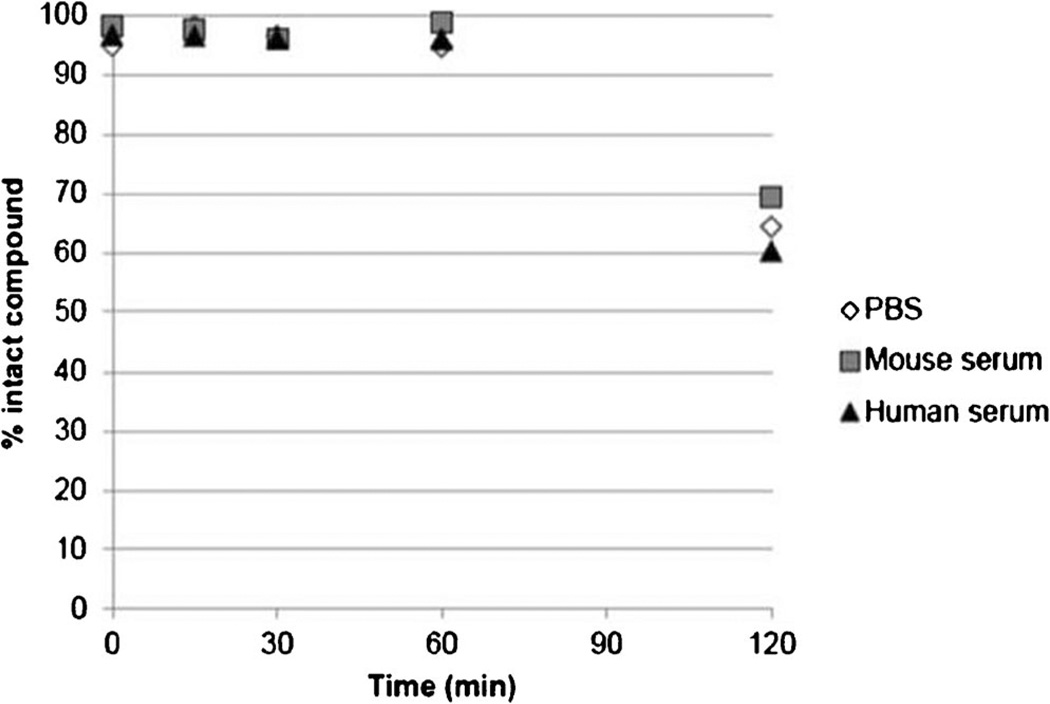
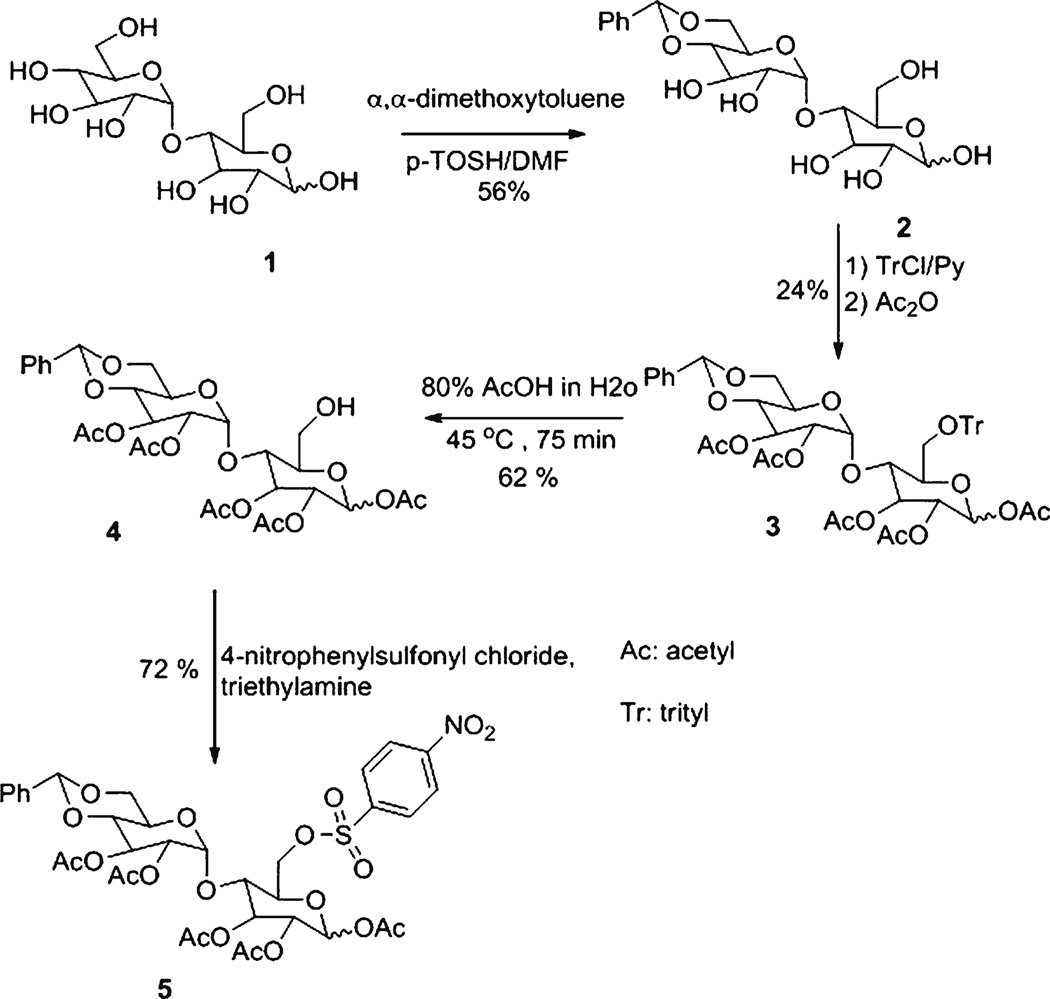
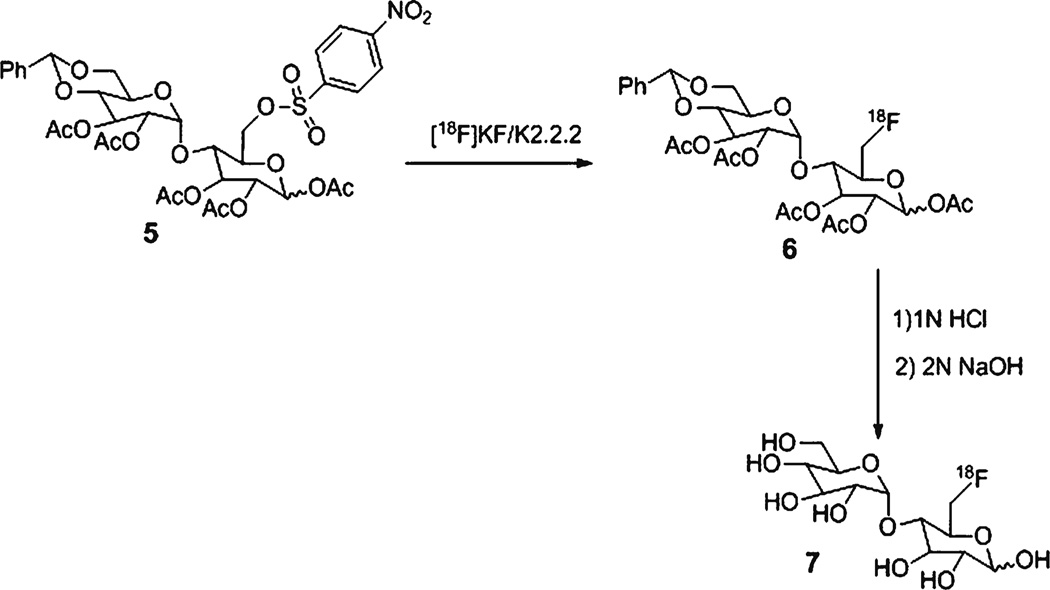
It is known that maltose and maltodextrins are energy sources for bacteria. Hence, (18)F-labelled maltose derivatives could be a valuable tool for imaging bacterial infections. We have developed methods to synthesize 4-O-(α-D-glucopyranosyl)-6-deoxy-6-[(18)F]fluoro-D-glucopyranoside (6-[(18)F]fluoromaltose) and 4-O-(α-D-glucopyranosyl)-1-deoxy-1-[(18)F]fluoro-D-glucopyranoside (1-[(18)F]fluoromaltose) as bacterial infection PET imaging agents. 6-[(18)F]fluoromaltose was prepared from precursor 1,2,3-tri-O-acetyl-4-O-(2',3',-di-O-acetyl-4',6'-benzylidene-α-D-glucopyranosyl)-6-deoxy-6-nosyl-D-glucopranoside (5). The synthesis involved the radio-fluorination of 5 followed by acidic and basic hydrolysis to give 6-[(18)F]fluoromaltose. In an analogous procedure, 1-[(18)F]fluoromaltose was synthesized from 2,3, 6-tri-O-acetyl-4-O-(2',3',4',6-tetra-O-acetyl-α-D-glucopyranosyl)-1-deoxy-1-O-triflyl-D-glucopranoside (9). Stability of 6-[(18)F]fluoromaltose in phosphate-buffered saline (PBS) and human and mouse serum at 37 °C was determined. Escherichia coli uptake of 6-[(18)F]fluoromaltose was examined.
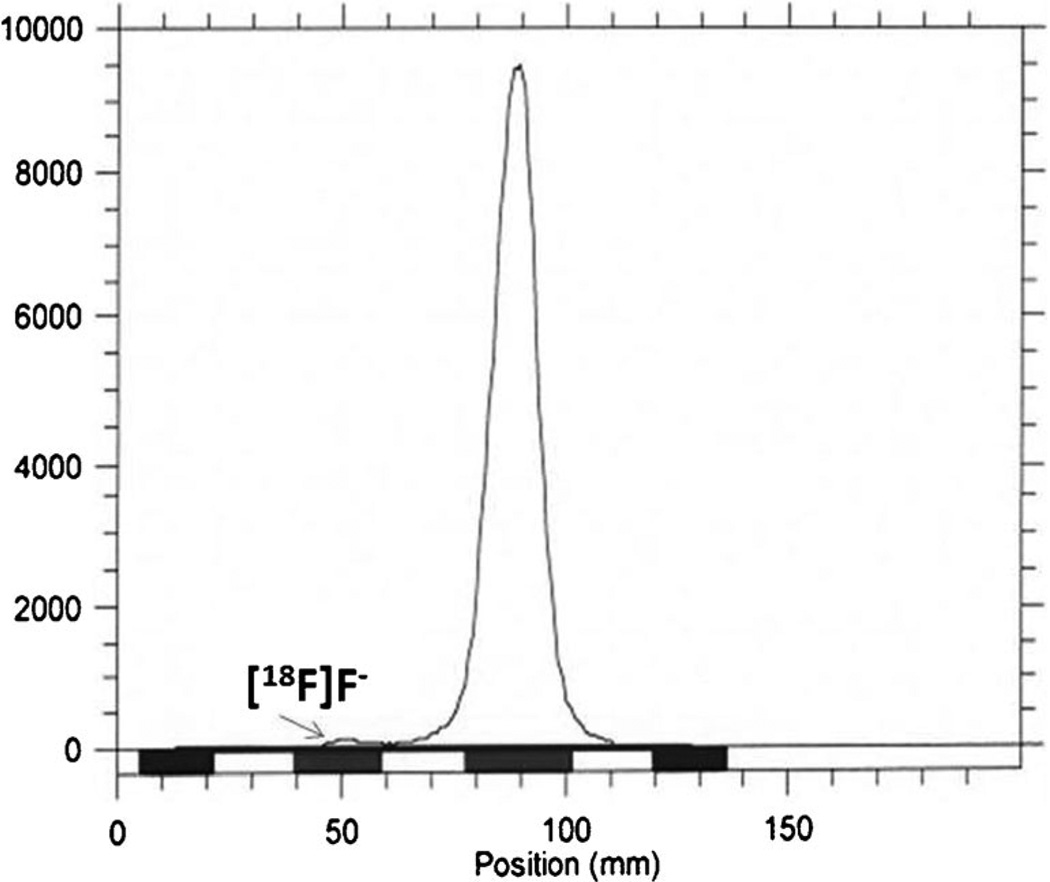
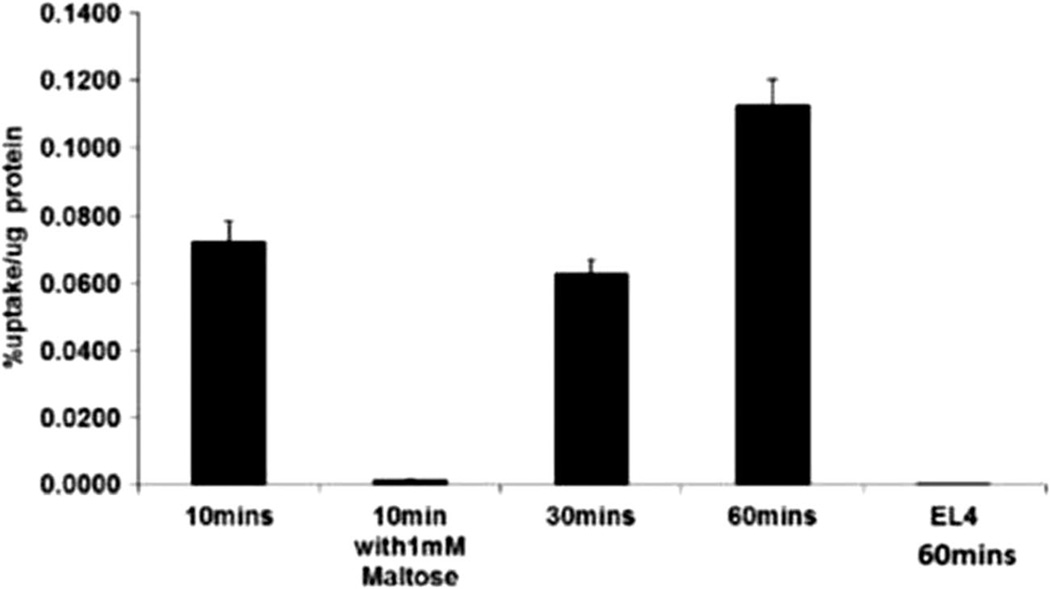
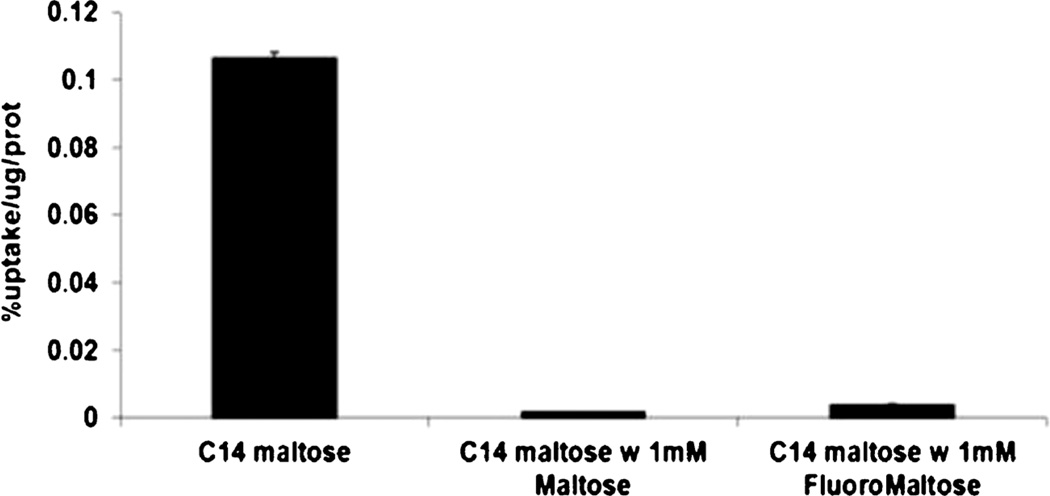
A reliable synthesis of 1- and 6-[(18)F]fluoromaltose has been accomplished with 4-6 and 5-8% radiochemical yields, respectively (decay-corrected with 95 % radiochemical purity). 6-[(18)F]fluoromaltose was sufficiently stable over the time span needed for PET studies (∼96% intact compound after 1-h and ∼65% after 2-h incubation in serum). Bacterial uptake experiments indicated that E. coli transports 6-[(18)F]fluoromaltose. Competition assays showed that the uptake of 6-[(18)F]fluoromaltose was completely blocked by co-incubation with 1 mM of the natural substrate maltose.
We have successfully synthesized 1- and 6-[(18)F]fluoromaltose via direct fluorination of appropriate protected maltose precursors. Bacterial uptake experiments in E. coli and stability studies suggest a possible application of 6-[(18)F]fluoromaltose as a new PET imaging agent for visualization and monitoring of bacterial infections.
开发用于细菌感染可视化和治疗监测的新型正电子发射断层扫描(PET)剂。
已知麦芽糖和麦芽糊精是细菌的能量来源。因此,(18)F标记的麦芽糖衍生物可能是用于细菌感染成像的有价值工具。我们已经开发出合成4-O-(α-D-吡喃葡萄糖基)-6-脱氧-6-[(18)F]氟-D-吡喃葡萄糖苷(6-[(18)F]氟麦芽糖)和4-O-(α-D-吡喃葡萄糖基)-1-脱氧-1-[(18)F]氟-D-吡喃葡萄糖苷(1-[(18)F]氟麦芽糖)作为细菌感染PET成像剂的方法。6-[(18)F]氟麦芽糖由前体1,2,3-三-O-乙酰基-4-O-(2',3'-二-O-乙酰基-4',6'-亚苄基-α-D-吡喃葡萄糖基)-6-脱氧-6- nosyl-D-葡萄糖苷(5)制备。合成过程包括5的放射性氟化,然后进行酸性和碱性水解以得到6-[(18)F]氟麦芽糖。按照类似的程序,由2,3,6-三-O-乙酰基-4-O-(2',3',4',6-四-O-乙酰基-α-D-吡喃葡萄糖基)-1-脱氧-1-O-三氟甲磺酰基-D-葡萄糖苷(9)合成1-[(18)F]氟麦芽糖。测定了6-[(18)F]氟麦芽糖在磷酸盐缓冲盐水(PBS)以及人和小鼠血清中于37°C下的稳定性。检测了大肠杆菌对6-[(18)F]氟麦芽糖的摄取。
已分别以4 - 6%和5 - 8%的放射化学产率(经衰变校正,放射化学纯度为95%)成功合成了1-和6-[(18)F]氟麦芽糖。6-[(18)F]氟麦芽糖在PET研究所需的时间跨度内足够稳定(在血清中孵育1小时后约96%的完整化合物,2小时后约65%)。细菌摄取实验表明大肠杆菌能转运6-[(18)F]氟麦芽糖。竞争试验表明,与1 mM天然底物麦芽糖共同孵育可完全阻断6-[(18)F]氟麦芽糖的摄取。
我们通过对适当保护的麦芽糖前体进行直接氟化成功合成了1-和6-[(1)F]氟麦芽糖。大肠杆菌中的细菌摄取实验和稳定性研究表明,6-[(18)F]氟麦芽糖有可能作为一种新型PET成像剂用于细菌感染的可视化和监测。