Hall M, Doherty S, Courtney P, Latief K, Zhang W, Doherty M
Academic Rheumatology, University of Nottingham, UK; School of Health Sciences, University of Nottingham, UK.
Academic Rheumatology, University of Nottingham, UK.
Osteoarthritis Cartilage. 2014 Oct;22(10):1627-33. doi: 10.1016/j.joca.2014.05.025.
To [1] compare the frequency and severity of ultrasound (US) features in people with normal knees (controls), knee pain (KP), asymptomatic radiographic OA (ROA), and symptomatic OA (SROA), [2] examine relationships between US features, pain and radiographic severity, [3] explore the relationship between change in pain and US features over a 3-month period.
Community participants were recruited into a multiple group case-control study. All underwent assessment for pain, knee radiographs and US examination for effusion, synovial hypertrophy, popliteal cysts and power Doppler (PD) signal within the synovium. A 3-month follow-up was undertaken in over half of control and SROA participants.
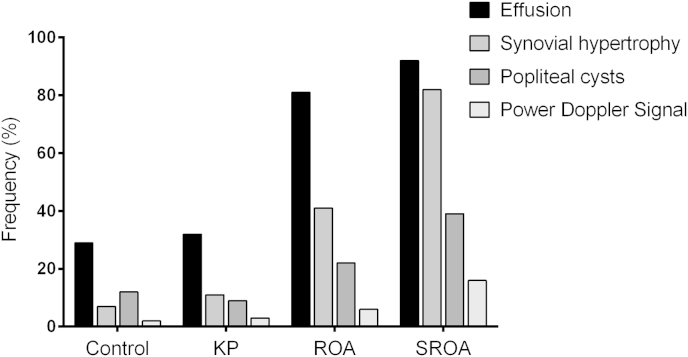
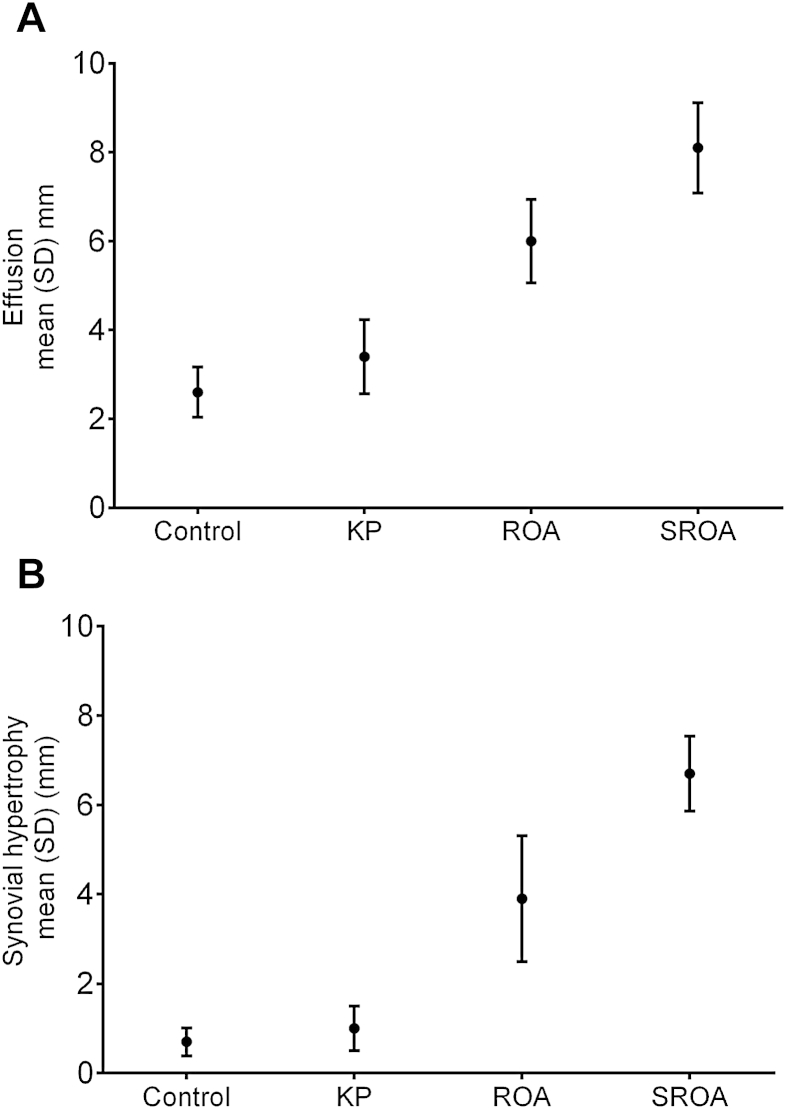
243 participants were recruited (90 controls; 59 KP; 32 ROA; 62 SROA). Effusion and synovial hypertrophy were more common in ROA and SROA participants. Severity of effusion and synovial hypertrophy were greater in SROA compared to ROA (P < 0.05). Severity of US effusion and synovial hypertrophy were correlated with radiographic severity (r = 0.6 and r = 0.7, P < 0.01) but the relationship between pain severity and US features was weak (r = 0.3, P < 0.01). In SROA participants, pain severity did not change in tandem with a change in synovial hypertrophy over time.
US abnormalities are common in OA. Effusion and synovial hypertrophy were moderately correlated with radiographic severity but the relationship with pain is less strong. The degree to which these features reflect "active inflammation" is questionable and they may be better considered as part of the total organ pathology in OA. Further studies are warranted to confirm these findings.
[1]比较正常膝关节人群(对照组)、膝关节疼痛人群(KP)、无症状放射学骨关节炎(ROA)和有症状骨关节炎(SROA)的超声(US)特征的频率和严重程度;[2]研究US特征、疼痛与放射学严重程度之间的关系;[3]探讨3个月期间疼痛变化与US特征之间的关系。
社区参与者被纳入多组病例对照研究。所有人均接受疼痛评估、膝关节X线检查以及针对积液、滑膜增生、腘窝囊肿和滑膜内能量多普勒(PD)信号的US检查。超过一半的对照组和SROA参与者进行了3个月的随访。
共招募了243名参与者(90名对照组;59名KP;32名ROA;62名SROA)。积液和滑膜增生在ROA和SROA参与者中更为常见。与ROA相比,SROA中积液和滑膜增生的严重程度更高(P<0.05)。US积液和滑膜增生的严重程度与放射学严重程度相关(r=0.6和r=0.7,P<0.01),但疼痛严重程度与US特征之间的关系较弱(r=0.3,P<0.01)。在SROA参与者中,疼痛严重程度并未随时间与滑膜增生的变化而同步改变。
US异常在OA中很常见。积液和滑膜增生与放射学严重程度中度相关,但与疼痛的关系较弱。这些特征在多大程度上反映“活动性炎症”值得怀疑,它们可能更好地被视为OA中整个器官病理学的一部分。需要进一步研究来证实这些发现。