Artico Sinara, Ribeiro-Alves Marcelo, Oliveira-Neto Osmundo Brilhante, de Macedo Leonardo Lima Pepino, Silveira Sylvia, Grossi-de-Sa Maria Fátima, Martinelli Adriana Pinheiro, Alves-Ferreira Marcio
Department of Genetics, Universidade Federal do Rio de Janeiro - UFRJ Av, Prof, Rodolpho Paulo Rocco, s/n - Prédio do CCS Instituto de Biologia, 2° andar - sala 93, 219410-970 Rio de Janeiro, RJ, Brazil.
BMC Genomics. 2014 Oct 4;15(1):854. doi: 10.1186/1471-2164-15-854.
Cotton is a major fibre crop grown worldwide that suffers extensive damage from chewing insects, including the cotton boll weevil larvae (Anthonomus grandis). Transcriptome analysis was performed to understand the molecular interactions between Gossypium hirsutum L. and cotton boll weevil larvae. The Illumina HiSeq 2000 platform was used to sequence the transcriptome of cotton flower buds infested with boll weevil larvae.
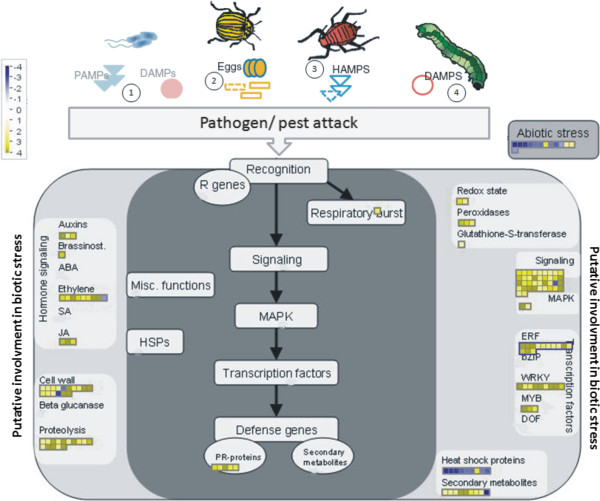
The analysis generated a total of 327,489,418 sequence reads that were aligned to the G. hirsutum reference transcriptome. The total number of expressed genes was over 21,697 per sample with an average length of 1,063 bp. The DEGseq analysis identified 443 differentially expressed genes (DEG) in cotton flower buds infected with boll weevil larvae. Among them, 402 (90.7%) were up-regulated, 41 (9.3%) were down-regulated and 432 (97.5%) were identified as orthologues of A. thaliana genes using Blastx. Mapman analysis of DEG indicated that many genes were involved in the biotic stress response spanning a range of functions, from a gene encoding a receptor-like kinase to genes involved in triggering defensive responses such as MAPK, transcription factors (WRKY and ERF) and signalling by ethylene (ET) and jasmonic acid (JA) hormones. Furthermore, the spatial expression pattern of 32 of the genes responsive to boll weevil larvae feeding was determined by "in situ" qPCR analysis from RNA isolated from two flower structures, the stamen and the carpel, by laser microdissection (LMD).
A large number of cotton transcripts were significantly altered upon infestation by larvae. Among the changes in gene expression, we highlighted the transcription of receptors/sensors that recognise chitin or insect oral secretions; the altered regulation of transcripts encoding enzymes related to kinase cascades, transcription factors, Ca2+ influxes, and reactive oxygen species; and the modulation of transcripts encoding enzymes from phytohormone signalling pathways. These data will aid in the selection of target genes to genetically engineer cotton to control the cotton boll weevil.
棉花是一种在全球广泛种植的主要纤维作物,遭受包括棉铃象甲幼虫(棉铃象甲)在内的咀嚼式昆虫的广泛损害。进行转录组分析以了解陆地棉与棉铃象甲幼虫之间的分子相互作用。使用Illumina HiSeq 2000平台对被棉铃象甲幼虫侵染的棉花花蕾转录组进行测序。
分析共产生了327,489,418个序列读数,这些读数与陆地棉参考转录组进行了比对。每个样本中表达基因的总数超过21,697个,平均长度为1,063 bp。DEGseq分析在被棉铃象甲幼虫感染的棉花花蕾中鉴定出443个差异表达基因(DEG)。其中,402个(90.7%)上调,41个(9.3%)下调,使用Blastx将432个(97.5%)鉴定为拟南芥基因的直系同源物。对DEG的Mapman分析表明,许多基因参与了生物胁迫反应,涵盖了一系列功能,从编码受体样激酶的基因到参与触发防御反应的基因,如MAPK、转录因子(WRKY和ERF)以及乙烯(ET)和茉莉酸(JA)激素信号传导。此外,通过激光显微切割(LMD)从雄蕊和心皮这两种花结构中分离RNA,通过“原位”qPCR分析确定了32个对棉铃象甲幼虫取食有反应的基因的空间表达模式。
幼虫侵染后,大量棉花转录本发生了显著变化。在基因表达变化中,我们突出了识别几丁质或昆虫口腔分泌物的受体/传感器的转录;编码与激酶级联、转录因子、Ca2+内流和活性氧相关酶的转录本的调控改变;以及来自植物激素信号通路的编码酶的转录本的调节。这些数据将有助于选择目标基因,通过基因工程改造棉花以控制棉铃象甲。