Strillacci Maria G, Frigo Erika, Schiavini Fausta, Samoré Antonia B, Canavesi Fabiola, Vevey Mario, Cozzi Maria C, Soller Morris, Lipkin Ehud, Bagnato Alessandro
Department of Health, Animal Science and Food Safety (VESPA), University of Milan, Via Celoria 10, Milan, 20133, Italy.
BMC Genet. 2014 Oct 6;15:106. doi: 10.1186/s12863-014-0106-7.
Mastitis is a major disease of dairy cattle occurring in response to environmental exposure to infective agents with a great economic impact on dairy industry. Somatic cell count (SCC) and its log transformation in somatic cell score (SCS) are traits that have been used as indirect measures of resistance to mastitis for decades in selective breeding. A selective DNA pooling (SDP) approach was applied to identify Quantitative Trait Loci (QTL) for SCS in Valdostana Red Pied cattle using the Illumina Bovine HD BeadChip.
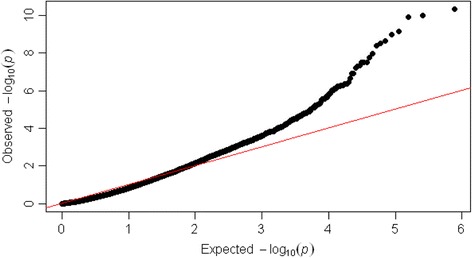
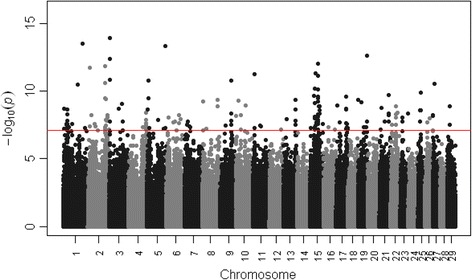
A total of 171 SNPs reached the genome-wide significance for association with SCS. Fifty-two SNPs were annotated within genes, some of those involved in the immune response to mastitis. On BTAs 1, 2, 3, 4, 9, 13, 15, 17, 21 and 22 the largest number of markers in association to the trait was found. These regions identified novel genomic regions related to mastitis (1-Mb SNP windows) and confirmed those already mapped. The largest number of significant SNPs exceeding the threshold for genome-wide significant signal was found on BTA 15, located at 50.43-51.63 Mb.
The genomic regions identified in this study contribute to a better understanding of the genetic control of the mastitis immune response in cattle and may allow the inclusion of more detailed QTL information in selection programs.
乳腺炎是奶牛的一种主要疾病,是由环境暴露于感染因子引起的,对乳制品行业有巨大的经济影响。体细胞计数(SCC)及其体细胞评分(SCS)的对数转换是几十年来在选择性育种中用作乳腺炎抗性间接指标的性状。采用选择性DNA池化(SDP)方法,利用Illumina牛HD BeadChip芯片鉴定了瓦尔迪斯塔纳红白花牛SCS的数量性状基因座(QTL)。
共有171个单核苷酸多态性(SNP)达到与SCS关联的全基因组显著性水平。52个SNP位于基因内,其中一些与乳腺炎的免疫反应有关。在牛染色体(BTA)1、2、3、4、9、13、15、17、21和22上发现了与该性状关联的标记数量最多。这些区域确定了与乳腺炎相关的新基因组区域(1兆碱基SNP窗口),并证实了已定位的区域。在位于50.43-51.63兆碱基的BTA 15上发现了超过全基因组显著信号阈值的最大数量的显著SNP。
本研究中鉴定的基因组区域有助于更好地理解牛乳腺炎免疫反应的遗传控制,并可能使选择计划中纳入更详细的QTL信息。