Tudor-Locke Catrine, Schuna John M, Katzmarzyk Peter T, Liu Wei, Hamrick Karen S, Johnson William D
Pennington Biomedical Research Center, Baton Rouge, Louisiana, United States of America.
U.S. Department of Agriculture Economic Research Service, Washington, DC, United States of America.
PLoS One. 2014 Oct 8;9(10):e109051. doi: 10.1371/journal.pone.0109051. eCollection 2014.
We used linked existing data from the 2006-2008 American Time Use Survey (ATUS), the Current Population Survey (CPS, a federal survey that provides on-going U.S. vital statistics, including employment rates) and self-reported body mass index (BMI) to answer: How does BMI vary across full time occupations dichotomized as sedentary/non-sedentary, accounting for time spent in sleep, other sedentary behaviors, and light, moderate, and vigorous intensity activities?
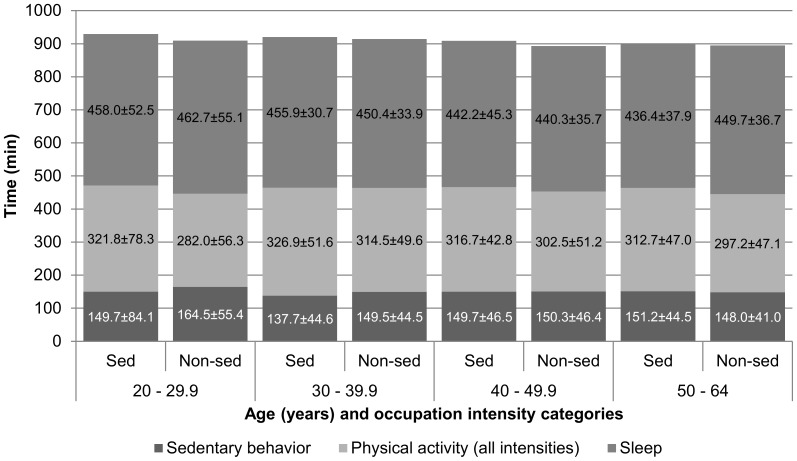
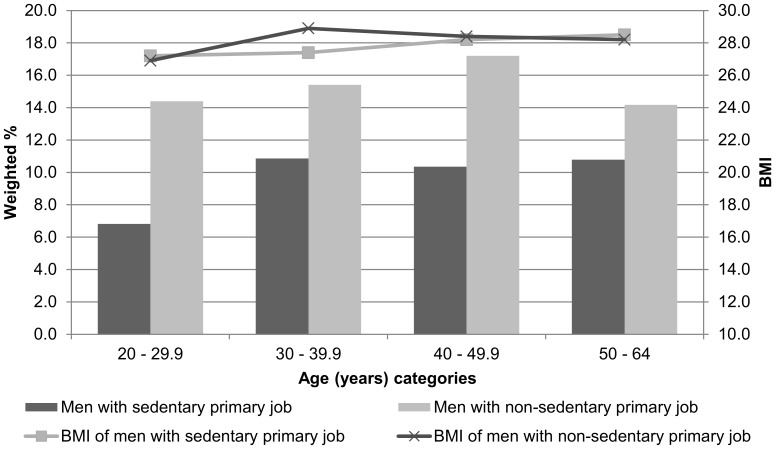
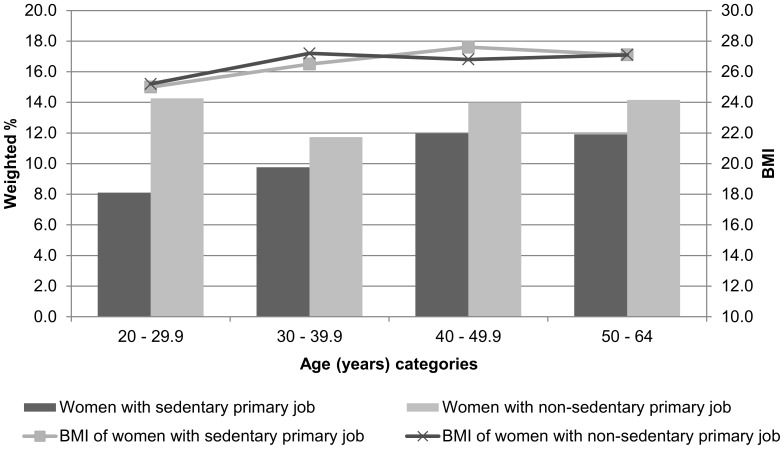
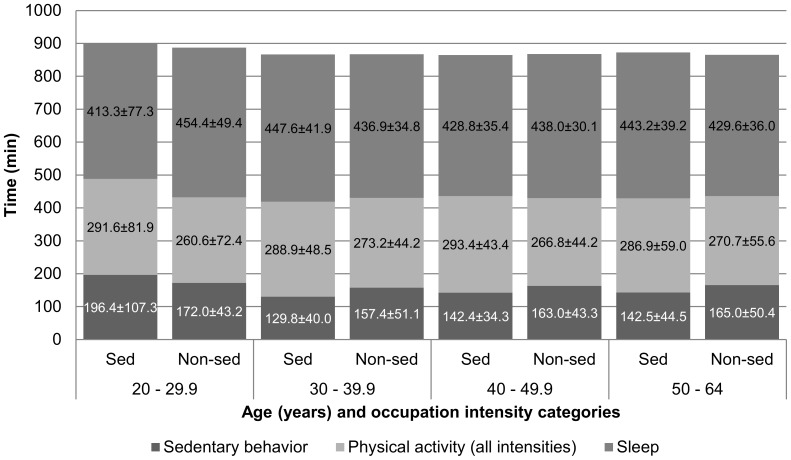
We classified time spent engaged at a primary job (sedentary or non-sedentary), sleep, and other non-work, non-sleep intensity-defined behaviors, specifically, sedentary behavior, light, moderate, and vigorous intensity activities. Age groups were defined by 20-29, 30-39, 40-49, and 50-64 years. BMI groups were defined by 18.5-24.9, 25.0-27.4, 27.5-29.9, 30.0-34.9, and ≥35.0 kg/m2. Logistic and linear regression were used to examine the association between BMI and employment in a sedentary occupation, considering time spent in sleep, other non-work time spent in sedentary behaviors, and light, moderate, and vigorous intensity activities, sex, age race/ethnicity, and household income.
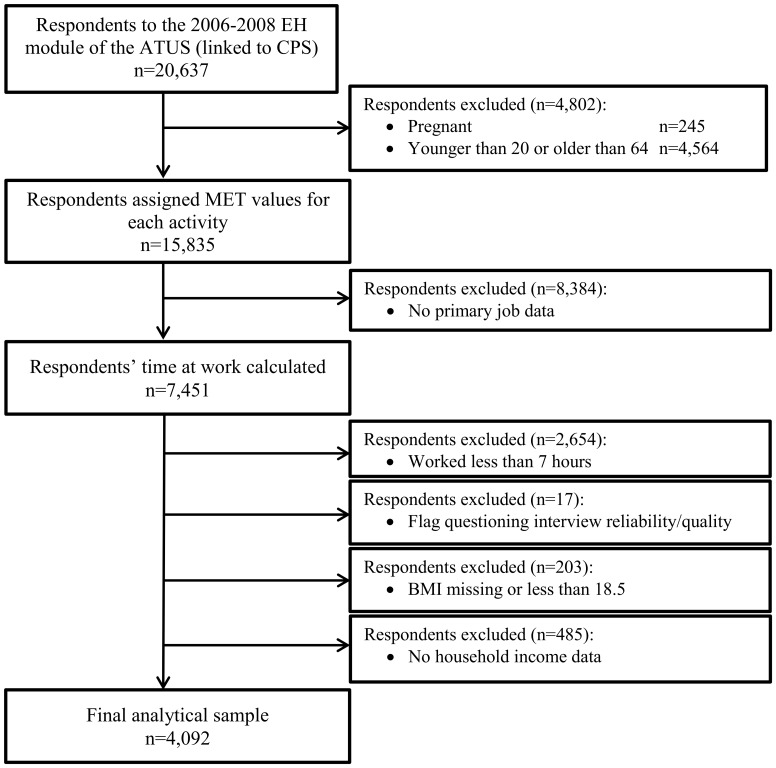
The analysis data set comprised 4,092 non-pregnant, non-underweight individuals 20-64 years of age who also reported working more than 7 hours at their primary jobs on their designated time use reporting day. Logistic and linear regression analyses failed to reveal any associations between BMI and the sedentary/non-sedentary occupation dichotomy considering time spent in sleep, other non-work time spent in sedentary behaviors, and light, moderate, and vigorous intensity activities, sex, age, race/ethnicity, and household income.
We found no evidence of a relationship between self-reported full time sedentary occupation classification and BMI after accounting for sex, age, race/ethnicity, and household income and 24-hours of time use including non-work related physical activity and sedentary behaviors. The various sources of error associated with self-report methods and assignment of generalized activity and occupational intensity categories could compound to obscure any real relationships.
我们使用了来自2006 - 2008年美国时间使用调查(ATUS)、当前人口调查(CPS,一项提供美国持续人口统计数据,包括就业率的联邦调查)以及自我报告的体重指数(BMI)的关联现有数据,以回答:在将全职职业分为久坐/非久坐的情况下,考虑到睡眠时间、其他久坐行为以及轻度、中度和剧烈强度活动的时间,BMI如何变化?
我们对从事主要工作(久坐或非久坐)、睡眠以及其他非工作、非睡眠强度定义的行为所花费的时间进行了分类,具体包括久坐行为、轻度、中度和剧烈强度活动。年龄组定义为20 - 29岁、30 - 39岁、40 - 49岁和50 - 64岁。BMI组定义为18.5 - 24.9、25.0 - 27.4、27.5 - 29.9、30.0 - 34.9以及≥35.0 kg/m²。使用逻辑回归和线性回归来研究BMI与久坐职业就业之间的关联,同时考虑睡眠时间、其他非工作时间中用于久坐行为的时间以及轻度、中度和剧烈强度活动、性别、年龄、种族/族裔和家庭收入。
分析数据集包括4092名20 - 64岁的非怀孕、非体重过轻个体,他们在指定的时间使用报告日报告在主要工作上工作超过7小时。逻辑回归和线性回归分析未能揭示BMI与久坐/非久坐职业二分法之间的任何关联,该分析考虑了睡眠时间、其他非工作时间中用于久坐行为的时间以及轻度、中度和剧烈强度活动、性别、年龄、种族/族裔和家庭收入。
在考虑性别、年龄、种族/族裔、家庭收入以及包括非工作相关体育活动和久坐行为在内的24小时时间使用情况后,我们没有发现自我报告的全职久坐职业分类与BMI之间存在关系的证据。与自我报告方法以及广义活动和职业强度类别的分配相关的各种误差来源可能会叠加,从而掩盖任何实际关系。